Showing posts with label wheeled vehicles. Show all posts

Wednesday, November 29, 2017

Eastern European AFV program updates


The military of Slovakia has chosen the Patria AMVXP (extra payload) as the new 8x8 wheeled vehicle. The AMVXP is an improved variant of the original Armored Modular Vehicle (AMV) with a raised maximum gross vehicle mass of up to 30 metric tons according to Patria's current data sheet, 13 tons of which are payload that can be used for installing heavier armor packages, mission kits or new weapon stations. Other sources mention a larger maximum gross vehicle mass of 31 or 32 metric tons. The vehicle is powered by a 450 kW (603 hp) Scania diesel engine linked to a 7+1 gear automatic transmission. It features a fully independent double wishbone suspension, an integrated terrain control system and a central tyre inflation system.

Patria AMVXP in an APC configuration
The Slovakian Army will use the AMVXP as an infantry fighting vehicle (IFV) fitted with the Turra 30 turret from local manufacturer EVPÚ. This unmanned turret is armed with a 30 mm autocannon - either a Soviet-design 2A42 gun or a Mk-44 Bushmaster II from Aliant Techsystems - a coaxial machine gun and a dual missile launcher for anti-tank guided missiles (ATGMs). Self-defence is provided by limited amounts of passive bolt-on armor aswell as eight smoke-grenade dischargers. The Turra 30 features a single main optic incorporating a laser rangefinder, a camera and a thermal imager. There is no independent optic for the commander, thus the turret is not enabling operating in a hunter-killer mode. This turret was also offered on the BVP Šakal modernization for the BMP-2.
The unmanned Turra 30 turret will be fitted to the vehicle
The Slovakian military has plans to order a total of 81 AMVXP vehicles, that will be delivered between 2018 and 2024. Prime contractor for the deal is Konštrukta Defence A.S., other contractors include Patria Land Systems and EVPÚ. Previously the country had ordered about thirty AMV vehicles in a variant made under licence by the Polish company Rosomak S.A.. These vehicles also were set to recevie the Turra 30 turret and were nicknamed Scipio; maybe this name will be retained. The deal was canceled for unknown reasons, apparently the Patria AMVXP hulls will be manufactured in Finland rather than in Poland.


227 Piranha 5 vehicles will be operated by the Romanian military in the future.
The Romanian news website hotnews.ro has reported that the German company Rheinmetall is still trying to sell the Agilis vehicle to the Romanian military. Previously there were no details revealed on the state of this program - following the decision of the Romanian government to start the licence production of 227 Piranha 5 vehicles in the Uzina Mecanica Bucuresti plant in Bucarest, a site operated by the state-owned company Romarm, one had to consider that this possibly meant the end of the Agilis.

The Agilis APC is fitted with a Lance MTS turret
Rheinmetall plans the production of about 400 of the Agilis vehicles via the company Romanian Military Vehicle Systems S.A., a joint-venture between Rheinmetall (50%) and the Ministry of Economy (50%) of the Eastern European country. Originally more than 600 Agilis vehicles were planned, but the adoption of the Piranha 5 reduces the required number of new vehicles. The factory of Romanian Military Vehicle Systems S.A. is located in the town of Moreni and would also assemble MAN military truck, if Rheinmetall's bid to provide the next truck system to Romania is successful. The Agilis contains 87% locally manufactured components, some of which are derived from the previous SAUR vehicle projects - the design is said to also include some features from the Dutch-German Boxer vehicle; only the engine, transmission and some parts of the Rheinmetall-designed drivetrain have to be imported. The chassis is expected to be assembled in the Moreni plant. The fact that all intellectual property of the vehicles remains in Romania is one of the reasons why the Agilis could be easily exported to other countries.
The Agilis program could create a further 420 jobs in the Romanian defence industry; 120 jobs in the joint-venture and up to 300 jobs in the Moreni plant. While Rheinmetall is still pushing for the Agilis, the final decision has to be made on the side of the Romanian government. At the end of the year the Romanian Ministry of Finances has to agree with the funding for the Agilis development, which would take some €234 million for a period of three years. The first vehicles could then be delivered in 2020, after a public tender would be held and a contract would have been signed. Local production would last until 2029, if no follow-up contract is signed. The vehicles are then expected to last to 2055 or beyond.

At least six variants of the Agilis are planned
According to current projections, the Agilis 8x8 wheeled vehicle will serve in at least six different variants within the Romanian army. These variants are an armored personnel carrier (APC), which however is expected to be fitted with a 30 mm gun turret and therefore might be considered to be an infantry fighting vehicle instead, a mobile command post variant, a medevac ambulance vehicle, a CBRN variant, a recovery version featuring a 3 metre long crane cabale of lifting a 5 ton heavy object and two 11 ton hydraulic winches, and a mortar variant with a 120 mm mortar located in the rear compartment.

Features of the Agilis
The Agilis vehicle is 8.02 metres long and 2.99 metres wide (excluding the side-view mirrors) while being 2.5 metres tall in the APC variant. The vehicle is powered by a 612 horsepower diesel engine from the German manufacturer Liebheer, that is linked to a ZF transmission. The ground-clearance is projected to be 430 milimetres. The top speed of the Agilis is expected to exceed 100 kilometres per hour on road, while the road range is more than 800 kilometres. The vehicle can climb 60% slope and drive on 30% side-slope. The vehicle is designed with a turn radius of 9.5 metres. The Agilis is an amphibious vehicle, although depending on armor package and mission kit the vehicle might loose this capability.

The Agilis is fitted with modular armor providing a limited amount of protection in the basic configuration.
The vehicle is protected by modular composite armor, although the basic armor package is designed to provide ballistic protection against small arms fire only - earlier sources suggest protection according to the STANAG 4569 level 2 or level 3 standard. The high ride and a composite floor plating are to provide decent protection against mines and improvised explosive devices (IEDs) of unspecified size. While it has not revealed which type of armor is to be used on the Agilis, it seems reasonable to assume that Rheinmetall's own VEHRA (Versatile Rheinmetall Armour) or the AMAP/ProTech composite armor designed by IBD Deisenroth, which is manufactured by Rheinmetall Chempro, is to be used to protect the vehicle. 
While the older Agilis designs saw the APC/IFV variant armed with a 25 mm gun only, the latest suggestions include a 30 mm autocannon with 150 rounds of main gun ammo and a 7.62 mm machine gun with 400 rounds ready-to-fire ammunition for the APC/IFV. These weapons are located in Rheinmetall's two-men Lance Modular Turret System (MTS), which is fitted with two set of SEOSS sights - while the graphics show only a SEOSS for the gunner, the text speaks of an independent optic for the commander aswell. The Lance turret is also offered on the Boxer CRV/IFV and the tracked Lynx IFV. It was chosen a few years ago by the Spanish marines for use on the Piranha IIIC. The digital SEOSS sight includes a two-axis stabilization, a third generation SAPHIR thermal imager, a laser-rangefinder and a daysight CCD camera.
The APC/IFV variant has a crew of three (commander, driver and gunner) and carries seven dismounts. The command post variant has a crew of two and carries five dismounts/further soldiers. All other variants have a crew of four.


As detailed by the Czech military news website/blog Armádní Noviny, the negotiations on buying the Puma IFV are going on. The main German companies responsible for developing and manufacturing the Puma have met with representatives of more than 30 potential Czech partner companies in the Diplomat hotel in Prague to discuss possible work-share and future cooperation in the military vehicle industry. According to PSM Projekt System & Management GmbH, the joint-venture between Krauss-Maffei Wegmann (KMW) and Rheinmetall that manages the Puma project, a cooperation in the manufacturing process of the Puma IFV would result in a gain of know-how and could also lead to future cooperations in projects like the Boxer APC, the Leopard 2 main battle tank and the Panzerhaubitze 2000, vehicles that the Czech Army might want to buy in the future.

Puma IFV during the Czech trials.
Czech sources mention that in theory about 35 billion Czech koruna (about €1.3 billion) worth of contracts could be awarded to local companies in case of the Puma being chosen as new infantry fighting vehicle. Given that the Puma supposedly outperformed all other alternatives, the key problem remains the budget - the acquistion of new IFVs is planned to cost only half of the 50 billions Czech koruna (€1.916 billion) budget, but the price for 210 new Puma IFVs, spare parts, training, simulators and other services is understood to exceed this amount of money.

Wednesday, October 25, 2017

The market for wheeled 8x8 is not saturated (yet)

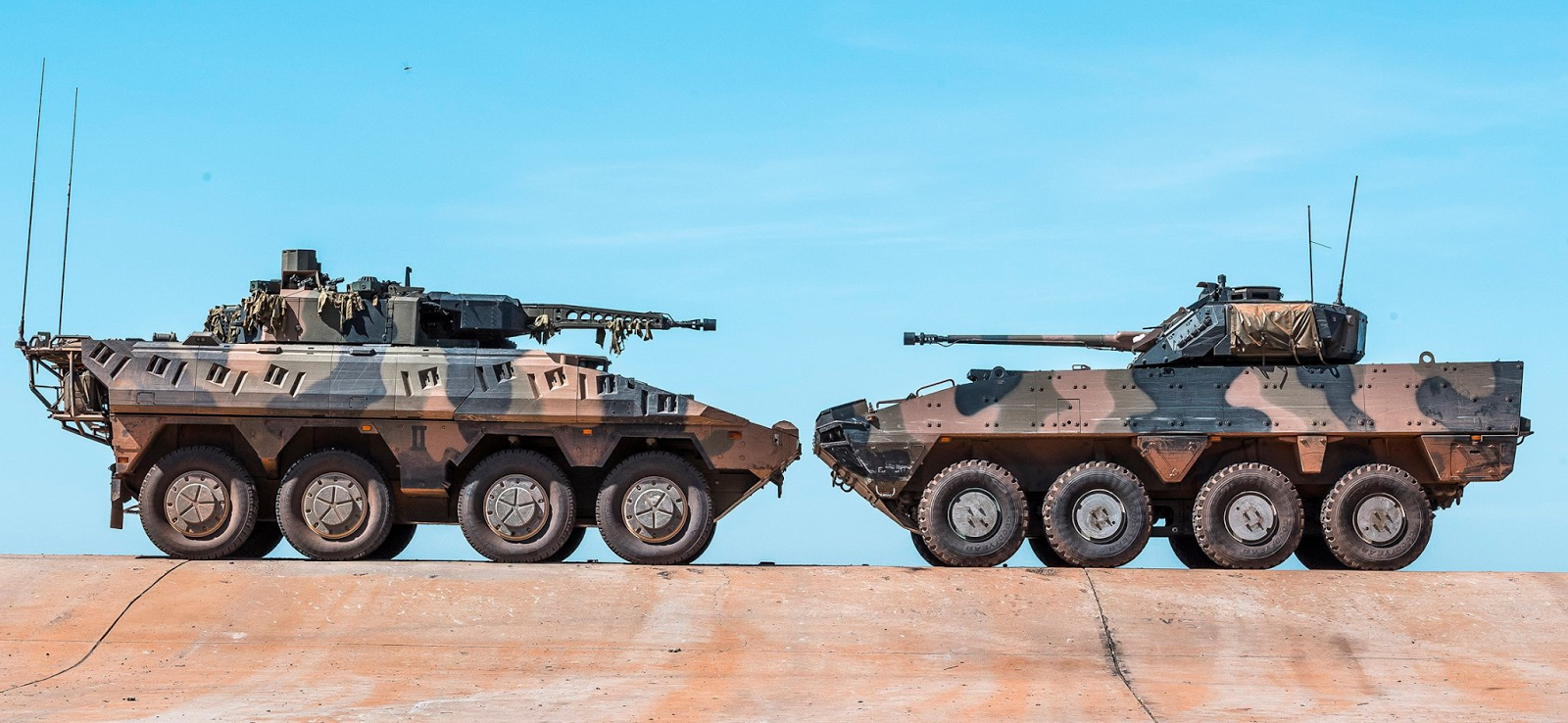
There are multiple ongoing procurement programs in Asia and Europe regarding the adoption of modern 8x8 wheeled vehicles for use as ambulance vehicles, armored personnel carriers, infantry fighting vehicles, mortar carriers and other roles. While Australia and supposedly also Japan are looking for a new 8x8 vehicle, Germany is upgrading the Boxer MRAV and adopting further variants. The British Army is requiring the largest number of new 8x8 vehicles, but various Eastern European countries including Bulgaria, Romania, Slovakia and Slovenia are also interested in new wheeled combat vehicles. This means that vehicles such as the Advanced Modular Vehicle (AMV) from Patria, Artec's Boxer MRAV (multi-role armored vehicle), the Pandur II and Piranha V from General Dynamics European Land Systems, and "underdogs" on the international market such as the Terrex 3 and the French VBCI might be adopted in larger numbers by the militaries of multiple countries in the near future. The US-based company Textron and a Turkish company are also bidding in some tenders.

The Boxer CRV and AMV-35 are being evaluated during the LAND 400 program
A key factor for the developments on the global 8x8 vehicle market might be the decision of the Australian military in the LAND 400 program, which is expected to be made in early 2018. The phase 2 of LAND 400 included four of the most advanced current 8x8 vehicles - variants of the Boxer, the Patria AMV, the LAV 6.0 and the Sentinel (Terrex 3) - i.e. vehicles that are relevant for any military considering to buy a new eight-wheeled armored personnel carrier (APC), infantry fighting vehicle (IFV), or Combat Reconnaissance Vehicle (CRV). Various other vehicles such as the VBCI 2 were initially also offered to the Australian military, but the bids were withdrawn when it became clear that a solution based on military of the shelf (MOTS) components was favored.
Currently only the Boxer CRV and AMV-35 remain in the competition. Based on the prototypes being tested in Australia, it appears that both consortia are betting on very different strategies. While Rheinmetall showcases the Boxer CRV as a very customizable high-end offering including all of the latest gadgets (including active protection system, remotely operated weapon station, anti-tank guided missile launcher, accoustic sniper detection system, laser warners, situational awareness system, etc.), the BAE-Patria joint-venture focuses with the AMV-35 on a more affordable offering, presumably trying to impress with a higher cost effectiveness compared to the Boxer.

The VBCI was already tested in the UK during the FRES project
The British military is considering to buy the Boxer MRAV for the Mechanized Infantry Vehicle (MIV) program, as mentioned by various news sources over the last year. The number of vehicles to be purchased within the £3 billion project is varying by source from just 300 up to 900. While there are several options offered by the arms industry to the UK, the British Army has not yet decided wether it wants an open tender or prefers a direct government-to-government (G2G) deal with Germany for buying Boxers. The advantage of open competition is that the best solution can be found, be it the overall cheapest solution, the most capable vehicle or the jack of all trades. On the other hand the budget of the British Army has shrunken dramatically - and is expected to shrink further thanks to the Brexit - so that English newspapers suggest that an open evaluation of multiple contenders might be too expensive (and with Brexit potentially resulting in additional tolls to be paid also too time consuming). A decision wether to buy the Boxer MRAV or have an open competition is expected at the end of 2017.

By painting a Boxer in the Union Jack pattern, Rheinmetall reminds the UK of the British participation in its development
If the Boxer CRV is chosen by the Australian Army over the AMV-35, this could have positive effects on its chances in the United Kingdom according to German speculations. First of all, there would be greater interoperability between the ground forces of two commonwealth nations, something that is assumed to be desirable. Furthermore the British Army could argue that the Australian tests already have proven the superiority of said vehicle, circumventing open competition in order to rush a vehicle in service. While this in general would also work with the Patria AMV, there are no news reports on the UK Ministry of Defence (MOD) thinking about purchasing the AMV instead of having an open tender.

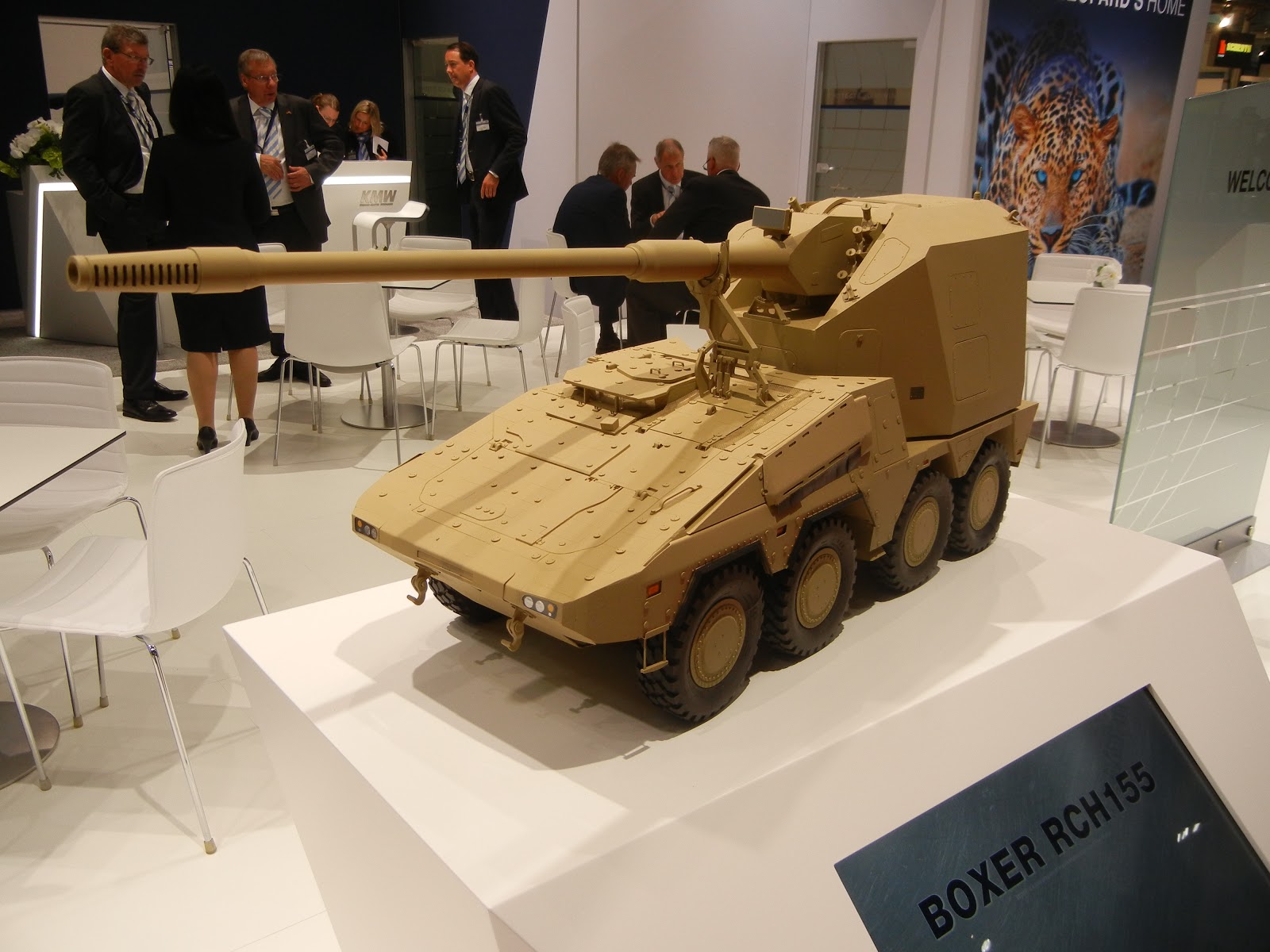
The Boxer RCH 155 mounts an AGM instead of a mission module
Supposedly the UK is also looking for a self-propelled artillery gun (SPG) variant of the vehicle purchased under the MIV program. The Boxer MRAV is the only modern 8x8 wheeled solution that has been showcased with a 155 mm gun, i.e. the artillery gun module (AGM) from Krauss-Maffei Wegmann (KMW) mounted instead of a mission module. The long L/52 gun barrel of the AGM and the high level of protection provided by the Boxer's drive module makes this solution in some aspects better than the current tracked AS-90 self-propelled gun.
At the DSEI 2017, various manufacturer's presented their potential offers for the MIV program including the Piranha 5 from General Dynamics, the Patria AMV XP, the VBCI from Nexter, and  two different Boxer variants from Artec. Rheinmetall painted one Boxer with the Union Jack, while KMW focused on showcasing the modularity of the vehicle with an IFV variant. Aside of the benefits that the modular design enables, the German companies also mention that the UK would have full intellectual property of the Boxer due to its history (being designed in a multi-national project that used to include the UK), allowing them to create and sell their own vehicle variants without any interference from the Germany.

The Japanese military has presented a prototype of their indigenous 8x8 APC
Supposedly Japan is also interested in adopting a more modern 8x8 vehicle compared to its old and lightly protected Type 96 armored personnel carrier. Mitsubishi has already created and showcased a prototype vehicle based on components from the Type 16 Maneuver Combat Vehicle (MCV). However Japan is known to have a somewhat deep military cooperation with Australia, which is why the country of islands is observing the decisions LAND 400 program - apparently some sources suggest that the Japanese Ground Self-Defence Force (JGSDF) might be interested in having a certain degree of interoperability with the Australian Army.
According to the German website hartpunkt.de, defence industry insider sources claim that the Japanese military requested informations on the performance of the Boxer MRAV, specifically regarding its armor protection and modularity. It is worth mentioning that in July 2017 Germany and Japan signed an agreement for cooperation in the arms industry/technology sector. Back then it was reported that Japan was primarily interested in German protection technology, i.e. technologies regarding special armor and potentially also active protection systems. The Japanese news service Asahi Shimbun specifically mentioned that this technology was meant for a "troop transport carrier" (i.e. an APC or IFV). Negotiations regarding the agreement started already in 2015; both countries agreed to not disclose the exact content of the contract. In September 2017 a German-Japanese military technology forum was held in Tokio, which included more than thirty German defence companies.

The Boxer A1 saw combat in Afghanistan
The Bundeswehr recently decided to upgrade all current Boxers to the new A2 configuration, which features changes to both the drive module and the mission module, such as installing a new satellite communication system, fitting an improved driver vision systems, adopting a new storage arrangement, making changes to the cooling and exhaust system of the vehicle, improved protection and adding a secondary control panel for the FLW 200 remote weapon station. A contract for the upgrade of 124 armored personnel carriers, 72 ambulance vehicles, 38 command post vehicles and 12 driver training vehicles was announced in July 2017. All new Boxers that have been and will be ordered by the German Army will also be delivered as Boxer A2 or in a follow-up configuration.

According to the German website hartpunkt.de, the German Army plans to use the Boxer as base for a heavy vehicle for the joint fire support team (JFST) units. This Boxer JFST variant would be equipped with a high quality sensor package, probably the mast-mounted BAA II surveillance and reconnaissance platform from Hensoldt Optronics, that is already being used on the light JFST vehicle on the Fennek 4x4. Rheinmetall as member of Artec also offers a number of sensor platforms for ground vehicles, such as Vingtaqs II system that is operational with the Norwegian and Malaysian militaries. Alternatively the greater payload and internal volume of the Boxer could be used for a larger sensor package, which could in theory also include a larger ground surveillance radar unit. A Fennek can carry only the equipment for either ground-to-ground coordination or ground-to-air coordination, each Fennek JFST vehicle is hence specialized on either role. The Boxer has enough room to hypothetically carry the equipment for both tasks, although it hasn't been decided if a single Boxer should be used for both roles. The Boxer was chosen over a competiting design based on the PMMC G5. Unlike current JSFT solutions from the UK and the United States, the Boxer is not expected to be fitted with a direct fire gun or anti-tank missiles. There is a requirement for about 20 to 30 Boxer heavy JFST vehicles.

JFST vehicle based on the Fennek 4x4
Currently there are also plans for a fire support variant of the Boxer for the Jäger units, according to Inspector of the Army Jörg Vollmer, who is in charge of the German Army. The plans see the fifth (heavy) company of each battalion receiving Boxers with direct fire guns.
The exact type of armament has not been specified, but given earlier reports it seems likely that the interest is focused around the 30 x 173 mm calibre, i.e. the same MK 30-2/ABM main gun as used on the German Puma infantry fighting vehicle (IFV). The vehicle might as well be fitted with a launcher for the Spike-LR anti-tank guided missile (ATGM).

A so called "PuBo" - Boxer with RCT 30 (Puma turret)
Currently the German military is said to consider different turret options and still has to decide wether a manned or an unmanned system is favored. It is understood that the choice - if the informations regarding a 30 mm calibre are correct - is limited to KMW's Remote Controlled Turret 30 (RCT 30; essentially a Puma turret) and the Lance Modular Turret System from Rheinmetall. Both these turrets have their own unique advantages and drawbacks. The RCT 30 is already in service with the German military and hence provides advantages in regards to training, logistics and spare parts. Furthermore it appears to be more heavily armored than the Lance turret, as it is can be fitted with additional roof armor against shaped charge bomblets; while Rheinmetall manufactures similar armor, there hasn't been a prototype of the Lance turret featuring such improved roof armor. The unmanned nature of the turret makes it smaller and lighter. However unmanned turrets have worse situational awarness than their manned counterparts.

A Boxer with Lance turret being demonstrated at a Rheinmetall facility in Germany
The Lance turret on the other hand is available in either unmanned or manned configuration, but it seems likely that only the latter is being considered, as this was already installed on several Boxer prototypes including the Boxer CRV. It is larger than a Puma turret and also heavier, when fitted with a similar armor package; however in theory it can also adopt larger calibre guns such as the 35 x 228 mm Wotan 35 chain gun. The Lance turret suffers from being fitted with several Rheinmetall-made components, which have not been adopted yet by the German military, albeit the modular construction might allow to change them. For example the turret is fitted with either one or two stabilized electro-optical sensor systems (SEOSS); one for the gunner (and one for the commander respectively), but the German Army relies on optics from Hensoldt Optronics for the Puma and several other combat vehicles.

The Belgian Army operates several Piranha DF90 fire support vehicles with 90 mm gun
In theory the German military could choose a lighter or heavier weapon station from various manufacturers. Just looking at the offerings from the two companies involved with producing the Boxer MRAV shows a wide variety of possible alternative armament options. Krauss-Maffei Wegmann showcased the FLW 200+ on the Boxer a few years ago, which is an enhanced variant of the currently used FLW 200 remote weapon station (RWS),  that can accept the 20 mm Rh 202 autocannon with 100 rounds of ammunition. The 500 kilograms heavy FLW 500 RWS can accept 30 mm autocannons such as the M230LF chain gun from ATK, a coaxial 7.62 mm machine gun and an optional missile launcher. Rheinmetall has developed the Oerlikon Fieldranger 20 RWS, which is armed with a 20 mm Oerlikon KAE autocannon; however this is not chambered in the 20 x 139 mm calibre as the Rh 202, for which the German Army should still have lots of ammunition - instead it uses the slightly less powerful 20 x 128 mm calibre.
Given that the new Boxer variant is meant as a fire support vehicle, one could wonder why the armament choice is supposedly focused on the 30 mm calibre, when other vehicles of the same type are often fitted with larger guns. E.g. the Belgian Army has adopted a number of Piranha IIICs with a 90 mm Cockerill gun for direct fire support, while a Rosomak prototype was fitted with the Cockerill 3105 turret. The Boxer with a much higher maximum gross vehicle weight - the latest available variant can support up to 38.5 metric tons and can be fitted with a 800 horsepower engine - should have no issues accepting a low-profile turret with a 120 mm smoothbore gun (such as the 120 mm L/47 LLR from Rheinmetall).

Aside of the exact turret choice, a number of other questions remain. A key question revolves around the role of the Jäger (light mechanized/motorized infantry) compared to the Panzergenadiere (mechanized infantry). Traditionally only the Panzergrenadiere are making use of infantry fighting vehicles, while the Jäger are limited to "battle taxi" style vehicles, which also affects the doctrines of these units. However putting a gun on an armored personnel carrier (APC) doesn't mean that it has to be employed like an IFV. Another decision yet to be made is focused on wether the Boxer fire support variant will carry a dismount squad or not. If a dismount squad is carried, it needs to be smaller in order to compensate for the ammunition storage, the gun operator(s) and the turret basket (in case a manned turret is chosen). Regardless of the decision, a contractt is not expected to be made before 2019. Then the Boxer fire support vehicles could enter service in 2021. A total of about 100 vehicles is required based on the current amount of German Boxer APCs.

The Vilkas is a Boxer IFV variant with the Samson Mk 2 RWS
The Bulgarian military is planning to purchase about 600 new 8x8 vehicles in several different variants for three new battlegroups. Among the demanded variants are also a mortar carrier and an infantry fighting vehicle. Supposedly the bidding process for this military procurement started already in May, with six vehicles being offered to win contract worth more than €500 million Euro. Artec is offering the Boxer, despite the fact that currently no operator has ordered a mortar carrier variant and not a single prototype of this is known to exist - the modular design however would enable a fast creation of such. It is also not known which turret will be offered for the IFV variant.
While the Boxer MRAV is extremely expensive compared to other solutions - in Lithuania the initial offer was claimed to be more than twice as costly as the Stryker ICV proposed by General Dynamics - the vehicle's superior performance (specifically the higher level of protection) resulted in the Lithuanian Army opting for it. The military prefered the Boxer MRAV, the politicans wanted a cheaper solution. In the end the Vilkas variant of the Boxer, mounting the cheaper and slightly less capable Samson Mk 2 RWS instead of the Puma's RCT 30 turret, was chosen.
General Dynamics European Land Systems (GDELS) offers the Piranha V vehicle family. An IFV variant of the Piranha V fitted with Rafael's Samson Mk 2 RWS was demonstrated on the 27. April at the Military Poligon Tylbleto in Bulgaria. The demonstration lasted three days and included live firing tests with the 30 x 173 mm Mk 44 Bushmaster II gun. The Samson Mk 2 RWS features two separate set of sights, a 30 mm autocannon, a coaxial 7.62 mm machine gun and a pop-up launcher for two Spike-LR missiles. It was also fitted to various IFV prototypes provided to the Czech Republic.
 
Patria AMV with 120 mm NEMO mortar system
While KMW as part of Artec is suggesting the Boxer to Bulgaria, the French company Nexter - a joint-partner of KMW - is offering an unknown configuration of the VBCI or VBCI 2. While not produced yet, Nexter already showcased scale models of a mortar carrier variant of the VBCI back in 2013. These models featured a large roof hatch with a two-piece door atop of the rear compartment. Inside the rear compartment an unspecified semi-automatic 120 mm mortar - similar to RUAG's Cobra mortar and the MO 120 mm R2RM from TDA Armaments - is mounted. As IFV the VBCI 2 can be fitted with a 25 mm autocannon in a one-man turret or with a two-man turret mounting a 40 mm CTAS gun. In theory unmanned turrets and other calibres are also available, but they have not been fitted to known prototypes of the VBCI 2.
Patria is offering versions of the Armored Modular Vehicle (AMV), although more details have yet to emerge. The wide userbase of the AMV has resulted in various different variants, so often multiple AMV versions are available for the same role. I.e. there are infantry fighting vehicles based on the AMV mounting the Hitfist turret from Leonardo (after acquiring Oto-Melara), the LCT30 turret from Denel Land Systems, and the BMP-3 turret, while prototypes were equipped with the unmanned MCT-30 turret from Kongsberg, the E35 turret from BAE Systems and the new 40 mm CTAS-armed turret of the Warrior WLIP upgrade. Likewise there are multiple 120 mm mortar variants with the Polish Rak mortar, the NEMO turret and the AMOS turret, while South-Africa has ordered a 60 mm breech-loaded mortar turret for some of its AMVs. 
Supposedly two further competitors are interested in getting a deal for equipping the new Bulgarian battlegroups: Textron and an unnamed Turkish company. There is some confusion regarding Textron here: Textron is not known for offering 8x8 vehicles, although it is not directly specified that a 8x8 vehicle is required. The US company was contracted to deliver about 17 M1117 Guardian armored security vehicles (ASVs) to the East European country in 2014; a further batch of ten vehicles was ordered in mid-2017. According to the Bulgarian news website dnevnik.bg, Textron and Rheinmetall have partnered to offer an unknown 6x6 vehicle for local production in Bulgaria.
As for the Turkish contender, this most likely is either FNSS offering a variant of the Pars or Otokar offering a variant of the Arma. Given the recent political tensions between various European countries and Turkey, it seems unlikely that a Turkish contractor would be chosen - the Czech Republic rejected all Turkish tracked IFVs due to the instable political relations.

The Scipio IFV
Two years ago in 2015, the Slovakian Army ordered about 30 Rosomaks (a Polish variant of the Patria AMV) fitted with the locally made Turra 30 turret from EVPÚ. Apparently the contract was scrapped according to different reports, which is why Slovakia has shown interest in buying a total of about 100 - some sources mention a lower number of only 81 - new 8x8 vehicles. Furthermore a total of 404 modern 4x4 vehicles are required by the army. The official requirements for the procurement project are not known, but they include a larger number of contenders. Deliveries of the first vehicles are expected to start in 2018 and last until 2029; it is however possible that the earlier date is only valid for the 4x4 armored cars.

The Corsac 8x8 is an IFV based on the Pandur II
General Dynamics European Land Systems is understood to offer a variant of the Pandur II. The Pandur II is an evolution of the Austrian-designed Pandur I, that is currently only manufactured in other countries. The militaries of the Czech Republic, Indonesia and Portugal operate various versions of the Pandur II. Due to its relatively low weight - the currently procuded models have a combat weight of only 24 metric tons - the overall level of armor protection is rather limited. While fitting applique armor allowed to meet the STANAG 4569 level 4 requirement for ballistic protection, i.e. all-round protectiton against 14.5 mm AP ammo fired from close range, the protection against mines was rather limited. Only in October 2017, the Czech military annonced that the latest 20 Pandur IIs in the mobile command post variant have managed the qualification for STANAG 4569 level 4b mine protection, after being fitted with the new BOG-AMS-V seats.
Last year GDELS presented a variant of the Pandur II co-developed with the Slovakian MSM Group, which is known as Corsac and features the same Turra 30 turret as the Scipio, mounting a 30 x 165 mm 2A42 autocannon, a coaxial MG and two 9M113 Konkurs (AT-5 Spandrel) ATGMs. However this armament can be replaced by Western alternatives such as the 30 x 173 mm Mk 44 Bushmaster II gun from Aliant Techsystems and Rafael's Spike-LR ATGM.
The Corsac IFV is powered by a 450 hp Cummins ISLe HPCR diesel engine and has a combat weight of only 19.8 metric tons, which is apparently related to the armor package fitted to the prototype. Top speed is quoted as 115 kilometres per hour on roads, but the vehicle is amphibious and can swim at a speed of up to 10 kilometres per hours. The basic ballistic protection reaches only STANAG 4569 level 2, but applique armor kits for level 3 and level 4 are available - the vehicle was never presented without bolted-on add-on armor. The Corsac has room for six dismounts and a crew of two or three. It seems likely that GDELS could offer the same enhancments as found on the Czech Pandur IIs to reach a STANAG 4569 level 4 mine protection.
One of the other two known offers supposedly made to Slovakia includes the Patria AMV, possibly in the same configuration as originally ordered with the Scipio. If these vehicles will also be made in Poland (like the Rosomak and Scipio) or be made in Sweden is currently not known. Artec is offering the Boxer MRAV to the Slovakian Army - again it is unknown which exact variant is offered.

Meanwhile Slovenia is said to intend purchasing about 50 wheeled IFVs for its military. Previously the military of Slovenia ordered a total of 135 AMV vehicles in different variants. The AMV is locally known as Svarun. The order however was halted in 2012, after issues with the funding aswell as other political issues arose, which resulted in only thirty already delivered AMVs becoming operational with the Slovenian Army. Given this fact and that the southern neighbour Croatia is already operating the AMV in larger numbers, it seems likely that the Patria AMV has an advantage over potential competitors. Potentially Artec, General Dynamics, Nexter and ST Kinetics might be interested in competing for the contract.

The Piranha 5 has already been purchased by Denmark and Spain
The Romanian Army will adopt General Dynamics' Piranha 5. In October 2017 the company announced that an initial batch of 227 vehicles will be manufactured by the Bucharest Mechanical Factory, which is owned by the Romanian state's Romarm Group. For handling the production of the Piranhas, GDELS will create a joint-venture in Romania. The military of the Eastern European country already ordered 43 older Piranha IIICs in five small batches starting in 2008.
It is not known what effect this decision will have on the development of the Agilis, a 8x8 wheeled vehicle to be locally manufactured in Romania. It is/was developed by a joint venture of the Romanian Ministry of Economy and the German company Rheinmetall. A total of 7 variants was to be made, while 80% of the work was planned to be done locally - only the engine and other drivetrain components would be imported. Hundred percent of the intellectual property of the Agilis would belong to the state of Romania, allowing easy export and local upgrades. The plans saw a total of 628 Agilis vehicles - 161 amphibious APCs, 192 heavier armored non-amphibious APCs, 24 medevac/ambulance vehicles, 90 CBRN reconnaisance vehicles, 40 mobile command posts, 75 mortar carriers and 46 recovery vehicles - to be made between 2020 and 2035, with further 4x4 and 6x6 options possible. 

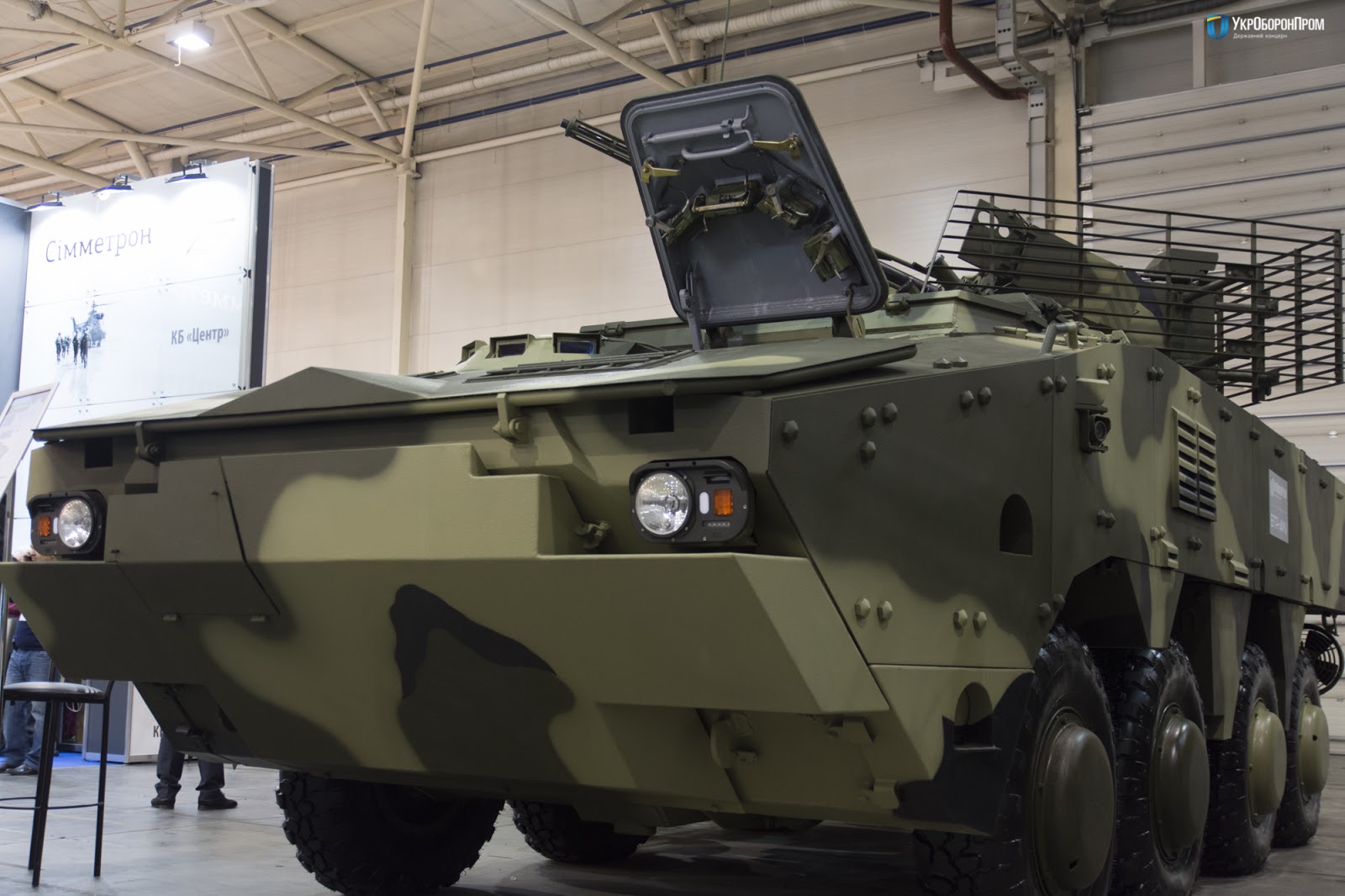
The BTR-4MV1 feautres bolt-on armor modules
The state-owned Ukrainian company UkrOboronProm has presented a new version of the BTR-4 8x8 wheeled vehicle known as BTR-4MV1, which has been developed to NATO standards. This vehicle is designed and manufactured by the Kharkiv Morozov Machine Building Design Bureau and features improved armor protection over its predecessor. The BTR-4MV1 uses modular bolt-on armor that allows the vehicle to reach the STANAG 4569 level 4 and 5 (if desired) - this means the armor can provide allround protection against 14.5 mm AP ammunition and protection against 25 mm rounds along the frontal arc. The new system also allows fitting explosive reactive armor (ERA) to the vehicle in order to resist shaped charge weapons such as the HEAT warheads of rocket propelled grenades (RPGs). The modular nature of the armor elements allows replacing damaged ones, thus reducing the time and costs required to repair a damaged vehicle.

The BTR-4MV1 is armed with a 30 mm autocannon
The weight of the BTR-4MV1 is claimed to have only increased by 2 to 3 metric tons, thus the vehicle would 23-24 metric tons with some more growth potential left. In terms of mobility nothing has changed, the vehicle uses the same suspension, the same German Deutz diesel engine and an Allison transimisison just like the original BTR-4. Due to the usage of low density/high volume armor in some sections of the vehicle, the BTR-4MV1 retains the amphibious capabilties of the original design, reaching a top speed of about 10 km/h in water and 110 km/h on land.
A key difference compared to the BTR-4 can be seen at the vehicle's front. The large windscreens have been eliminated in favor of better armor protection. Commander and driver can now only see the exterior through a number of vision blocks. A number of cameras mounted along the vehicle's surface however provide the crew with a 360° situational awareness. The BTR-4MV1 retains the same weapon station as used on some of the earlier models, including a 30 x 165 mm autocannon, a dual launcher for missiles and a machine gun. There is only one set of optic on the weapon station, therefore the vehicle cannot be used for hunter-killer operations.

Friday, June 2, 2017

Austrian Pandur projects progression

The Austrian company GDELS Steyr, part of the General Dynamics European Land Systems (GDELS) division and formerly known as Steyr-Daimler-Puch Spezialfahrzeug GmbH (SSF), is responsible for developing a new vehicle of the Pandur family of wheeled vehicles (FoV). A few photos of an unspecified Pandur 6x6 variant, which apparently is a long wheelbase version of the Pandur II, were taken at a recent event in April. The fact that the vehicle was presented in a modern digital camouflage pattern has caused some funny commencts regarding the lack of style; however here these photos were the inspiration to take a very short look at the Pandur 1 projects in Austria and other countries. The fact that a Pandur II 6x6 is located at the Steyr plant might be a hint regarding the development of the Pandur EVO - it could be used as reference or as base model for the next iteration of the Pandur vehicle. The Pandur 1 is operated in different versions by the Austrian Army (the so called Bundesheer), the Belgian Army (as scout and ambulance vehicles), the Kuwaiti National Guard (some armed with 25 mm autocannons or 90 mm Cockerill medium calibre guns), the Slovenian Army (known as locally as "Valuk") and the US Army's Special Forces (fitted with applique armor, operated by the Delta Force and 75th Rangers in very small numbers).

The Pandur EVO has a long wheelbase and flat side walls. The rendering shows also a WS4 Panther RWS
The start of the Pandur EVO project was officially announced on the 21st of April 2017, after initial news reports appeared in December 2016 and January of 2017. It has been confirmed that 34 vehicles were ordered by the Bundesheer (Austrian Army) from GDELS Steyr and ESL Advanced Information Technology GmbH for a speculated price of €105 million. The Pandur EVO is a modernized version of the Pandur 1 armored personnel carrier (APC), but is a new development rather than an upgrade of the older vehicle version. Why the Pandur II, which is known to be superior to the existing Pandur 1 models and is available as a 6x6 and a 8x8 version, hasn't been chosen instead is currently not known, but the decision has been claimed to be related to logistics: the Pandur II is currently only operated by the Czech Army and the Protoguese Army - the Pandur EVO supposedly shares more components with the Pandur 1. It has been said that using the Pandur 1 as base of the EVO model will enable the Austria Army to reduce the costs for spare parts and maintenance. The delivery of the first prototype of the Pandur EVO is expected for 2018, so photos taken at a recent event at the GDELS Steyr factory might showcase the current state of development - although this is most definetly not the final Pandur EVO, due to lacking the rear ramp.

The two rear doors and the flat side walls with bolt-on armor can be used as reference for identifying the Pandur II
Another factor for choosing the Pandur EVO over the Pandur II might be the combat weight: the Pandur II 6x6 is only capable of supporting a maximum combat weight of 16.5 metric tons in case of the long wheelbase variant, while the short wheelbase model supports only 15.5 metric tons. The weight of the Pandur EVO, utilizing a new hull with a long wheelbase, has not been released yet. However the Pandur 1 chassis, in the process of being upgraded as part of the Pandur A2 improvment project, is meant to be boosted to support up to 16.8 metric tons - 3.3 tons more than the original Pandur 1. This requires modifications to the brakes, steering system and the suspension. The Pandur II 8x8 has a maximum combat weight of 24 metric tons in the standard configuration. 
The Pandur EVO is expected to be heavier than the upgraded Pandur A2. The additional weight is utilized for better protection - the demanded level of protection couldn't be achieved with modifying the original Pandur 1 design - and to increase transport capacity from 9 (crew of three + six dismounts) to eleven (crew of three + eight dismounts). This is why the Pandur EVO will feature a long wheelbase. In order to deal wtih the heavier vehicle, the engine has been replaced by a more powerful one, delivering about 27 hp per ton (implying at least a 450 hp engine) - rumors suggest a MTU engine (i.e. a version of the MTU 6V 199), although it might be fitted with a Cummins engine instead (as used on the Pandur 1 vehicles for Kuwait and the Pandur II production versions); the adoption of a new transmission (from Allison, Renk or ZF) is also expected. The Pandur EVO will feature a large rear ramp, rather than two separate rear doors. The seats will be mine-proof and thus not connected to the vehicle's floor plate. A NBC protection system and an anti-lock braking system will also be installed in the Pandur EVO.

 In US service the vehicle is known as Armored Ground Mobility System
There is also a politcal component to the decision to purchase the Pandur EVO: in the past the GDELS Steyr plant located in Vienna-Simmering had been manufacutring Pandur 1s for Kuwait;  apparently twenty out of seventy from the original order aswell as forty vehicles from the second order were manufactured in Austria, the others were assembled by AV Technology in the United States of America. The plant has finished its task, but no other follow-up order for Pandur 1s existed (the Pandur 2 is not being manufactured in Austria, it's only licence made in the Czech Republic and in Portugal), which meant that ordering the Pandur EVO is essentially for keeping 147 jobs working on the Pandur production - in fact the decision to order the Pandur EVO created jobs, because GDELS Steyr announced to increase it's workforce by about 10%. Previously the plant was downsized, at some time in the past it was even suggested to turn it into a pure repair and maintenance plant. Overall 179 Austrian companies take part in the development of the next evolution of the Austrian APC, leading to 70% of the contract value ending up in Austrian pockets.

Some of the Pandur 1 vehicles for the Kuwaiti National Guard are IFVs
The basic protection of the Pandur 1 is provided by it's all-welded steel hull, which features no proper provisions made for mine protection. The well-sloped frontal aspect is protected against 12.7 mm ammunition from distances greater than 100 metres and against 14.5 mm rounds fired from distances greater than a 1,000 metres. All-round protection is provided against 5.56 mm ammunition only. An initial upgrade to the Pandur A1 included new seats, that together with the relatively high ground clearance common in wheeled vehicles lead to a STANAG 4569 level 1 mine resistance (hand grenade or anti-personnel mine detonating below the vehicle).
The Pandur EVO's higher protection level is a result of bolt-on applique armor and a new mine protection kit; the relatively high level of required mine protection made it necessary to modify the hull. The exact supplier for the armor has not been disclosed, but the EVO variant might feature an armor kit consisting of RUAG's SidePRO-KE/IED armor for ballistic protection and a MinePRO system for the hull belly in order to resist mines. Both armor types, enabling the vehicle to survive different types of IEDs aswell, have been integrated in the next Pandur A2 upgrade. RUAG has been ordered by Austria and Belgium to develop an applique armor package based on it's existing protection technology in 2015. The total costs for this contract on the side of Austria were €13.57 million. The upgrade unfortunately requires completely stripping down the vehicle, integrating the armor and then adding all previously removed components again - this is the reason why only one prototype of the improved Pandur A2 has yet been finished, two further vehicles are scheduled for 2017. At the time of making the contract, the final delivery of the last uparmored Pandur A2 was expected in 2020; in the same timeframe the Pandur EVO production should be introduced in Austrian service.
In theory Austria might have chosen another contractor for the armor systems of the Pandur EVO - the Ulan for example is protected by MEXAS armor from RUAG's German competitor IBD Deisenroth, this however would nullify some of the logistic advantages gained by choosing the Pandur EVO rather than the Pandur II. The Pandur II of the Czech Army is fitted with ceramic armor from the Israeli manfacturer Rafael in order to reach STANAG 4569 level 4 ballistic protection (all round protection agianst 14.5 mm AP ammo). The mine protection plating of the EVO version is scheduled for testing in this month, i.e. June 2017.
If the weight of the Pandur EVO is somewhat close to the Pandur A2 after RUAG's armor upgrade, it shouldn't be able to reach a very high level of protection. Other 6x6 armored fighting vehicles (AFVs) such as the German Fuchs 1A8 reach a combat weight of up to 27 metric tons, which allows a high level of ballistic and mine protection, meeting the full NATO STANAG 4569 level 4 - this includes aside of all-around resistance to 14.5 mm AP rounds, also blast protection against 10 kilograms of TNT and roof armor to withstand artillery fragments from a distance of 30 metres. 

Pandur A2 firring it's M2 Browning heavy machine gun
The Pandur EVO is to be armed with a remotely controlled weapon station (RWS) of unknown type. The current Pandur A2 APCs are armed with a WS4 Panther weapon station from ESL Advanced Information Technology GmbH, a subsidairy of the Israeli manufacturer Elbit Systems. This RWS can be fitted with either a single 7.62 mm machine gun (MG), a single 12.7 mm heavy MG or a 40 mm automatic grenade launcher (AGL); due to not having an AGL in the inventory, the Austrian Army utilizes only the M2 Browning MG. Alternatively the WS4 Panther Duo, capable of holding a 7.62 mm machine gun and a 40 mm grenade launcher at the same time, might be fitted to the Pandur EVO, if an AGL is purchased at the same time. Both types of the Panther RWS feature an advanced set of optronics with a thermal imager, a laser rangefinder and a daylight camera.

This camouflage pattern might be useful for aval infantry, but it is not suited for Austria
The Austrian Army also bought seven used Pandurs (six APCs and a medical treatment vehicle) for an extremely low price of only half a million Euros from Belgium in 2016. Steyr GDELS is currently also working on an upgrade of the Ulan infantry fighting vehicle (IFV), which is focused around the adoption of an air-conditioning unit. This would enable the Ulan - internationally known as ASCOD (Austro-Spanish co-development) to be used for peace-keeping missions in the hot regions of Asia and Africa.

Saturday, May 13, 2017

New Turkish combat vehicles presented at IDEF 2017

The thirteenth International Defence Industry Fair (IDEF 2017) has been held in Turkey. While not extremely popular with foreign companies - despite having "international" in the name, not many international AFV manufacturers were present - this exposition serves as an opportunity for all Turkish defence companies to present their latest and greatest developments.
The company FNSS Defence Systems, a joint-venture of the Nurol Holding and BAE Systems, has presented a number of vehicles from the wheeled PARS family of vehicles (FoV) and the tracked Kaplan-20 and Kaplan-30 armored fighting vehicles (AFVs).

The Kaplan family of tracked vehicles
There are three main variants of the PARS: a light-weight 4x4 vehicle suited only for scouting, a slightly larger 6x6 variant and a large 8x8 version. The PARS design was originally developed by the the US company General Purpose Vehicles Inc. (GPV Inc., previously GPV LLC.), but failed to gain any orders by the US Army and USMC. In terms of weight and protection level, the PARS 6x6 and PARS 8x8 are more comparable to the previous generation of wheeled vehicles including AFVs such as the German Fuchs, the Swiss Piranha III, the French VAB and the US Army's Stryker interim armored vehicle (IAV). This is probably one of the main reasons for it's lack of sales, being not able to compete in performance (payload, protection, mobility and features) with more modern European designs such as the GTK Boxer, the Patria AMV and General Dynamic's Piranha 5.
The PARS vehicles have however been successfully exported to Malaysia, where a local version is known as AV-81 Gempita and manufactured by the local company DefTech.

The PARS 6x6 Scout features a new driver's cabin
At IDEF 2017, three new versions of the PARS were presented. The PARS Scout is also known as Special Purpose Tactical Wheeled Armoured Vehicle (SPTWAV) and is competing in the Turkish tender for a special purpose vehicle (SPV) against an offering from Otokar (probably a version of the Arma vehicle). The biggest change compared to other variants of the PARS 6x6 is the two-seat cabin at the vehicle front, which now features large windscreens made of ballistic glass, that allow a 230° horizontal viewing angle. A SARP remote weapon station ontop of the roof of the vehicle serves as main armament. The combat weight of the PARS Scout has yet to be made public, however it has a power-to-weight ratio of 22 horsepowers per ton and can reach a road speed of up to 100 kilometres per hour. The weight has not been announced, but if it's power by a 500-600 horsepower engine (like other PARS variants), the PARS 6x6 Scout would weigh around 22-27 metric tons. The hull belly is designed to withstand blasts from mines and IEDs, the seats are blast-proof. The amphibious vehicle is powered by two water blades located at the rear, reaching a swimming speed of 8 kilometres per hour (4.3 knots). On roads, the vehicle has a maximum operation rangee of 600 kilometres. It can cross 1.2 metres wide trenches and climb over vertical obstacles up to 600 mm high. It's maximum fording depth is one metre.

The PARS III is a further evolution of the old GPV design
Aside of the PARS Scout, the third generation of the baseline vehicles were presented. The PARS III 8x8 now has a maximum combat weight of 30 metric tons and can carry 12 soldiers (in the configuration presented at IDEF 2017, which included the Saber-25 one-man turret): Three crew members (commander, driver and gunner), aswell as up to 9 dismounts. The PARS III 6x6 has a lower combat weight of only 25 metric tons, and can carry only six dismounts in the configuration presented at IDEF 2017. Both vehicles have an operation range of more than 700 kilometres.
The main focus of the third generation PARS vehicle was apparently protection against current threats in assymetric warfare, FNSS claims that the resistance against mines is comparable to a MRAP, without stating anything more specific (some vehicles with relatively low level of protection are also called MRAPs...). The fuel tanks of the PARS III vehicles are designed to not detonate upon penetration and also to not leak fuel after being hit.

FNSS' Teber turret system
The company also presented it's TEBER-30/35 turret, which exists either as a manned turret for a crew of two or as an unmanned version, which does not penetrate the hull roof. The unmanned version - designated the TEBER-30/35 Remote Controlled Turret (RCT) can be fitted with either a 30 mm autocannon, such as the Bushmaster II Mk 44 chaingun from Aliant Techsystems, or a larger 35 mm autocannon such as the more powerful Bushmaster III gun. There is also the option of using the Bushmaster II Mk 44 with the 40 mm SuperShot (40 x 180 mm) calibre, which provides more payload, but lower penetration than the 35 x 228 calibre. The gun has dual-axis stabilization.

Depending on gun, ammunition storage varies. Up to 250 rounds of 30 x 173 mm ammunition fit into the turret, the amount of 35 x 228 mm ammo is limited to only 100. A 7.62 mm machine gun with 750 ready rounds serves as coaxial secondary armament. The maximum gun depression is -10°, the maximum elevation is +45°. The TEBER turret has two seperate sets of optics for gunner and commander, allowing hunter-killer operations. The type of optics has not been disclosed. The TEBER-30 unmanned turret is a welded aluminium construction with add-on steel or composite armor modules in order to reach what is believed to be STANAG 4569 level 4 protection all-around at most. Eight smoke grenade dischargers enhance the self-protection of the vehicle.

CGI showing the two-men Teber-30 turret
The manned TEBER-30 turret is operated by a crew of two. It's largely identical to the TEBER-30/35 RT, but provides storage options for up to 300 ready-to-fire rounds of 30/40 mm ammo and up to 1,000 rounds of 7.62 mm machine gun ammunition. Unlike the unmanned version, the TEBER-30 cannot be fitted with the more powerful 35 mm autocannon, due to the gun's greater size and recoild path. The turret has a weight of 3.85 metric tons when fitted with an unknown armor package. Like the unmanned version, it is consisting of aluminium with applique steel and composite armor options. The maximum possible ballistic protection level is STANAG 4569 level 5 (protection against 25 mm ammunition along the frontal arc).

Kaplan-20 armored personnel carrier
Like the PARS, multiple different versions of the Kaplan tracked combat vehicle were presented at IDEF 2017. The Kaplan-20 amphibious infantry fighting vehicle (IFV) has already been presented in 2015. It is meant to replace the ACV series of vehicles, which are essentially upgraded M113s, sometimes fitted with one-man turrets. FNSS calls the Kaplan vehicles also NG-AFV (next generation armored fighting vehicle).
The weight is depending on turret configuration, but it leads to a power to weight ratio between 22 and 25 horsepower per ton; 23 hp/ton in case of the exact vehicle displayed at IDEF 2017. Six roadwheels per side, which are connected to a torsion bar suspension, spread the weight of the vehicle along the lightweight rubber band tracks.
The IFV variant is fitted with the Teber-30/35 RT turret, usually armed with a 30 mm gun. It can carry up to 9 passengers, of which three are crew members (commander, driver and gunner). This year at IDEF, the armored personnel carrier (APC) configuration was showcased, which is armed with a remote weapon station (RWS) that is fitted with a machine gun. Modular composite armor provides protection against ballistic threats and mines of a yet to be officially announced level.

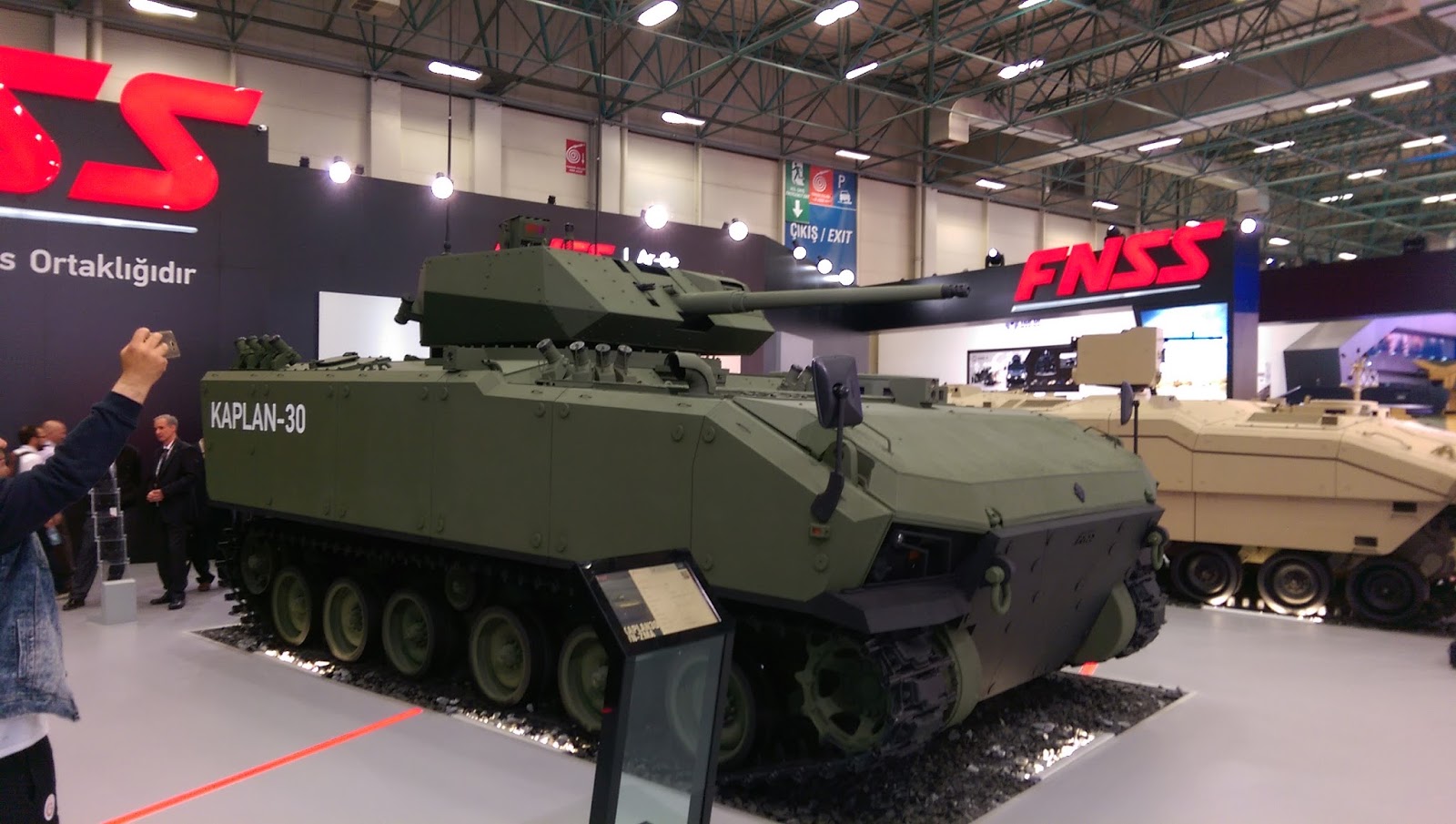
The Kaplan-30 is an enlarged Kaplan with betterr protection
First presented at IDEF 2017 is an enlarged version of the vehicle, known as the Kaplan-30 NG-AFV. Like the Kaplan-20, it is fitted with an automatic transmission coupled to a diesel engine. It was demonstrated with the latest version of the Teber-30/35 RT remotely controlled turret system, newer as the version used on the Kaplan-20 in 2015. The increased size of the vehicle offers greater payload. The Kaplan-30 has lost the amphibious capabilities of it's smaller cousin, while the power-to-weight ratio is reduced to only 20 hp/ton. These drawbacks were accepted in order to obtain a higher level of protection and to transport a a crew of three (commander, driver and gunner) plus eight dismounts instead of only six.
The Kaplan-30 might be a reaction to Otokar's Tuplar IFV. The Turkish Army is expected to open a tender for replacing the outdated ACV-15s; while FNSS developed the rather light Kaplan-20, the Tuplar is much heavier, providing a higher level of protection and room for twelve soliders (9 dismounts plus the crew of three).

The Kaplan Medium Tank is designed for the Indonesian Modern Medium Weight Tank (MMWT) program, competing with Rheinmetalls offer - a modified Marder 1A3 fitted with a Leonardo's Hitfact II turret. It is being developed by FNSS in cooperation with PT Pindad. The vehicle is based on a modified Kaplan chassis with rear-engine instead of the front-mounted concept used on the IFVs. With an estimated weight of 30 to 35 metric tons, the medium tank might be the development link between the Kaplan-20 and the Kaplan-30. The Cockerill 3105 turret from CMI Defence is fitted ontop of the modified hull. It is armed with a with 105 mm high-pressure Cockerill gun, capable of firing ammunition exceeding the official pressure limit of the 105 mm clabire according to NATO standards. The turret provides the commander and the gunner with two separate sets of optics (including thermal imagers and laser rangefinders), allowing the crew to carry out hunter/killer operations.
Previously the Kaplan medium tank for the MMWT project was only presented in form of computer-generated images, while Rheinmetall already had a working Marder medium tank by last year. The Kaplan Medium Tank was presented at IDEF 2017 to the public for the first time, it is expected to be ready for service by 2018.

Aselsan's Korhan features an advanced 35 mm gun-turret
Another armored fighting vehicle has been made by Aselsan, the largest defence company of Turkey; however Aselsan is usually focused on providing electronics and sub-components for combat vehicles. The new vehicle is known as Korhan and might be also meant to compete against Kaplan-20/30 and Tulpar for a potential contract with the Turkish Army. Unfortunately at the time of writing this passage, no reliable source provides enough adequate information about the vehicle.

It is fitted with an Aselsan-developed unmanned turret featuring advanced optics. Thanks to two separate sight units, the system is enabled for hunter/killer operations. The optronic units include laser rangefinders, daysight cameras aswell as thermal imaging systems. A further number of smaller optics is fixed to the turret; some of them are part of a 360° close-range surveillance system, while others optics located at the turret sides are part of a laser warning system.
The remotely controlled turret is armed with a 7.62 mm coaxial machine gun as secondary armament. The main armament consists of a 35 mm autocannon, which is capable of firing locally developed KETF (kinetic energy time fuzed) airburst ammunition - essentially a direct copy of the AHEAD (advanced hit efficiency and destruction) concept for KETF rounds developed by Rheinmetall Oerlikon. AHEAD-based systems include various 35 mm anti-air guns such as the Rheinmetall Oerlikon GDF series, the Skyshield gun and the MANTIS C-RAM (counter rockets, artillery and mortar) system. It is also used on the CV9035 and on the German Puma IFV. The Turkish copy is also used in the new Korkut self-propelled anti-air gun (SPAAG), which is based on an upgraded M113 hull.
The Korhan's gun has a maximum elevation of +45°, the maximum gun depression is only -10°. A remote weapon station can be added ontop of the turret, if desired by the costumer. Alternatively the Akkor active protection system (APS) with two twin-launchers or a hatch for a mini-UAV (controlled
from inside the vehicle) can be added.

The Korhan's hull can be used for a mortar carrier
The Korhan's turret system is fitted with a modular armor system, utilizing bolt-on panels of composite armor atop the metal structure. The hull however apparently lacks any sort of modular armor in the demonstrated version. A sniper detection system and two banks of four smoke grenade dischargers each provide improved protection for the vehicle and nearby infantry. Like most IFVs, the Korhan has a front-mounted engine in order to allow the designers to incorporate a rear hatch for the dismounts. Up to eight dismounts can be tansported inside the rear compartment. Three crew members (commander, driver and gunner) are located in front of them. The vehicle utilizes steel tracks with rubber padding, the hull has six roadwheels per side, which are connected to an unknwon type of suspension (most likely a torsion-bar system or a hydropneumatic suspension). Aselsan also proposed a mortar vehicle based on a modified variant of the same hull.

Upgraded M60T Sabra
Other vehicles presented by Aselsan at IDEF 2017 include the Korkut SPAAG, and upgraded versions of the M60T Sabra and Leopard 2 NG. The M60T Sabra, a Israeli-developed upgrade for the Turkish M60A1 main battle tanks, now has been fitted with a SARP remote weapon station (RWS), a 360° camera system, laser warners and a new commander's cupola with increased situational awareness. The SARP RWS accepts either a 7.62 mm general purpose MG, a 12.7 mm heavy machine gun (HMG) or a 40 mm automatic grenade launcher.
The Leopard 2NG is an upgrade for the Leopard 2A4, which has been developed by Aselsan. It is based on the Leopard 2 Evolution armor package from the German company IBD Deisenroth, while Aselsan has developed new optics and electronics. On the enhanced Leopard 2NG, Aselsan has added a laser warning system and a SARP RWS.
The company Otokar presented it's range of wheeled vehicles, including four different variants (two 6x6 and 8x8 vehicles) of the Arma wheeled AFV fitted with the Mizrak and Mizrak-S unmanned turrets - the latter being a new development first presented at IDEF 2017. The up to 24 metric tons heavy Arma failed to gain contracts by the Turkish Army, but has been successfully exported to other countries in the Middle East.

The Altay has been fitted with the SAAB Barracuda MCS
Otokar demonstrated two variants of the new Turkish Altay main battle tank (MBT), which is expected to enter production within the next year. However the project mightr be delayed after severe issues with the local engine development: while all original prototypes were build using the EuroPowerPack made by the German companies MTU (engine) and Renk (transmission), the Turkish government was interested in using an indigenous engine for the tank - in the end the only reason for the development of the Altay was to have an own Turkish tank, rather than buying the licence to locally manufacture the M1A2 Abrams, the Leopard 2A6 or the Leclerc MBT. When South Korea offered a transfer of technology (ToT), the Altay project was born. The MTU powerpack might still be used for the very initial batch of Altay tanks, but makes exporting the Altay quite complicated - Germany could block possible export contracts to countries with poor human rights record. The Turkish industry however failed to develop a proper replacement engine on it's own, which is why the Austrian company AVL List was chosen to deliver technology and components to TUMOSAN, the Turkish engine manufacturer.

The Ukrainian 6TD-3 six-cylinder engine might be fitted to some Altay batches
Due to political issues between Turkey and Austria, the Altay engine project the was delayed. The Austrian government decided to forbid AVL List to export know-how to Turkey, after the Turkish president insulted and threatend Austria and other European countries. Thus the Turkish government searched for another source of engine technology and ended up finding Ukraine's State Enterprise Malyshev Plant. About a year ago in May 2016, this state-owned company presented the 6TD-3, a six-cylinder two-stroke enigne with an output of 1,500 horsepower, which is supercharged and liquid-cooled. It is a further development of the 6TD-2E used on the Oplot MBT from KMBD, which can be traced back to the times of the Soviet Union. It's very questionable that this six-cylinder engine can achieve the same performance in all aspects (including size, fuel consumption, operational range, etc.) as the current offerings from the market-leading German and US enterprises. Pakistan supposedly is interested in using the same engine for the upgraded Al-Khalid 2 tank variant.

The Altay AHT
Also presented at IDEF 2017 for the first time was the Altay-AHT, new Altay variant optimized for assymetrical warfare and urban combat - why a modern tank, designed after the bad experiences of the US military in Iraq, lacks the armor for urban combat shows that something went wrong within the development process. The tank should have been designed with either a proper applique armor package or enough armor to be used in urban combat from the get go.
When upgraded to the AHT configuration, the tank's sides are protected by an unknown type of explosive reactive armor (ERA); given that Otokar is not known for making it's own armor solutions, this might be a type of new ERA designed by Roketsan. ERA from Roketsan will be fitted to a large number of Turkish M60 and Leopard 2 tanks. The turret front now has a sloped shape rather than flat walls, due to addition of passive applique armor. This might imply that the original frontal armor was not meant to resist all possible threats encountered in Syria. At the rear section of the hull and turret, slat armor is adopted to protect against rocket-propelled grenades (RPGs).

The flanks of the Altay AHT are covered by ERA and slat armor
The tank is fitted with a new suite of optics in order to detect enemies approaching from all sides. The commander's independent periscope was dropped out of the AHT's design, instead a remote weapon station (RWS) fitted with a 12.7 mm heavy M2 machine gun, aswell as telescopic elevated observation system (EOS) have been added to the turret roof. The EOS is mounted on a retractable mast, it can be raised in order to enable the tank's crew to observe and spot targets, while the vehicle completely remains behind cover. It is apparently fitted with a thermal imager, but probably also includes a laser rangefinder and a daysight CCD camera - there are at least three openings for optics at the EOS' top module.

At the corner of the turret, the YAMGÖZ system and laser warners are mounted
The YAMGÖZ close-range surveillance system provides 360° degree coverage using cameras and thermal imager with a rather limited resolution. It consists of eight modules, each being a tandem of a camera and a night vision optic. Two modules are mounted at each corner of the turret, with a laser warning system located inbetween them. Each detector of the thermal imaging sensors has a resolution of 640 by 480 pixels, they operate at a spectral band of 8 to 12 µm. The daysight camera's have a slightly better resolution at 976 by 582 pixels. The field of view of both optics is limited to 40° horizontally and 30° in elevation. In terms of design this arrangement is similar to Rheinmetall's situational awareness system (SAS), but due the worse sensor unit layout, more optics are required - potentially leading to a higher price than Rheinmetall's offering.

Unlike the current Altay prototypes, the Altay-AHT's hull makes use of  a torsion-bar suspension; it can however be fitted with the original hydropneuamtic suspension if desired. Otokar cites easier maintenance for this decision. Indirectly the move to a torsion bar suspension might imply, that the Altay's hydropneuamtic suspension is not capable of dealing with the higher weight of the Altay-AHT, that it might offer lower reliability than the torsion-bar design or that replacing damaged components is a pain in the arse for the maintentance crews. A dozer blade is fitted to the hull front, which can be used for self-entrenching and clearing obstacles.

Like most modern tanks designed for urban combat, the upgraded Altay is also fitted with an electronical jammer to counter radio-fuzed improvised explosive devices (IEDs) by jamming the frequencies used to fuze them. Furthermore the Altay-AHT has an acoustic location system to track the position of enemy snipers and soldiers. The laser warning system allows to launch the smoke grenade dischargers, acting like a simple soft-kill active protection system. Depending on setting, either the RWS, the EOS or the turret can be turned to face into the direction of a laser, from which the turret-mounted warners were triggered.