Showing posts with label rumors. Show all posts

Friday, April 8, 2016

Upgraded Abrams to feautre XM360 gun and guided ammunition?

In the document "The US Army - COMBAT VEHICLE MODERNIZATION STRATEGY" published by the Army Capabilities Integration Center of the U.S. Army Training and Doctrine Command (TRADOC) in 2015, there is an interesting passage about the future of the M1 Abrams tank:


"Next-Generation Large Caliber Cannon Technology. The XM360 next-generation 120mm tank cannon integrated with the AAHS will provide the M1 Abrams a capability to fire the next generation of high-energy and smart-tank ammunition at beyond line-of-sight (LOS) ranges. The XM360 could also incorporate remote control operation technologies to allow its integration on autonomous vehicles and vehicles with reduced crew size. For lighter weight vehicles, recoil limitations are overcome by incorporating the larger caliber rarefaction wave gun technology while providing guided, stabilized LOS, course-corrected LOS, and beyond LOS accuracy"


The 120 mm XM360 tank gun was originally designed for the XM1202 Mounted Combat System tank component of the canceled Future Combat Systems (FCS) program of the US Army. It retains the original dimensions of the M256 smoothbore gun (aside from being fitted with a muzzle break to reduce the recoil impulse/force) and is ballistically equivalent to the M256 gun when firing the same ammunition. Due to having an increased pressure limit the XM360 gun can however utilize more powerful KE ammunition. An ammunition data link (ADL) allows the usage of programmable ammunition or more accurate firing (i.e. when the propellant temperature can be taken into consideration by the fire control system). Parts of the barrel and many other components are made of composite materials, which reduces the weight compared to a conventional design. The XM360 is 2100 pounds (952.5 kilograms) lighter than a M256.
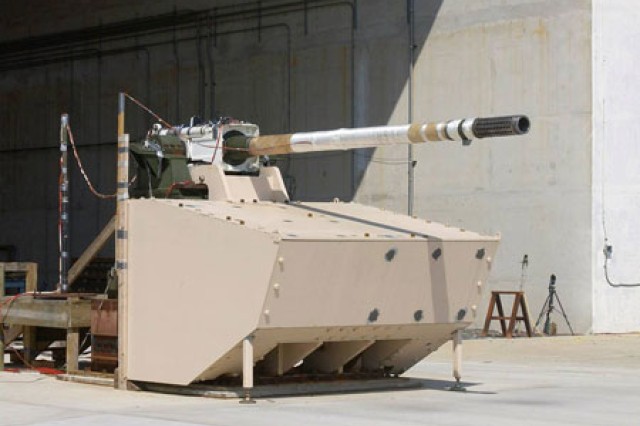
XM360 prototype on a mock-up XM1202 hull during Army trials
The XM360E1 is a version of the XM360 specifically designed for the M1 Abrams. Some components of the former M256 gun like the rotor are reused to reduce cost and increase commonality to older M1A2 tanks. It seems very likely that the XM360E1 is actually meant, when the article from TRADOC speaks about the XM360 gun for the M1 Abrams. From the renderings of the XM360 and XM360E1 posted above, the XM360E1 appears to have a slightly longer barrel. However this is no secured information and no official data on the XM360E1 has been published yet. The fact that the XM360E1 looks longer might be result of the perspective or the claims that the XM360 has the same length as M256's are including the muzzle break in the XM360's length, albeit drawings implying otherwise. The XM360E1 might have a barrel length of 46 to 48 calibre then.

The second part of the quote is implying that the US Army has yet to loose interest in developing guided tank ammunition. This means that the Army has either reactivated a formerly canceled development program like the XM943 STAFF or the XM1111 Mid Range Munition (MRM), or the US Army has started a new development program for long range/beyond-LOS guided tank ammunition.

While upgunning the M1 Abrams is certainly a move in the right direction - the Leclerc with it's GIAT CN-120-26 and the Leopard 2A6 with it's Rh 120 L/55 tank gun have already introduced longer barreled tank guns designed to sustain higher operating pressures more than a decade ago - the question remains if the XM360 is enough for the future. The German company Rheinmetall is currently working on an improved 120 mm smoothbore and a new 130 mm smoothbore gun for the Leopard 2 and the future Franco-German main battle tank (MBT), while the new Russian T-14 MBT is being fitted with either a new 125 mm high-performance gun (2A82) or an 152 mm 2A83 gun. It seems that the US tanks might be lacking in the gun department, despite receiving a new gun in the near future. 
The fact that the XM360E1 gun's barrel is rather short might be related to the oscillation and stabilization issues found on the M1A2, when investigation upgrading the M1A2 tank with the Rheinmetall L/55 (M256E1) gun. From 1998 to 2000 the US tested three modified Rheinmetall L/55 guns (and a further 12 barrels produced under licence by TACOM/Watervliet Arsenal) under the designation M256E1. While the Rheinmetall gun was designed to specifically fit into a modified gun mount of the German Leopard 2 tank, the different gun mount and stabilization systems of the M1A2 Abrams had troubles handling the longer and heavier barrel. This would result in a reduced accuracy and required major modifications (including a completely new stabilization system) to fix, which results in inappropriately higher costs for simply upgunning. The same issues arrived when testing the 120 mm XM294 L55 smoothbore gun prototype on the Abrams between 1996 and 1998.

The IDF's Pereh missile carrier is a lot better suited for launching ATGMs than a conventional tank
As far as the guided ammunition is concerned, one should take into account that this has to fit into the XM360 smoothbore gun and into the ammo racks of an M1A2 tank. This means the maximum missile diameter can be 120 milimetres (mm) and the maximum length of a hypothetical gun-launched missile for the Abrams can not exceed ~990 mm (39 inches). Unfortunately the limitations on the missiles size have a negative impact on the possible effectivness: currently all ATGMs are relying on shaped charge (HEAT) or explosively formed penetrator (EFP) warheads. Modern ATGMs such as the Hellfire, Javelin, PARS 3 LR (TRIGAT), Spike-LR, Kornet, etc. all exceed a diameter of 120 mm, mostly by a rather large amount. The length of long-range high performance ATGMs exceeds 1.5 metres (59 inches). Thus it seems rather unlikely that guided LOS/BLOS ammunition for the M1 Abrams can defeat the frontal armor (in some cases even the side armor) of a current and next-generation tank. Therefore in order to have a high chance at defeating current generation armor, the guided ATGMs have to follow a top-attack design. Even then, a number of current tanks already has enhanced roof protection against top-attack ammunitions (e.g. every Soviet/Russian tank since the 1980s has roof mounted explosive reactive armor). Some variants of the German Leopard 2 aswell as the Israeli Merkava tanks have been fitted with passive roof armor against shaped charges and/or EFPs.

So overall there are good news for the Abrams, but are they good enough?

Sunday, August 16, 2015

Russia cheating at Tank Biathlon 2015?

Just stumbled upon this gem at another forum:

The Chinese website Guancha.cn Russia did it's best to manipulate the Tank Biathlon 2015 for an outcome in favor of the Russian army. The following claims were made by the Chinese news website:

  • The Chinese delegation was told that a 40 metres river had to be crossed. As a result the Chinese team went with a total of 50 metres of pontoon bridges to Russia. They were "speakless" when discovering that the river to be crossed had a width of 60 metres.
  • Russian forces also had faulty bridge equipment, but simply ignored the normal rules of crossing a river; they aligned their bridges under sub-ideal conditions directly in the river - their tanks had to wade several meters into the river to enter the bridges.
Russian forces crossing their pontoon bridges
  • During the IFV competition, there were problems with reloading. Not exactly sure what it says in the article (bad translation), but it seems that Russia didn't agree on accounting the higher rate of fire and the higher reload speed of the Chinese IFV.
  • The rules of the NBC trials of the Tank Biathlon were changed, but the Chinese team wasn't informed of any changes. As a result a 45 second punishment was added to the team's time.
  • The amphibious troop transport competition for which the Chinese team brought their ZBD-05 IFVs was canceled without explanation. The Chinese considered their ZBD-05 to be greatly superior to the Russian BTR-80 in this task.
  • The Chinese PLL-05 self-propelled howitzer managed to beat the Russian counterparts, but for reasons of balancing the performance of crew to that of the equipment, a perfomance modifier was used, which resulted in the parity of the performance of both systems.
  • Several "aggressive rule changes" were made during the infantry/paratrooper competitions to negate the poor performance of the Russian soliders.
There are many more claims in the article, but I don't speak Chinese and it's cumbersome to decode what Google Translator outputs...

Do I believe the Chinese claims? I am not sure. They are probably exaggerated, but there might be truth in them. Maybe the Chinese are simply "sore loosers" who are trying to find an excuse for their poor performance. However the Chinese claims are not hard to believe, based on what I have heard and read about Russian competitions and the protectionism of Russian defence industry and their army.
I think it's save to assume that the ZBD-05 has better amphibious performance than a BTR-80. The mix-up with the river width might have been a mistake however, just like it could have been a mistake to not inform the Chinese team about changed conditions.

This reminds me of the Canadian Army Trophy - in 1987 the US won with their M1A1 Abrams tanks, but they received heavy criticism from the other competitors? Were the European teams "sore loosers"? I don't think so. The US team did operate with open hatches - as only team. In the conditions of the Cold War, where every tank was expected to operated under full NBC protection (and CAT should simulate the crew and vehicle performance in Cold War) this is for sure bad behaviour.

Source: Guancha.cn (chinese)

Thursday, July 30, 2015

Pakistan prefers Oplot?

According to rumors spread on the internet, Pakistan recently trialed the latest version of the Ukranian Oplot-M main battle tank and the Norinco MBT-3000. Supposedly, the results were in favor of the Ukranian tank.

The Oplot MBT in Pakistan
The Oplot-M main battle tank is made by the Kharkiv Morozov Machine Building Design Bureau in the Ukraine. It is protected by composite armor and heavy Duplet reactive armor along the frontal arc, while ERA protects the flanks. It is also fitted with the Varta proteciton system (an improved version of the Shtora system of the Soviet Union), which already has been adopted on the Al-Khalid.
The main armament consists of a modern 125 mm KBA-3 smoothbore gun, which is fitted with a T-80-style autoloader. The Oplot-M also features a modern fire control unit with thermal sights for both gunner and commander.
The Oplot is powered by a six-cylinder 6ТD-2 multifuel diesel engine, which provides an output of up to 1200 hp.

More detailed information can be accessed on the manufacturer's website.

The Chinese MBT-3000 was claimed to be very similar to the current version of the Al-Khalid and seen "as not much of an improvment". Given the relationship between the Al-Khalid (which started as a modified Chinese Type 90 design) and the MBT-3000 (which is a modified Type 90/Type 96 tank design) this seems to be plausible.

The Chinese MBT-3000, supposedly tested in Pakistan alongside the Oplot.


Author's opinion: I don't know if these rumors are true, but it seems to be reasonable to choose the Oplot-M over the MBT-3000. At least the Oplot-M seems to be a more advanced and better design.
However it is rather questionable if the Ukraine is able to manufacture enough tanks for Pakstain (they already have troubles with the Thailand deal) and also wether the Ukraine is willing to agree on a local production (which seems to be demanded by Pakistan).