Showing posts sorted by relevance for query Strong Europe Tank Challenge. Sort by date Show all posts

Saturday, May 13, 2017

Austria won the Strong Europe Tank Challenge 2017

Two days ago the Strong Europe Tank Challenge (SETC) 2017 ended. The winning platoon comes from Austria, one of the first time participants. The soldiers of the Austrian Bundesheer deployed the 1980s' Leopard 2A4 main battle tank (MBT), beating last year's winner Germany. In the challenge held from 8th to 11th of May, teams from Austria, France, Germany, Poland, the Ukraine and the United States tried to show their skill in a number of different disciplines. These included offensive actions, defensive actions, target recognition/identification of thirty allied and enemy targets, estimating the range to a target without using the laser rangefinder, accurately reporting targets in a simulated urban area and firing crew weapons (pistols or submachine guns). Also part of the SETC was to recover a tank with simulated damage from an NBC attack, evacuating and treating wounded, calling for fire support by artillery/aircraft and precision driving along a pre-defined track. Crews also had to endure a physical fitness test. In comparison to last year the scoring was changed.

The confirmed rankings are:
  1. Austria (Leopard 2A4)
  2. Germany (Leopard 2A6)
  3. United States (M1A2 SEP v2)
As expected, the top ranks were occupied by the Leopard 2 tanks; last year the three top-scoring teams were all operating the Leopard 2 tank. That the older Leopard 2A4 managed to beat the sixteen years newer Leopard 2A6 gives a lot of reasons to speculate. It shows that the Leopard 2A6 tank (just like the Leclerc and M1A2 MBTs) probably could not make full use of their more advanced optics, as no night operations were tested. The Leopard 2A4 - fitted with only a single, older thermal imager - should perform a lot worse than these tanks. The limited range during firing trials also makes it impossible for the German and French crews to make full use of their longer barreled main guns.

The crews of the four Austrian Leopard 2 tanks with their trophy
However there is also another major factor for the Austrian victory: crew training. The Strong Europe Tank Challenge is not meant to be an evaluation of the technical characteristics of a main battle tank, but instead tries to measure how well a platoon from a country can perform with it's own equipment. The Austrian crew won, because they were the best trained crew (or rather: they could make the most use of their training).
Based on a photo from a score sheet, that was taken during the competition, the Austrians managed to perform best in calling for fire, the highest scored part of the competition. The Austrian crew got 696 of 700 possible points, while other teams such as the Germans and the Poles got only 500 and 450 points respectively. The Leopard 2s managed to get the best results in offensive operations, which might be related to the high quality and performance of the Leopard 2's fire control system (FCS) and optics. The platoons manning the Leopard 2A4 and the Leclerc tanks both managed to get the fastest time in the precision driving challenge; both these tanks happen to have the highest power-to-weight ratio of the competing models. This should give some of the tank designers a reason to think, if upgrading the engines shouldn't be a priority for the future, specifically after armor upgrades lead to an increase in combat weight of tanks like the M1 Abrams and the Leopard 2 by more than seven metric tons.

The score sheet during the competition
According to the US Army's own news report, there were different 12 events/challenges in the SETC 2017, which allowed for a total score of 1,500 possible points. However official data from the Austrian Army (scores during the competition, not all teams have finished the same amount of tasks) and the photo from a score sheet during the competition suggest that there were more than 1,500 possible points.
Unconfirmed rumors from an Ukranian websites suggest that the French team with the Leclerc MBT managed to get the fourth place, while the Ukranian platoon - operating an upgraded version of the T-64BV tank (sometimes described as T-64BM) - got the fifth place. These tanks were fitted with new radios, GPS systems and night vision optics before being send to SETC 2017. Apparently the crews managed to beat other Ukranain soldiers with T-64BM Bulats and T-80BVs in a national competition before being send to Germany. Supposedly the Polish team with the Leopard 2A5 was on the last place, something that has been blamed on poor training; last year the Poles managed to outperform all but the Danish and German crews. Based on the score sheet from during the competition the Polish crews apparently underperformed in the recovery of a damaged vehicle in a CBRN scenario, in precision driving, in calling for fire, in identifying vehicles and in determining the range. Other claims to justify the poor performance of the Polish platoon say that the fire control system of a single Leopard 2A5 broke in such a way, that the crew couldn't repair it. However the Polish press claims, that they managed to get the fourth place, beating the French and the Ukranian squads - it might be possible, that after the challenge a modifier was added to compensate the lack of a single tank.
According to claims from the US website Stripes.com, all scores are rather close to each other.

The trophy and the awards for first, second and third place
In 2017 the US Army had only one single platoon competing in the Strong Europe Tank Challenge; previously two US platoons tried their best to win the trophy. Back then the M1A2 SEP v2 tanks managed to only secure the fifth and sixth place, beating out only the M-84s of the Slovenian platoon. For the second time in a row, the US Army used the most modern of all tanks (the M1A2 SEP v2, which first entered service in 2011), but again failed to beat at least some of the Leopard 2 users with much older hardware. This means that the either the training of the US tank crews is lackluster, or that the M1A2 SEP v2 still requires some work in order to reach the same level of performance as the older German designs. Based on the very few known scores, the US tank platoon did perform slightly worse in offensive actions (gunnery, target spotting) than either German-speaking team, while also being a lot worse in precision driving. Specifically the offensive actions should be among the events, that are most affected by equipment.

The runner-up of the SETC 2016, Denmark, couldn't afford to participate. The Strong Europe Tank Challenge is rather expensive, it not only requires sending four tank crews, but also four tanks, to Southern Germany. Denmark instead decided to compete at the Worthington Challenge in Canada and the Nordic Tank Challenge in Scandinavia; both these competitons require only two crews, while tanks can be leased.
Next year Sweden will compete in the Strong Europe Tank Challenge, probably with an upgraded version of the Strv 122; there are hopes that the United Kingdom with the Challenger 2 and Canada with the Leopard 2 (2A6 or 2A4M) will also be part of the Strong Europe Tank Challenge 2018.  

Wednesday, May 11, 2016

Strong Europe Tank Challenge 2016

Currently the Strong Europe Tank Challenge 2016 is under way (from 10th to 12th May) It's the first competition under the name, but follows the tradition of the Canadian Army Trophy (CAT) competition of the Cold War or the Russian Tank Biathlon.

Tanks for the Strong Europe Tank Challenge 2016
The competition is held in Germany at Grafenwöhr. Participating are the Danish Army using the Leopard 2A5DK, the German Army with the Leopard 2A6, the Polish Army using ex-German Leopard 2A5 tanks, the US Army with the M1A2 SEP and the Slovenian Army using their current version of the M-84.
The Italian Army has been said to also take part in the challenge, but their Ariete tank wasn't presented at the photoshooting on 8th May nor in the video recap of the 7th Army Joint Multinational Training Command of the US Army. This might indicate that Italy has withdrawn from the competition or the Italian tanks simply were delayed or arrived at a later point of time.

The trophy shows a WW1 British tank...
The Strong Europe Tank Challenge is a competition between several tank units stationed in Europe. In the challenge, tanks have to fullfill a number of tasks such as shooting targets at different range stationary and on the move, while time and accuracy are taken into account.
Based on the results and some further rating pattern, the winner is chosen and given the trophy.


PS: The Italian Ariete arrived at a different time, it's, also taking part in the Strong Europe Tank Challenge 2016.

Sunday, May 22, 2016

Strong Europe Tank Challenge 2016: Germany claims the Trophy

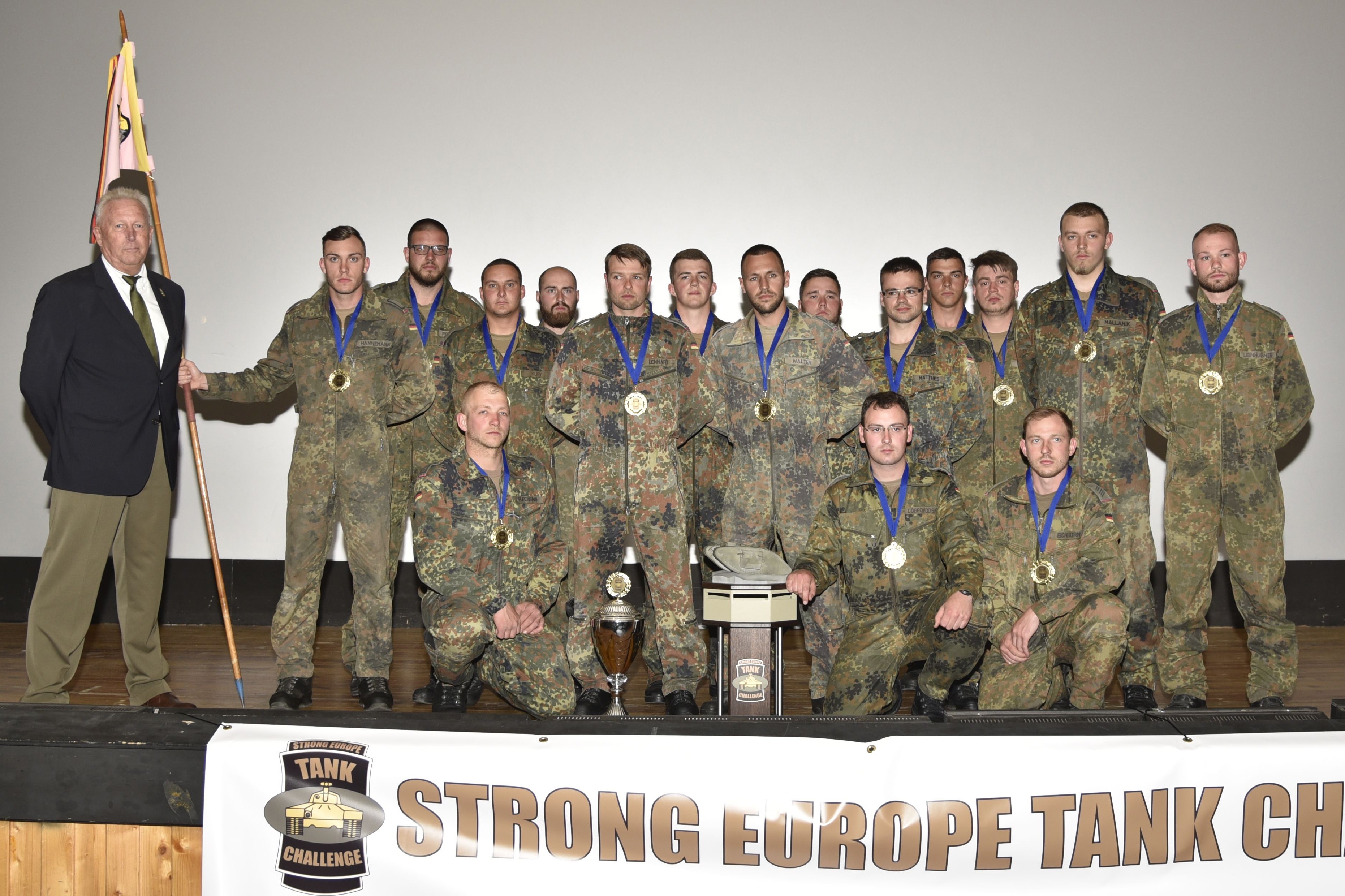
The platoon from the German Army has won the Strong Europe Tank Challenge 2016. The Danish platoon managed to win the second place, while the third place was claimed by the Polish platoon.

The winning platoon of the Strong Europe Tank Challenge

An interesting aspect of the Strong Europe Tank Challenge 2016 is the fact that the top three platoons all used variants of the German Leopard 2 main battle tank (MBT). The Polish and Danish platoons operated versions of the Leopard 2A5, which originally entered service in 1995 (more than twenty years ago) with the German Army. The German platoon was equipped with the slightly newer Leopard 2A6, an upgraded version of the Leopard 2A5 with longer gun barrel. This configuration was first used by the German Army in 2001, about 15 years ago.
Suprisingly, the Italian platoon C1 Ariete did manage to get the fourth place, beating the two American platoons operating the M1A2 SEP v2, the newest tank in the competition. The Slovenian team with the M-84 performed worse.


Every nation used a platoon of four tanks to compete. Except for the US Army, all nation was represented only by a single platoon. Only the M-84, a local version of the T-72, was manned by a crew of three; all other tanks had a four men crew.

The Strong Europe Tank Challenge 2016 consisted of a number of tasks which alltogether had a maximum score of 1,000 points.
  • For offensive and defensive trials including firing and maneuvering up to 700 points were awarded (350 points for offensive actions, 350 points for defensive actions).
  • For "mounted orienteering" (MO in the further text) up to 300 points evenly distributed in six sub-tasks (each 50 points) were awarded 
  • MO included a "mystery physical challenge" were teamwork was important
  • There was an obstacle course with thirteen minor challenges
  • Soldiers from each platoon fired 10 rounds with their service weapons from three locations in the combat shooting lane
  • A total of 25 firendly and threatening targets had to be identified while the tanks were on the course at the vehicle idenfication lane
  • During a simulated NBC attack, crews had to recover and tow one of their tanks while wearing NBC protection gear
  • Multinational teams reacted to an IED attack, assessed and evacuated the casualities
  • One task was to walk as many laps as possible along a track located at a hillside while carrying a 20 kilogram (44 lbs) training round


Further detailed results have unfortunately no been published, only a very few informations and rumors have emerged. A short list of the informations and common rumors gathered is presented below:
  • According to the German Army video, the German targets used for the tank shooting tests were smaller than the ones usually used by the other participating nations
  • The German team was the best in terms of physical fitness, managing a record of 64 laps on the track while carrying ammunition
  • They also performed best at recovering one of their tanks after the simulated NBC attack
  • Contrary to the often posted claim that the German unit consisted of reservists, it actually consisted of normal soldiers: the GebPzBtl 8 is semi-active, the first two platoons (1st and 2nd platoon) are made of reservists. The other two platoons (3rd and 4th) are consisting of professional soldiers. The third platoon of GebPzBtl 8 (belonging to the PzBtl 104 during the time the GebPzBtl 8 is not fully active) participated. However German rumors say that the reserve platoons actually performed equal or better during their last official training
  • According to Polish sources the Polish platoon destroyed more than 75% of of all their targets during the offensive shooting (distance to target up to 2 kilometres, two targets were destroyed at more than 1800 metres distance) and scored 285 out of 350 points. Only the German platoon performed better. In the defensive shooting the Poles managed to hit 17 out of 23 targets, scoring 277.5 out of 350 points - supposedly the highest score in this category.
  • The Italian Ariete tanks were filmed performing extremely bad, missing most of their targets. But on the second day shooting at another lane they supposedly were among the best during shooting
  • Supposedly the Italian Ariete performed worst overall in gunnery
  • The US platoons did a poor job at camouflaging their tank, supposedly the crews couldn't figure out how to properly use a camouflage net. According to US sources Lt. Gen. Ben Hodges said that of those skills tested, some — like using camouflage netting to mask a 60-ton hunk of metal — haven’t been part of regular tanker training in some time.
  • Rumors from the unofficial US Master Gunner network say that the US platoons scored 4th overall in the shooting tests
  •  During the medevac operation after an IED attack, the Slovenian team aswell as another one (according to the rumors probably the Polish team) run over the dummy simulating the wounded
Overall some blogs, forums and people are reacting in either a state of denial ("how could my country loose, their tanks should be better") or in a state of surprise. I don't think that a lot of the results is unexpected for the following reasons:
  • The German tanks had the highest muzzle velocity in combination with a very accurate round (the training round is meant to simulate the current DM53 and DM63 ammunition, which according to the values used in the marketing brochures is probably the most accurate), so that the good shooting results are not that surprising
  • The Polish and Danish platoons used slightly older/worse types of training, but still have a rather high muzzle velocity and rather flat trajectory.
  • The current US ammunition is the heaviest and slowest of all participating countries, which will result in a higher trajectory and a greater impact of external factors; hence it will have a higher dispersion. The current US training round is meant to simulate this ammunition.
  • The Slovenian M-84 is the oldest tank design with the worst ammunition, fire control system and gun stabilizer. 
  • While the M1A2 SEP v2 is the newest tank in the competition with the newest optronics, overall the optics of the M1A2 SEP suffer from a number of drawbacks: the field of view of the CITV is blocked by the RWS, the commander's cupola and the loader's gun shield; the CITV also lacks a day channel, which can be advantageous for target identication at day

Thursday, April 27, 2017

Leopard 2: Poland wants more; Germany and Turkey opt for upgrades

According to a news report from Defence24.com, the Polish Army is interested in buying more Leopard 2 main battle tanks (MBTs). Poland originally received 128 Leopard 2A4s for an extremely low price, a decision made in Germany in order to build up better political relationships between the two countries, which previously due to the second World War and previous conflicts had been terrible. A further 119 Leopard 2 tanks (including 105 relatively modern Leopard 2A5s) were ordered in 2013, after Germany (falsely) decided to downsize it's tank force. These second-hand tanks also were extremely cheap, costing only €180 million.
 
The Leopard 2PL is an upgraded Leopard 2A4 with AMAP armor, new optics, electronics and an APU
Given this history, it seems very unlikely that Poland is going to order newly built Leopard 2 tanks, which would cost between €5 and €11 million per vehicle, depending on variant and other parts and services being part of the contract value. Buying new tanks also would delay the introduction into service by some years, however the tanks could be more capable than what currently is possible with upgrading older vehicles - in order to keep upgrades cheap, most Leopard 2A4 users try to limit the weight of a modified version to 60 metric tons (above this limit the torsion bars need to be replaced, which requires some welding on the hull). 
Thus Poland is most likely looking to buy second hand Leopard 2A4 tanks for a much a lower price - before Russia annexed the Crimean peninsula, used Leopard 2A4 tanks were sometimes sold for less than one million Euros per tank.
If Poland purchased Leopard 2A4 tanks, these MBTs then should be upgraded to the modern Leopard 2PL standard, which features enhanced surivability, firepower and slightly improved mobility. A thick AMAP composite armor module at the turret front boosts the frontal turret protection to a level comparable to the Leopard 2A7, while optics and modifications to the gun, improved drive system and a computer unit to program the 120 mm DM11 HE-airburst ammunition boost the tank's lethality.

A possible source for these second-hand tanks might be Norway; recent reports suggest that Norway is considering giving up it's small tank force (originally ordered 52 Leopard 2A4s, 46 left operational) in favor of a more mobile infantry-focused doctrine. Small infantry units should take out enemy tanks by using anti-tank guided missiles and other weapons. This is however only one of three options being considered by the Norwegian Army, in the end the tanks might be kept operational.
Finland might also be able to sell slightly less than a hundred Leopard 2A4 tanks, after purchasing 100 ex-Dutch Leopard 2A6 MBTs in 2014. Some of the 139 Leopard 2A4s originally bought by Finland have been relegated to reserve units, while others were converted into bridge layers, support vehicles or cannibalized for spare parts.
A third option for getting Leopard 2A4s at a low price might be Spain. Originally Spain leased 108 Leopard 2A4 tanks from Germany, which later were purchased by the Ejército de Tierra (Spanish Army), after Germany had downsized it's own military significantly and had no need for further tanks. Spain has offered the tanks to the Czech Republic and to Peru; however they were rejected due to being in a bad condition and thus requiring costly factory-level maintenance.
It is currently unknown what buying more Leopard 2 tanks means for the fate of the PT-16 tank developed by the Polish industry. It might result in no PT-16 being bought by the Polish Army, however the current government plans to increase the size of the military dramatically (together with it's budget), which might allow to upgrade some of the older T-72 and PT-91 tanks to the PT-16 configuration.

Leopard 2A5 of the Polish Army
Due to Russia's politics towards Eastern Europe (predominantely annexing Crimea and supporting the rebels in the civil war in Ukraine) being considered an aggression and inacceptable, NATO has increased it's focus on conventional warfare, shifting away from focusing on international peace-keeping, peace-making and anti-terror operations. To react faster and better in case of a Russian aggression, the Polish Army has moved some of it's currently most advanced tanks - the Leopard 2A5 - closer to it's eastern border. The tanks originally belonging to the 34th Armoured Cavalry Brigade located in Zagan (a city close to the German border) have been moved to the 1st Tank Brigade, which is stationed in Wesola, a place close to the country's capital, Warsaw. Likewise the PT-91, an enhanced, local version of the T-72 featuring ERAWA armor and improved electronics, will be used to replace some other tanks in the 1st Tank Brigade. Previously the unit was equipped with obsolete T-72M1 tanks.

The ADS system utilizes pre-warner radars, optronic sensors and box-based countermeasures
Meanwhile ADS Protection GmbH, a German company owned by Rheinmetall Defence and it's partner IBD Deisenroth Engineering, has suggested to the German military to adopt it's Active Defence System (ADS), a box-based active protection system (APS) capable of defeating (depending on exact variant) anti-tank guided missiles (ATGMs) - including top-attack weapons, RPGs, EFPs, aswell as HE(AT) and APFSDS ammunition fired by main battle tanks. A report following an investigation on the system was presented to the German Defence Commitee at the end of March. Due to the commitee working in private, it is not known what the result of this report are. According to an earlier report in a news magazine, the system could enter service in 2018 or 2019, when ordered in 2017. The system manages to exceed the NATO STANAG 4686 requirements for active protection systems (intercepting more than 85% of incoming projectiles for a reduction in penetration capacity by 50%), defeating over 95% of incoming threats during testing.
On the 26th April of 2017, the German parliament finally approved a contract to buy and upgrade 103 Leopard 2A4 tanks, which are currently owned by the German defence industry. Previously the contract was delayed due to disputes between the two companies Krauss-Maffei Wegmann (KMW) and Rheinmetall, which could not agree on how the contract value would be split between them. Most of the tanks will be upgraded to the new Leopard 2A7V configuration, an upgraded variant of the Leopard 2A7, while the other tanks will be converted to support vehicles or repurposed in another way. The Leopard 2A7V will feature a stronger 20 kW auxiliary power unit (APU), enhanced armor protection, superior optics and improved communication systems. It might also feature the improved L/55A1 tank gun, that allows to operate at higher pressures. Together with new ammunition, this is said to improve performance/penetration by 20% compared to the current gun.

Leopard 2's originally produced with old armor package can be identified by the welded ammo hatch (red arrow)
After loosing several Leopard 2A4 tanks in combat against terrorists, Turkey is trying to improve the protection of the tanks. Depending on production batch, the 2A4 version of the tank is either fitted with a first, a second or a third generation armor package. At least some Turkish Leopard 2A4 tanks are most likely fitted with the oldest and weakest armor option, because they belong to the earliest production batches. These can be identified by the ammunition hatch located in the left side wall of the turret; it was closed (by welding steel ontop of it) when the tanks were upgraded to the 2A4 configuration.
According to the Military Technology Magazine, Turkish sources claim that a about 80 MBTs were used in the operation "Euphrates Shield", of which 43 were Leopard 2A4 tanks. Based on available data about 7 to 14 Leopard 2A4 tanks were hit by anti-tank guided missiles, damaging or destroying the tanks. Due to IS propaganda filming the same tank from different angles and pretending that this would be different vehicles, the exact kill number might be inflated.

M60A3 fitted with ERA from Roketsan
Currently 40 Leopard 2A4, 40 M60A3 and 120 M60T MBTs of the Turkish Army are planned to receive an upgrade to improve the protection against ATGMs, after two M60T tanks were already fitted with a remote weapon station (RWS) and laser warners. The M60T is meant to receive an active protection system; given that the Akkor APS is still in development, Turkey plans to buy an existing system. Furthermore the M60A3s and Leopard 2A4s are to be fitted with a new ERA kit from Roketsan (scheduled to be tested on a Leopard 2A4 first), a fire supression system, a close proximity surveillance system and the same upgrades as the two M60Ts received (which are laser warners and a SARP RWS). The upgraded Leopard 2A4 tanks are also meant to receive an APS, just like the M60T Sabra tanks. Which APS will be chosen is unknown, but Rheinmetall has complained about Germany blocking several weapon exports to Turkey; this might include the AMAP armor package used on the Turkish Leopard 2NG upgrade and/or the ADS active protection system.

The Leopard 2 tanks from Germany, Denmark and Poland did enjoy great success in the Strong Europe Tank Challenge 2016, hosted by the US Army on the Grafenwöhr site located in Germany. This year's competition is scheduled to take place between the 7th and 12th of May. Denmark, Italy and Slovenia won't return after participating last year, however Austria (with Leopard 2A4s), France (with the Leclerc MBT), Romania (with the TR-85M1) and Ukraine (most likely using an upgraded T-64 version) join last year's competitors Germany, Poland and the United States. Let's see how the Leopard 2 can handle the Strong Europe Tank Challenge 2017.