Showing posts with label Griffin. Show all posts

Sunday, November 6, 2016

Light/medium tanks gain popularity


The VT-5 light tank on display at Airshow China in Zhuhai
At the Airshow China event, a few new details on the Chinese tank VT-5 were released. The combat weight of the tank is claimed to be between 33 and 36 metric tons, depending on fitted armor package. Two different armor configurations for the VT-5 are currently being offered by Norinco, one optimized for conventional combat and one fitted with enhanced side armor protection.
The armament is confirmed to be a conventional 105 mm rifled gun, which is fitted with a thermal sleeve, a fume extractor and a bustle-mounted autoloader. Together with the computerized fire control system, the effective combat range is claimed to be 3,000 metres or more. The stabilized gun can be used stationary or fired from the move without affecting the accuracy of the VT-5. A remotely controlled weapon station (RWS) serves as secondary armament.

ERA and slat armor at the hull side of a VT-5 tank

In terms of size it is supposedly comparable to most normal MBTs, being 2.5 metres tall and 9.2 metres long, when the gun is facing forward. The width is depending on the armor configuration, when fitted with the ERA and slat armor combination seen at Zhuhai, the VT-5 is supposedly 3.3 metres wide. Thanks to a powerful engine with an output of 1,000 horsepowers, the VT-5 is believed to be extremely mobile. The power-to-weight ratio is between 27 and 30 hp/ton depending on the armor package.

Rendering of the MMWT proposal from FNSS and PT Pindad

The Turkish company FNSS and the Indonesian state-owned defence company PT Pindad are developing a light tank for the Indonesian Army's Modern Medium Weight Tank (MMWT) project. The winner of the Indonesian program is expected to deliver an inital order of 50 vehicle, on the long run order could be increased to 400 vehicles. FNSS is owned by 49% by the British defence company BAE Systems.
The MMWT is based on the FNSS-designed Kaplan infantry fighting vehicle (IFV) chassis, which seems to be the first proper own design; previously the company relied on licence-producing and modifying existing vehicles such as the M113 and the GPV Colonel (known as PARS in Turkey). The hull for the MMWT has however been redesigned - while the Kaplan has it's engine mounted in the front of the vehicle and the rear of the vehicle is used for a dismount compartment fitted with a rear ramp, the MMWT has a rear-mounted engine. 
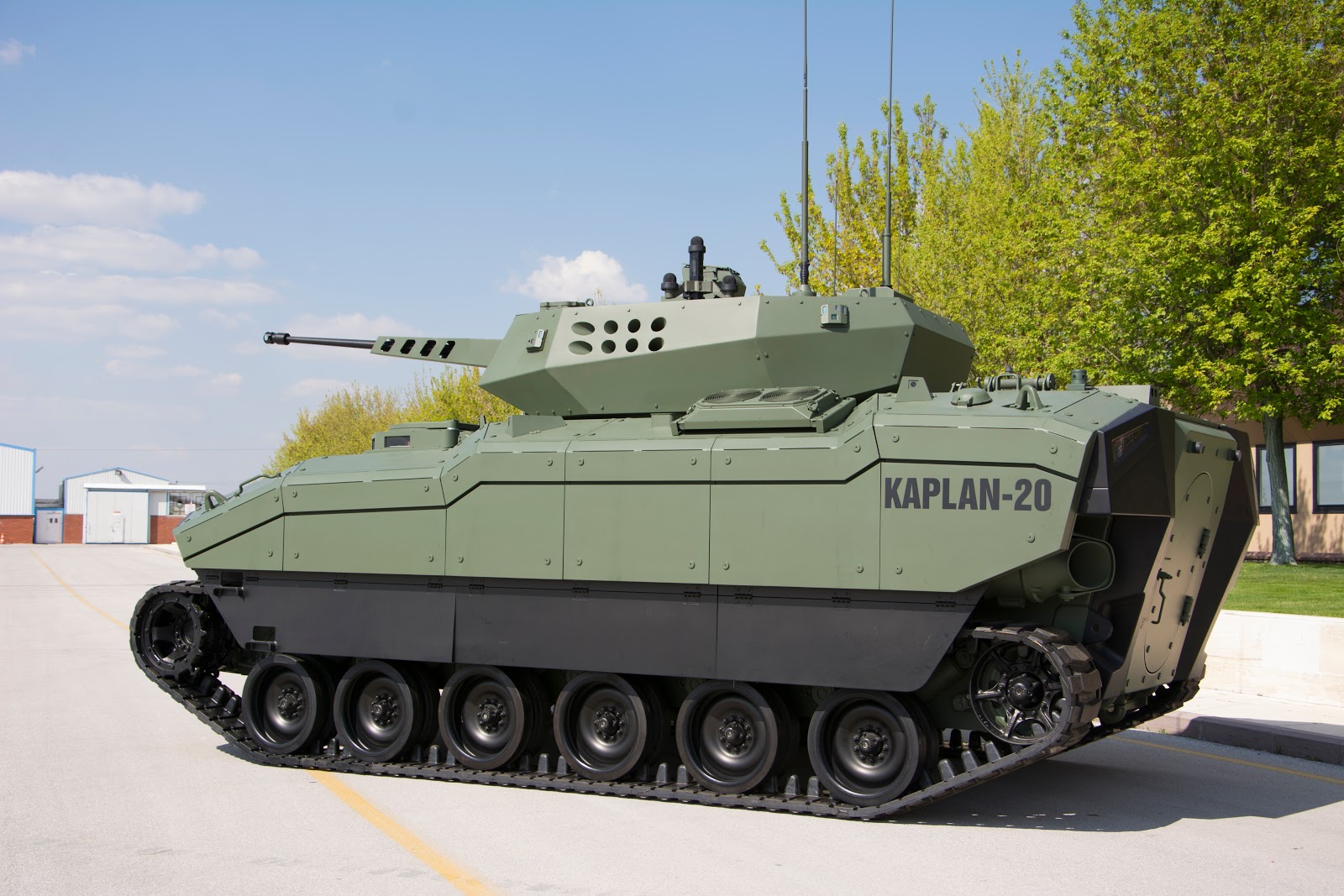
The MMWT uses a modified Kaplan-20 hull

The turret for the MMWT is provided by the Belgian company CMI Defence, part of the CMI Groupe. The exact turret used on the MMWT is not being disclosed, but based on the model and 3D renderings, it seems to be a version of the modern Cockerill CT-CV 105HP turret fitted with a coaxial machine gun and a 105 mm gun.
Currently it is not known if a standard 105 mm rifled gun or CMI's Cockerill 105 mm high pressure gun. Aside of firing the standard range of NATO 105 mm ammunition, the latter is also capable of firing the Falarick anti-tank guided missile with 5,000 metres range, which has been co-developed by CMI and the Ukranian company Luch, aswell as the M1060CV APFSDS with increased chamber pressure, which is capable of perforate a 280 milimetres armor steel plate sloped at 60° (560 mm steel armor along the line of sight) at 2,000 metres distance.  The Falarick ATGM uses a shaped charge warhead with more than 550 milimetres penetration into steel armor.

Rear view of the MMWT: note the engine vents at the rear hull

The MMWT is fitted with a currently unknown type of engine, which according to a FNSS spokesperson at Indodefence 2016 gives the vehicle a power-to-weight ratio of about 20 hp/ton - this would imply a maximum output between 640 and 700 horsepower, given the projected weight of the MMWT being between 32 and 35 metric tons. Six pairs of roadwheels connected to a torsion-bar suspension are used to distribute the weight along the ground. The road range of the vehicle is 450 kilometres and top speed is 70 kph.
The medium tank is 2.7 metres tall, about 7 metres long and has a width of 3.2 metres when fitted with the hull armor modules.

Protection is provided by the steel construction and further applique composite armor modules, which are mounted at the front and at the sides of the vehicle. Neither the protection levels of the MMWT nor of the Kaplan IFV has been disclosed yet, but a ballistic protection meeting the STANAG 4569 level 4 or the level 5 standard seems likely. This would mean all-round protection against 14.5 mm AP ammunitions or frontal protection against 25 mm medium calibre rounds. The MMWT is also fitted with a mine protection kit of unknown protection level.

Rheinmetall is offering a new version of the Marder medium tank. The first model of a modern Marder-based tank was presented at Eurosatory 2012 (nicknamed "Marder Medium MBT") and was a more comprehensive upgrade of the Marder, featuring the Oto-Melara HITFACT turret with a 105 mm rifled gun, thick AMAP composite armor modules for protection against RPGs and EFPs, a mine protection kit and an uprated engine. The vehicle is however too heavy for the Indonesian tank program, weighing up to 43 metic tons.

Marder medium tank with HITFACT II turret
The current Marder medium tank is fitted with a HITFACT II turret made by Leonardo, previously Oto-Melara. It is made out of weight-efficient aluminium with bolted-on steel plates for increased protection. The seven tons heavy three-men turret replaces the earlier two-men turret, which was armed with a 20 mm Rh202 autocannon and a coaxial MG3 machine gun in an overhead mount. The original up-armored turret of the Marder 1A3 weighed only 3.2 metric tons.
The Marder medium tank is still based on an upgraded Marder 1A3, which features improved survivability compared to the original model. The Marder 1A3 is protected by spaced steel armor, which resisted multiple impacts by 30 mm AP or APDS ammunition from close ranges (400 m). It is not known if the armor is enough to reach STANAG 4569 level 6, but the Lynx IFV (fitted with the same frontal armor, but different side armor) is offered to Australia as part of the LAND 400 Phase 3 competition, which supposedly demands a similar level of protection.

Marder Medium MBT at the Eurosatory 2012
Unlike FNSS and Pindad's offering, the Marder medium tank is only making use of proven systems, which already are in service with other militaries. The Marder 1A3 is operational with the Chilean Army, the German Army and the Indonesian Army, while the HITFACT II turret is used on the Centauro II and the previous version on the normal Centauro mobile gun system. The turret can be fitted with an autoloader, if demanded by costumer. However the current version of the Marder medium tank uses a manually loaden gun.

The rear of the Marder medium tank
The vehicle has a weight below 35 metric tons and features a 650 hp engine for reaching a top speed of 65 kph. The medium tank has a road range of over 600 km, but in heavy terrain this is reduced to only between 400 and 500 kilometres. The Marder medium tank is 3.07 metres tall, 8.48 metres long and 3.35 metres wide.

Lynx IFV with LANCE MTS turret
Rheinmetall is offering several other improved versions of the Marder. Aside of the Marder Medium MBT from Eurosatory 2012, there also is the Marder CCV prototype with LANCE RC turret, different configurations of the Marder IFV and the Lynx family of vehicles, currently being offered to Australia. Aside of this the TAM (Tanque Mediano Argentino - "Argentinian medium tank") and the TH 301 are based on modified versions of the Marder IFVs.
Currently Rheinmetall is also offering a Marder with modular armor package, an upgraded MTU diesel engine, an improved suspension system and increased internal volume by raising the vehicle's roof. The upgraded engine provides an output of 690 hp compared to the Mader's original 600 horsepower.

For the Indonesian medium tank project, a powerful air-conditioning system is a key requirement, because any military vehicle without air-conditioning can suffer from fungal growth within a few days when not being maintained and controlled. This is the result of the high humidity in Indonesia. Supposedly officials from the Indonesian Army are favoring a configuration with a two-men turret and autoloader instead of a three-men turret. This would mean that the cooperation between FNSS and PT Pindad has a clear advantage over Rheinmetall's Marder medium tank. In general the vehicle is more modern than the Marder, using state-of-the-art armor technology, and a modern drivetrain and suspension system. The meanwhile the Marder is a late 1960s design, which was upgraded in the late 1980s.
However Rheinmetall's Marder medium tank has the advantage of being based on well-proven military-off-the-shelf components. It might be cheaper than the MMWT. The fact that the Marder 1A3 is operational with the Indonesian Army should result in lower lifecycle costs and less infrastructure strains.
Both the Marder medium tank and the MMWT from FNSS and PT Pindad make use of off-the-shelf turrets from other companies. These feature 105 mm rifled guns and advanced fire control systems with thermal imagers and separate sights for gunner and commander, which enable the tank to conduct hunter/killer operations.
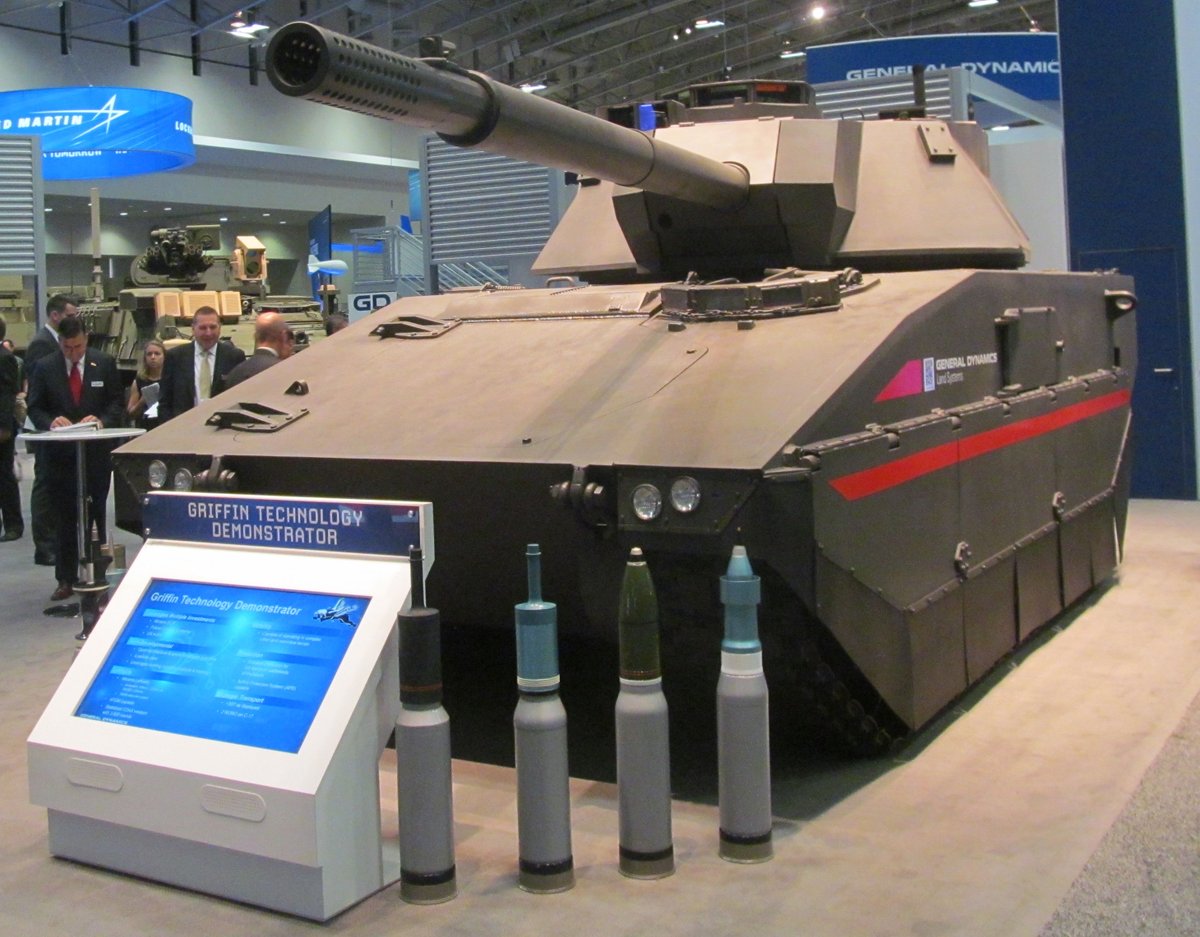
General Dynamics Griffin uses an ASCOD hull design and a highly modified Abrams turret made of aluminium
The US Army is looking for a light tank as part of the Mobile Protected Firepower (MPF) program. While members of the US Army in a TARDEC workshop came to favour a lighter vehicle with lower protection level and armed with a 50 mm autocannon, which could be deployed via a C-130 aircraft, the official requirements from the US Army call for a vehicle with a weight of 32 metric tons or below, which is armed with a 105 mm or 120 mm gun. Currently there are two contenders being pushed by the industry: a modernized version of the old M8 Armored Gun System (AGS) from BAE Systems and the new Griffin, a vehicle based on the ASCOD design, under development by General Dynamcis. Both vehicles were presented at the AUSA 2016.

It is interesting to see China apparently producing the best light tank design of 2016. Aside of the VT-5, only the outdated M8 AGS is based on a purpose-built light tank chassis. The Griffin, the Marder medium tank and the MMWT are all based on modified infantry fighting vehicles, which leads to a greater size than necessary and an unoptimised shape. The smaller physical size enables the VT-5 to reach a higher protection level - all-round protection against RPGs and at least heavy machine gun ammunition (probably even some medium calibre rounds) in the configuration presented at Zhuhai - without exceeding the weight of other vehicles such as the Marder medium tank and the MMWT. At the same time, the VT-5 has the highest power-to-weight and supposedly a hybrid suspension, combining torsion bars and hydropneumatic systems.

Monday, October 10, 2016

US armor programs at AUSA 2016

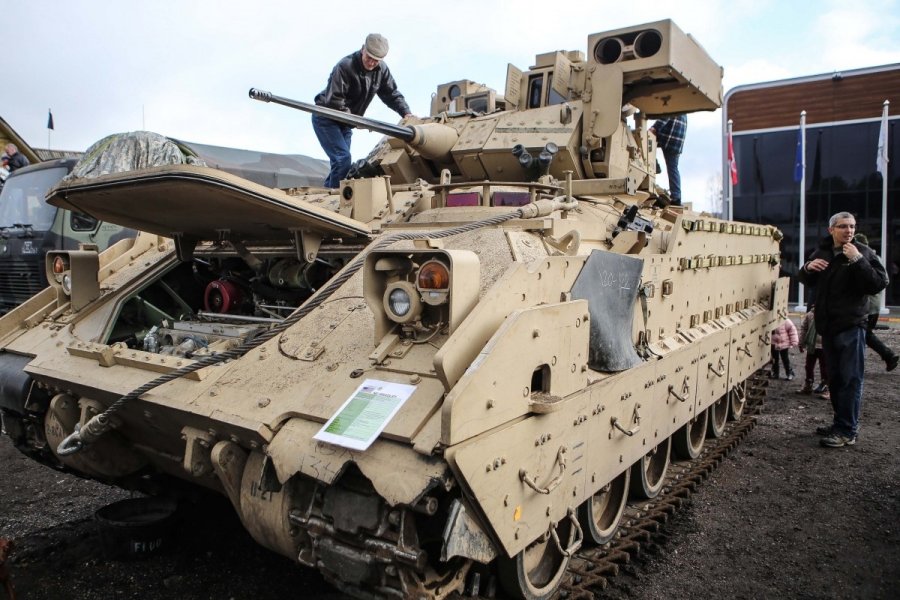
Aside of the Griffin, other vehicle upgrades and propsals have been presented at the AUSA 2016. In particular the current status of the AMPV and Bradley programs are interesting. The M8 Armored Gun System was also present, but apparently still identical to the version presented last year at AUSA. It is quite obvious that the Griffin and AGS are meant to compete with each other for possible adoption with the US armed forces.
Apparently the US Army is looking for a Mobile Protected Firepower vehicle with a weight of up to 32 metric tons (as reported by Jane's IHS), clearly disagreeing with a TARDEC workshop containing members of the US Army's 82nd Airborne Division and the 10th Mountain Divison. The workshop favoured lighter vehicles, designed to be compatible with the C-130 aircraft (thus at most 22 metric tons of weight) with lower armor protection. While the minimum required firepower is at least a 50 milimetre cannon, the US Army is supposedly not interested in introducing a new ammunition calibre into it's inventory, meaning that most likely a 105 or 120 mm tank gun has to be mounted.


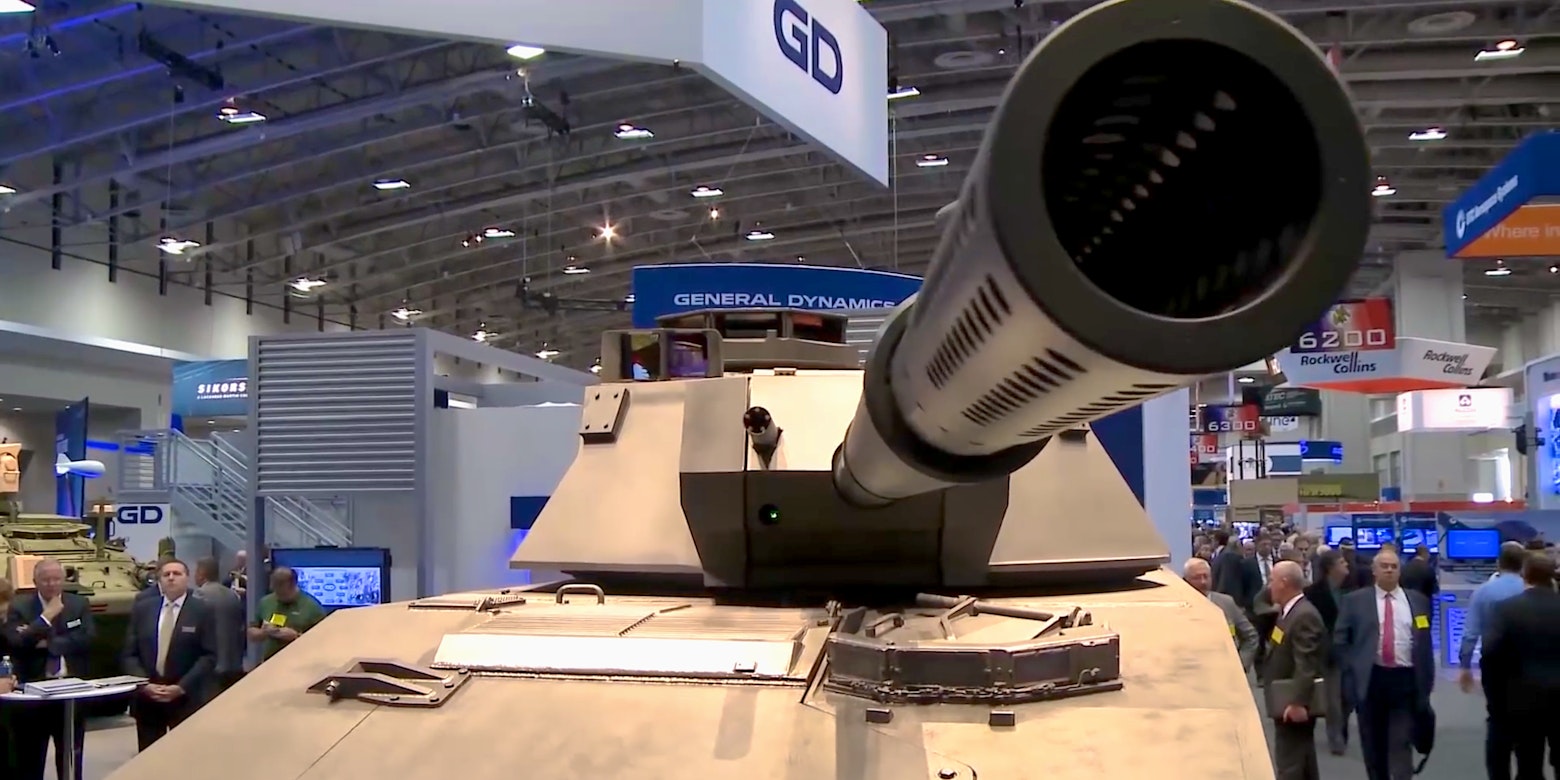
The current weight of the Griffin prototype is sitting at 28 metric tons, but another metric ton should be shaved of the design, resulting in a final combat weight of only 27 metric tons. The Griffin is fitted with a new turret based on the Abrams turret. This turret weighs only about a third of the Abrams turret, which implies a weight of 7 to 8 metic tons. It seems to be not fitted with composite armor and is made out of aluminium. Apparently it seems to be a modified Abrams turret design without composite armor. These factors leads to a number of changes in the general shape and layout of the turret.
The turret lacks a bustle-mounted ammunition rack with blow-off panels as found on the Abrams main battle tank (MBT). Instead the ammunition is stored in the hull, probably without any additional safety features. This is the common way of storing ammunition in light tanks based on IFV hulls such as the CV90-120 and ASCOD 2 Direct Fire variants. The Griffin features an external bustle rack that can be used to store crew equipment.

In the presented form, the Griffin offers protection against heavy machine gun and small arms ammunition only. However it's protection can be augmented with the installation of modular armor packages or active protection systems (APS). The prototype however seems to lack any sort of mounting mechanism or interfaces for such. The main gun of the Griffin has been confirmed to be the XM360 smoothbore gun, which was originally developed for the Mounted Combat System of the Future Combat Systems (FCS) program of the US Army.

The Bradley will receive new hand stations.
Some details on the ongoing development of the M1A2 SEP v3 main battle tank also have been released at the AUSA 2016. Currently there are seven full-scale prototypes undergoing testing. In the next twelfe months, the US Army is expected to make a decision on what exactly will be part of the third System Enhancement Package (SEP). The series production is expected to start in the first quarter of 2018, about the same time when the Leopard 2A7V and Challenger 2 LEP upgrade are expected to be ready.
The M1A2 SEP v3 upgrades moves the APU under armor and the inertial navigation system into the turret for increased performance. The digital screens for gunner and commander will be upgraded to a 1080p resolution and support third generation thermal imagers. Further upgrades to the armor protection and weapon station are also included. Initially 45 M1A2 SEP v3 tanks will be made in the first year. This rate will increase to a maximum of 60 tanks per year for the following years.

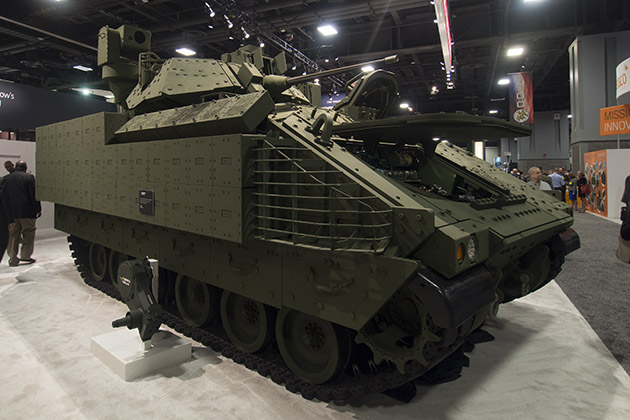
Old AMPV prototype
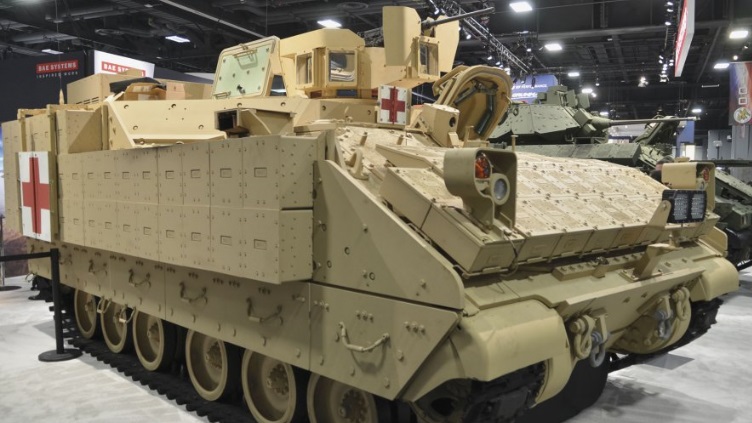
The AMPV is meant to replace the outdated M113 plattform and is based on the Bradley design. While original concepts saw General Dynamics using a rather unmodified Bradley hull without turret (but raised roof at the rear compartment), the final AMPV design however uses a newly (re-)designed chassis, which is largely based on the Bradley technology. It relies on a number of components common to the Bradley and M109A7 self-propelled gun, thus reducing development and life-cycle costs. The AMPV is heavier and significantly larger than the original Bradley hull, offering increased protection against mines and improvised explosive devices (IEDs).

The current version of the medical evacuation AMPV at AUSA 2016
Nine variants of the AMPV are being made; one of them is already being assembled, while the welding of the hulls for the other eight variants is underway. The variants include a medical evacuation vehicle, a medical treatment vehicle, a mortar carrier, a mission command vehicle and a general-purpose vehicle. The US Army plans on buying 2,907 AMPVs for replacing the obsolete M113 variants in the Armored Brigade Combat Teams (ABCTs) for an estimated cost of $10.233 billion. A further 1,922 M113 needs to be replaced at echelons above the brigade level, but as of 2016 the US Army has not established the requirements for this program - it seems likely however that the AMPV will also be used for this. In 2014 BAE Systems was awarded a $382 million contract of 52 months for the development of the AMPV. This contract includes the option of a 289 vehicles low-rate initial production (LRIP) for a total value of $1.2 billion. For the fiscal year 2017, the president budget request saw a $184.2 million funding for research, development, testing and engineering (RDT&E) of the AMPV. It is intended to support the assembly, support and shipment of 29 prototypes to government test sites for a 1,500 miles testing. The budget was backed by house and senate.


The distribution of AMPV demand is the following: 520 general-purpose AMPVs are needed to replace exisiting M113A3 GP (general-purpose) vehicles, 991 AMPVs are required to replace the M1068A3 mission command variant of the M113. 384 AMPV mortar carriers will phase out the M1064 mortar carrier, while 788 AMPVs replace the M113A3 medical evacuation variant. Another 214 AMPVs will follow the M577 vehicles for medical treatment. That is a total of 2,897 AMPVs, leaving a further 10 vehicles for the purpose of testing and developing. About nine to ten percent of all AMPV's are meant for the US Training and Doctrine Command as well as testing of the vehicles.
 
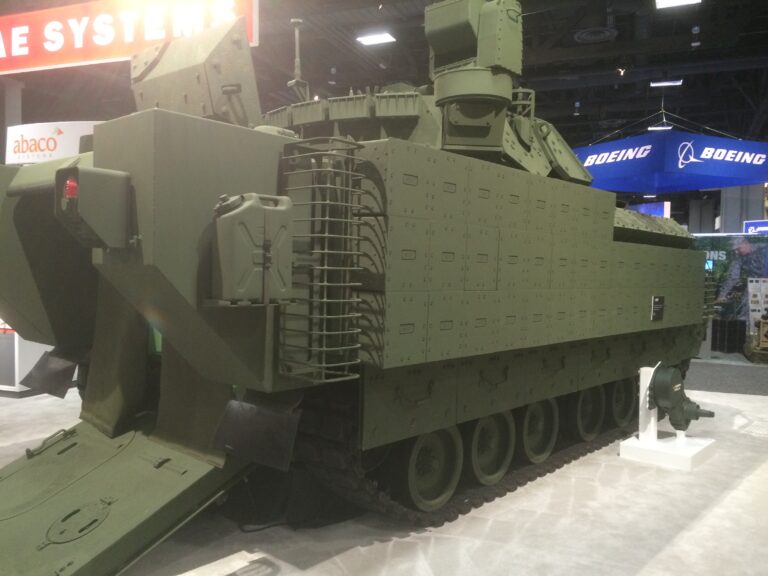
The Bradley Next-Generation has been presented at AUSA 2016 alongside the AMPV. The main feature of the Bradley Next-Gen is the increased belly protection against anti-vehicle mines and IEDs. The roof has been raised by seven inches (178 mm) in order to accept soldiers up to the whole 95th percentile of height. The fuel and ammunition such as TOW missiles (previously stored below the crew seats) are moved outside the crew compartment. For this two triangle-shaped sponsons have been added to the rear of the vehicle, located at each side of the rear door of the Bradley. At least the TOW missiles can still be accessed from inside, allowing to reload the missile launcher without the need of completely exiting the vehicle.

The Next-Gen Bradley has a new rear storage and a raised roof
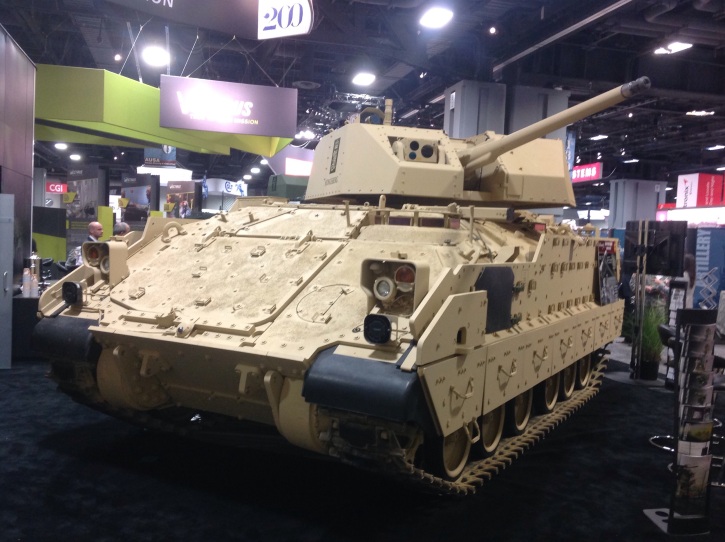
The Bradley Next-Generation features improvments to the mobility in form of installing the same engine as used on the AMPV and Bradley ECP2 upgrade. Together with a new high-efficiency transmission, the Next-Generation Bradley has essentially 200 additional horsepower compared to the current US Army model. The upgraded Bradley proposal also features new tracks and a new suspension, which is set higher (already a feature of the ECP upgrade proposal) and which uses a different torsion bar design. The new torsion bars won't ease and detach upon blast impact, so they won't penetrate the vehicle's floor and kill the soldiers inside. The vehicle still utilizes only six roadwheels, not seven as incorrectly claimed by some early sources.

Bradley with MCT-30 turret at AUSA 2014
The Bradley Next-Gen is still fitted with the original turret and the old 25 mm M242 Bushmaster chain gun. No upgrades were made to the turret by BAE Systems beyond the already planned ECP upgrades. The US Army has tested the Kongsberg Protector MCT-30 turret fitted with the 30 mm Mk 44 Bushmaster II chain gun in 2014 as possible upgrade path for the Bradley, but no further informations about this project have been surfaced in the last year. In the past decades, the Bradley has been fitted for tests and trials with a larger number of different turrets and guns, including the 35 mm Bushmaster III chain gun, the 40 mm Bofors cannon aswell as 40 mm CTAS case-telescopic armament system. It seems possible that fitting the MCT-30 turret to the Bradley might be just another BAE-funded prototype that is not meant for US Army service.

A major issue that both the Next-Gen Bradley and the AMPV share, is the outdated armor design. The base armor of the Bradley and the AMPV consists of a welded aluminium construction with bolted-on steel plates, which were added to the Bradley beginning in 1988. On the original production models of the Bradley, the aluminium alloy 5083 was used for most of the structure except some of the sloped roof sections of the hull side, where the aluminium of the alloy 7039 was utilized. The aluminium plates used for the assembly of the hull are supposedly one inch (25.4 mm) thick at the sloped front and the flat sides. The side armor of the hull also included an array of two spaced 0.25 inch (6.4 mm) steel plates to provide enough protection against 14.5 mm armor-piercing (AP) ammunition by tumbling the impacting projectiles. The frontal third of the hull bottom of the original Bradley was fitted with a 9.5 mm steel plate for enhanced protection against anti-personnel mines and grenades.


Around 1986 the development of an armor-upgrade was initiated, after being already demanded by different officials even before the Bradley entered service. The armor upgrade was adopted in 1988 and consisted of steel plates with a thickness of up to 1.5 inch (38 mm), although some sources suggest a slightly lower maximum thickness of only 1.25 inch (32 mm). The steel plates are connected via large bolts to the hull and turret. The size and amount of bolts differs depending on location and plate thickness. The side armor module consisting of spaced steel plates were replaced by a single solid steel plate at the upper part and two thin steel plates at the lower section. The only modern aspect of the Bradley's armor is the usage of Armor Shield-R reactive explosive armor developed by the Israeli company Rafael. There are different configurations of Armor Shield-R that have been used on the Bradley in the past with different protection levels, but the Next-Gen Bradley and the AMPV seem to feature the latest variant. According to Jane's IHS, this still cannot defeat tandem charge warhead arrangment and thus protects only against older and light rocket-propelled grenades.

Aluminium of the alloy 5083 is known to provide little to no weight savings over conventional armor steel. Depending on thickness and projectile shape, tests from the US Army's Ballistic Research Laboratory (BRL, renamed to Army Research Laboratory  in 1992) show an increase of protection by 8% in favour of aluminium compared to steel in best case, to a 22% decrease in protection compared to steel in worst case. The British Professor Richard M. Ogorkiewicz, who worked for/with the British MoD, noted that the main benefit of  (alloy 5083) aluminium armor is the greater structural stiffness resulting from the thicker aluminium plates compared to thin steel plates providing the same level of protection. Thinner steel plates have to be reinforced with bars or have to be ribbed in order to provide additional strucutral stiffness, leading to a slight increase of weight. In general one has to assume that the original hull and turret construction of the Bradley provide essentially no weight savings over steel armor. The addition of further (weight-inefficient) steel armor and the large overall profile of the M2 Bradley might mean that it is the most inefficient infantry fighting vehicle in regards to armor protection per weight.

Ceramic composite armor of the K21 IFV: This is what AMPV and Bradley need
More modern infantry fighting vehicles such as the ASCOD Ulan and ASCOD 2 Ajax, the Bionix, the later batches of the CV90, the K21 and the Puma IFV utilize ceramic composite armor for ballistic protection. Compared to high-hardness steel armor, the ceramic amror can in extreme cases offer more than four times as much protection for a given weight. When it was presented in 2014, the AMPV design (then still based on a slightly lighter, less modified Bradley hull) weighed 27.6 metric tons. It seems likely that the AMPV could have a total weight of close to only 20 metric tons if it was making use of more weight efficient armor (such as ceramic composite armor) and manufacturing methods, such as using a glass-reinforced plastic hull like the K21 or a base steel hull made with thin metal bending technology. Likewise the Bradely would probably weight about 25 metric tons when manufactured with more modern technology.
The only downside of this suggestion would be the increased costs, but these might be nullified by the lower fuel consumption, lowered wear of engine and tracks aswell as the overall greater tactical and strategic mobility. In the end the Next-Generation Bradley is meant to provide a solution to the US Army to last until 2030, when the decision is made to procure a new IFV for the US Army. The AMPV is meant to be operated beyond 2030. How well armored will the AMPV and Next-Gen Bradley be at this point of time? Does it make sense procuring outdated armor in the 2017 to 2025 timeframe, which is meant to serve until beyond 2030, when much more modern alternatives are already existing? Luckily the Next-Generation Bradley is just a proposal; the AMPV on the other hand seems extremely odd...