Showing posts with label NERA. Show all posts

Wednesday, January 18, 2017

Early M1 Abrams composite armor

On the TankNet forums, a user with the nickname "whelm" has posted drawings from a formerly classified document on the earliest iteration of the US M1 Abrams main battle tank (MBT). He got this document from Vollketten, a user with accounts at the Sturgeon's House forum, the WoT forum and other places. It details the armor layout of the tank, showing were the Burlington composite armor is located and how it is specifically implemented on different areas.

The name of the document

Burlington special armor, also known as Chobham armor, is a type of composite armor developed in the United Kingdom by the FVRDE from the late 1960s onwards. It consists of a number of sandwich plates - also called biscuits - which are mounted in a spaced configuration. It is understood that these sandwich plates work as a type of non-explosive reactive armor (NERA), by using an elastic interlayer located between two metal plates (usually steel or alumininum). On impact the rubber will compress to the point of maximum compression, until expanding again and bouncing back. This will move more material into the path of penetration and also shatter thin and fragile projectiles, such as the shaped charge jets created by high-explosive anti-tank (HEAT) warheads commonly used on anti-tank guided missiles (ATGMs) and rocket-propelled grenades (RPGs). Essentially NERA works like explosive reactive armor, but with a lot less plate movment, as it only reuses the energy from the impacting projectile, instead of using an external energy source (such as the detonation of an explosive layer) to move the metal plates.

The location of the special armor on the M1 Abrams MBT

The special armor covers the frontal arc of the tank only, with an exception being the sides of the turret bustle. The lower front plate (LFP) of the hull is fitted with composite armor, the upper front plate, also known as glacis plate, however relies on conventional steel armor with high sloping. The gun shield and turret front, as well as complete turret side armor and the frontal two/four side skirt segments are protected by Burlington special armor aswell.

The frontal hull armor
The lower fornt plate of the M1 Abrams' hull consists of an array of NERA sandwich plates, which however only cover about half of the complete armor volume. The other half of the armor thickness is occupied by a mounting bracket for the NERA sandwich array and conventional steel armor. When hitting the hull straight on, the projectile has to pass through the exterior steel layer, four sandwich plates and then the thick inner steel plate.

The armor layout of the gun shield
The special armor of the gun shield of the Abrams follows a similar design as the hull armor, however there is no mounting bracket. The gun shield itself also does only include a rather thin backplate, however there is a thick steel plate located behind the gun shield, which might be connected to the trunnion plate. When hitting the tank straight without any oblique angle, the penetrating projectile again has to pass through four sandwich plates.

The side armor of the turret bustle
 The side armor at the turret bustle seems to be the most interesting aspect of the tank, as it not only features a sloped NERA sandwich array and a mounting bracket as seen on the lower front plate armor array, but it also features a multi-layered backplate consisting of two steel plates with another material located between them. The exact naturre of this material is unkwnon, but it could be an application of ceramic as armor material. Using ceramic armor as part of the backplate in order to absorb the leftover penetration power of a projectile, that was damaged by (N)ERA sandwiches, has been suggested and patented by the Franco-German institute in Saint-Louis; it is believed that the armor used on the Leopard 2 and Leclerc might follow the same concept.
However there is no exact proof that said material is ceramic; other possibilities include glass and silicia, which have been tested by the US Army's Ballistic Research Laboratory in the 1950s and 1960s as part of the siliceous cored armor for the T95 medium tank and the XM60 MBT. In theory the material also might be a type of glass-reinforced plastic or aluminium, as used on the early models of the Soviet T-64 and T-72 tanks.

Side skirt armor
The sides skirts of the M1 Abrams consists of a four or five layer sandwich, which is spaced from the homogenous steel base hull armor. The outermost plate is apparently a steel plate, followed by what is believed to be alternating layers of elastic material and metal. On the left hull side only the frontal two skirt elements are fitted with special armor, which is required for protecting the crew and fuel tanks along the 60° arc (±30° from the tank's center line). On the right hull side, the first four side skirt elements are made of special armor, which is required to also protect the hull ammunition storage that is located behind the turret ring at the right hull side.

Burlington armor array for the British Chieftain Mk. 5/2 MBT
Unfortunately there is no image showing the frontal turret armor, but given that we know the layouts of the frontal hull armor, the gun shield armor array and the turret side armor, there is not much reason to doubt that the frontal turret armor will look a lot differently. In general the Burlington composite armor used on the M1 Abrams is a further evolution of the British designs from the 1960s and 1970s. Thanks to nowadays declassified documents, it is a secured fact that the UK shared it's armor research with the United States and the Federal Rebuplic of Germany during the Cold War. Thus we can expect the early armor arrays used on Leopard 2 and Challenger 1 to look very similar.

Merkava armor


Other countries have developed their own versions of NERA sandwich arrays in the past. The Soviet Union adopted a very similar armor layout in 1985. Leaked Chinese armor arrays from research papers and CAD models show a very similar conception, using NERA sandwich arrays held by mounting brackets in front of thicker and multi-layered backplates. Photographs of damaged Merkava tanks reveal a similar armor concept/technology.


Chinese composite armor arrays
More modern versions of the M1 Abrams and other tanks are still following this general armor design concept, however sometimes more complex arrays with additional layers and elements are used. A common design principle according to Dipl.-Ing. Rolf Hilmes, who formerly worked at the German BWB, and according to a presentation from the British Defence Science Technology Laboratory (DSTL), is to incorporate a further heavy layer in front of the armor array, which servers to disrupt (shatter/break) the projectile, before the fragments enter the NERA array. There are different options to implement this armor, however a common way is to use heavy ERA (such as the Kontakt-5 ERA and Relikt ERA used on Soviet/Russian MBTs) or thick NERA plates (as featured on the Leopard 2A5 and subsequent versions).


Turret armor of a Soviet T-72B MBT
Photographs from US Abrams tanks damaged in the Gulf War and in the Invasion of Iraq, show that in general the armor layout of the Abrams has not been altered drastically. Most likely the materials have been improved and the thicker back plates have been replaced by mutli-layered arrays including ceramics and other materials.

M1 Abrams' side skirt penetrated during the Invasion of Iraq
A known addition to the side armor of the M1 Abrams' turret is at least a new spaced armor array, which is mounted on coil springs. The spaced armor is made up of three rather thin, multi-layered sandwhich plates. Most likely the coil springs are compressed, which would enable greater force being used against a penetrating projectile.

Destroyed M1A1 HA with exposed armor elements
A more detailed coverage of modern armor technology on this blog is planned for the future.

Tuesday, November 1, 2016

Chinese main battle tank composite armor


The Chinese military was relatively late when it comes to introducing composite armor for main battle tanks and armored fighting vehicles. The first series-produced Chinese tank fitted with composite armor was the Type 85 tank, which was developed in the 1980s and is based on the Type 80. The Type 80 itself can be traced back to the Type 59, a locally made T-54A tank.

A presentation from the Pakistani company Heavy Industries Taxila, the state-owned manufacturer of the Al-Khalid main battle tank (MBT), featured an image of a three-dimensional CAD model representing the armor layout of an unknown tank. While the topic of the presentation are products of Heavy Industries Taxila and the slide title is mentioning the Al-Khalid tank, other images from the same slide however show a tank that looks more like a Type 96A/B, Type 99G or a MBT-3000; i.e. the tank has wedge-shaped explosive reactive armor (ERA) at the turret front and hull with no large gaps and irregular size, which certainly does not fit to the Al-Khalid. Heavy Industries Taxila wants to produce a local version of the MBT-3000 designated as Al-Hyder tank, so maybe this explains the CGI showing a tank that clearly is not featuring an Al-Khalid.
In general it seems possible, that the armor layout is similar on all Chinese-designed tanks (including local variants like the Al-Khalid) follows the same pattern. 

CAD drawing representing the armor layout (left) and layout drawn by militarysta
The armor consists of an external layer of explosive reactive armor (ERA), that is installed ontop of a armor steel plate. It is possible that this plate is made of high-hardness steel with a hardness of somewhere betweeen 400 and 600 BHN on the Brinell scale for enhanced protection. China has manufactured different types of ERA, some of which are claimed to provide protection against kinetic energy ammunition and even missiles with tandem shaped charge warheads. Based on the thickness alone the ability of protecting against the latter seems to be improbable for the ERA used on the MBT-2000 and Chinese Type 96A/B tanks. The Al-Khalid is supposedly fitted with locally developed Aorak reactive ERA. 

Behind the ERA is the actual armor array, which is located inside a dettachable module made of rolled homogenous steel armor (RHA; marked in blue). Between two mounting brackets an array of five or more sandwich plates are mounted. Based on older Chinese research papers, these plates are probably some kind of non-explosive reactive armor (NERA), consisting of an elastic material (marked in yellow) such as rubber being sandwiched between two steel plates (marked in red). This type of armor is also known as "bulging armor" or "bulging plates armor". Upon impact the steel plates will compress the elastic material, which will expand after reaching the point of maximum compression. This will impose lateral stress onto the penetrator and also move more steel into it's path. This will weaken and in the ideal case this shatter the penetrator or the shaped charge jet.

While the main function of the ERA and the NERA array is to weaken penetrator/shaped charge jet by distrubing and disrupting it, the main purpose of the rest of the armor array seems to be absorbing the left-over fragments of the penetrator/shaped charge jet in a passive manner. This is a common design scheme in armor design according to British and German sources. This passive-working rest of the armor array consists of four layers of unknown materials, but most likely the majority of this is steel.

Based on the color coding and some assumptions, the first two layers are conventional RHA (marked in blue). Armor steel is still a major design component in tank and AFV armor. On all Soviet tanks with composite armor - including the late T-72B and T-80U tanks - about half of the armor array was armor steel. Given that the Chinese tank development is based on local improvments of licence-made Soviet tanks (T-34, T-54A) and China is rumored to have bought several T-72 tanks from third world countries (such as Iraq and Iran) in the 1980s, it seems plausible that the Chinese composite armor design follows the Soviet design philosophy to some extend. The two plates could be made of different steel alloys with different ductility and hardness. This dual hardness or tripple hardness armor (depending on how many different types of steel are utilized) would lead to increased protection against kinetic energy penetrators (KE) and shaped charge warheads.
Such layered or spaced steel armor using different alloys has supposedly been used on the late models of the Leopard 1, the AMX-40 export tank, the Brazilian Osorio tank and as part of the armor arrays protection the Leopard 2 and Leclerc tanks. In ideal case nearly twice the protection against KE per weight could be achieved; however neither color coding nor the thickness of the plates used in the Chinese/Pakistani CAD image imply anything like this.
The backplate of the passive armor should be made of high-hardness steel (marked in darker blue); at least this is the case with the backplate of the armor arrays used on the T-72B and T-80U.

If these assumptions are correct, only one single layer of the four non-NERA layers - the third to be more exact - could be a non-metallic material (marked in grey). This might be some kind of polymer or glass-reinforced plastic. The composite armor types used on the BDD armor of the T-55AM/T-62M and the special armor used for the T-80U is known to contain different types of polymers. The hull armor of most Soviet tanks used a glass-reinforced plastic commonly knonw as stekoplastika or STEF. Alternatively this might be a ceramic layer. At least according to the British Defence Science Technology Laboratory (DSTL), ceramics can be used as absorbing elements of tank armor when fitted with backing.

Chinese armor array from a research paper (left) and layout drawn by militarysta (center)
Overall this armor array seems to be very similar to an array mentioned in a Chinese research paper. This armor consisted of several sloped NERA plates (using two steel plates of different thickness with an elasitc interlayer material) in a steel module. There are only two backplates; a thin one and a thicker backplate; both of these are apparently made of steel. Supposedly this armor was used on the Type 85 or the original Type 96, but this is not confirmed. Based on the illustration from the Chinese research paper, the overall thickness of the turret armor has increased.

Relative distribution of incoming fire in conventional and irregular combat; image taken from US CBO document

A problem of the Chinese tank design is the armor layout. Most tanks are designed with full armor protection along the frontal 60° arc (±30° from the turret centerline), because statistically between 60 and 80% of all hits (depending on conflict and measurement methodology) occur in this arc. Tanks like the Challenger 1/2, Leopard 2, the Leclerc and the M1 Abrams not only have thick frontal armor, but also turret side armor designed to provide the equivalent thickness when attacked from a 30° angle. Tanks following the Soviet tank design philosophy, such as the T-72, T-90, T-84 and the PT-91 don't feature composite armor at the turret sides, but the overlapping frontal armor and the turret geometry make sure, that the weak side armor is not exposed when being attacked along the frontal 60° arc. 

Chinese tank turret being manufactured; no armor modules fitted yet
Chinese tanks on the other hand don't feature composite armor at the turret sides, while the turret geometry doesn't follow the original Soviet concept. This means that it is possible to hit the tank from within the frontal arc (where between 60 and 80% of all hits are expected) at a place, which is not protected by any sort of composite armor at all. Another problem - at least if the armor layout looks like it does in the drawings - is the exposed upper section. In the CAD image, the roof of the special armor module is sloped at about 15°, which would be sufficient to make most RPGs and older APFSDS rods "bounce" or shatter, but is not enough against modern ammunition. Given that the NERA plates and most of the passive armor array do not cover the upper section of the armor module, hitting this area with any somewhat modern anti-tank weapon would allow to pentrate the tank easily. On actual Chinese tanks, the roof section of the armor module seems to be sloped at 12-13°, which would be a bit better, but still not sufficient against modern APFSDS rounds. Maybe this is the reason why the current Chinese "premium tank", the Type 99A2 is fitted with a new turret.

Chinese turret design. Note that the special armor doesn't cover the 30° arc.

It appears that the Chinese composite armor of the Type 85/96 and possibly also the Al-Khalid is following the same design pattern as the turret armor of the T-72B. The T-72B also has been fitted with ERA, while the cast steel turret featured a cavity into which several bulging plates and a high-hardness backplate are inserted. The armor of the T-72B might be less efficient, because the NERA is less sloped (only sloped in one dimension) and cast steel usually provides less protection than rolled steel plates; the T-72B has however an advantage in regards to armor coverage (both vertical coverage and coverage of the frontal arc). 
It is interesting that the Soviets and the Chinese managed to develop armor that is essentially following the same design pattern as the original British-developed Chobham armor, which used different types of sandwich plates to work as non-explosive reactive armor. The current armor solutions of  M1 Abrams, the latest Merkava tanks and the Leopard 2 tanks are known to be based around similar NERA systems. The German MEXAS and AMAP composite armor, used on tanks like the MBT Advanced Technology Demonstrator and on infantry fighting vehicles such as the Puma IFV and upgraded CV90s, also include NERA options similar to Chobham.

Monday, October 10, 2016

Puma IFV armor and upgrade speculations

The Puma infantry fighting vehicle (IFV) is the latest German combat vehicle; it entered service in 2014. It has been claimed to be one of the most advanced and the most protected IFV in the service, based on the relatively huge combat weight of up to 43 metric tons in the maximum armor configuration. Only the T-15 Aramta IFV at about 45 metric tons, which was revealed at a later point of time, seems to have comparable or better armor protection in certain areas (but apparently it's unmanned turret is rather poorly protected).

This post, originally made in slightly modified form in a forum, but I decided to post here about the topic with a bit further details added. Due to lack of motiviations, a lot of work for my job and other reasons I failed to meet my plans with this blog in the last month(s), so here is this rather speculative piece, just posted in order to not end with only one or two post per months this time. I'd like to note that all photographs used in this article are available to the public and no classified information has been used.
 

Puma armor protection layout

The Puma can uses a modular armor approach, where the protection can be adjusted according to the threat level. This also enables the Puma to remain air-transportable via the Airbus A400M aircraft, while being higher protected than other vehicles: for each three Pumas transported with a A400M aircraft, a fourth carrying the modular armor packages is required. 
Furthermore the modular armor allows replacing damaged sections much easier, a design that has been used on some applique armor kits for military vehicles since the 1990s. The weight of a Puma ranges from about 31.5 metric tons to up to 43 metric tons in the heavy combat configuration with all-round protection against medium calibre rounds and RPGs.

Side armor without ERA, parts of the ceramic applique armor have been dismanteled.
The hull side armor of a Puma hull consists of steel, onto which up to two layers of applique armor are mounted via shock-absorbing bolts. These two layers of passive armor, most probably ceramic composite armor. According to Rheinmetall Chempro, one armor manufacturing subsidiary of the German company Rheinmetall, the Puma IFV utilizes AMAP-B among other types of armor. AMAP-B is composite armor designed by IBD Deisenroth, which offers up to four times as much protection per weight against kinetic energy projectiles as conventional and high-hardness armor steel.

Ceramic armor layout
The light and medium versions of AMAP-B, designed to offer protection in accordance with STANAG 4569 level 1 to 6, are utilizing nano-metric high-hardness steel and nano-ceramics. These are modern materials with modified microstructure (in case of ceramics, the grain size is less than a micrometre and hence in the margin of nanometres), which results in higher hardness and less shattering upon repeated impact of armor-piercing ammunition. Based on the appearance and protection requirements, the Puma's side armor modules are most likely nano-ceramics glued onto a flexible aramid backing covered with a splinter foil or steel plate. The ceramics appear to be supplied by CeramTec-ETEC GmbH.
It is possible that just one of the two passive armor layers is required for protection against 14.5 mm AP ammunition and the second layer is part of the additional armor for protection against medium calibre ammunition. Against which calibre exactly the Puma's armor is meant to provide protection is unknown, but it is at least resistant to 30 mm APFSDS rounds according to statements from the manufacturer. Rumors suppose that the actual level of protection is noteworthy higher. The engine vent is also fitted with an additional armor module, which is made of sloped and spaced metal plates (presuambly high-hardness armor steel is used instead of non-ballistic mild steel).

During it's development the Puma's hull side armor has gone through four or five iterations. Originally on all of the initial five prototypes it consisted only of thick passive composite armor. When the production of the first proper pre-production/low-rate intial production vehicles was announced, the Puma instead used another type of passive armor with greater thickness and a more box-shaped appeareance. These vehicles also featured slat armor extending further to the center of the roadwheels. Then there were two versions which seemed to be using explosive reactive armor (ERA) only. The final configuration utilizes ERA at the upper portions, passive armor in the center and slat armor in the lowest sections (i.e. to the roadwheels). The rear section of the vehicle is also covered by slat armor.

The Composite Lightweight Adaptable Reactive Armour (CLARA) ERA is supplied by Dynamit Nobel Defence (DND) and uses fibre-composite plates without any metal content, in order to reduce the danger for nearby infantry of being hit by deadly metal fragments. According to an interview with the head of business development of Dynamit Nobel Defence, the ERA provides at least ten times the protection per weight as "conventional armor" (which probably is meant to be normal armor steel), but cannot defeat tandem warheads on it's own. Based on DND's patents, it might be a multi-layered ERA construction using two reactive layers and a passive one. There have been light and heavy versions of the CLARA ERA; apparently the Puma uses the heavy one based on the thickness and weight of the ERA tiles. This also uses Ultrax plates from Verseidag Indutex, a company which might be part of Rheinmetall Verseidag nowadays, to protect against 30 mm APFSDS and explosively formed penetrators (EFPs).

soAhIh5.png
Puma turret being assembled. The composite armor plates are not fitted yet-
The Puma's remote controlled turret is made from aluminium plates, which are welded together. The aluminium has to be welded a constant temperature, which suggests that they are using a more advanced alloy than the standard aluminium 5083 alloy used on the M113 and M2 Bradley. The 5083 alloy offers essentially no weight savings over steel, requiring in some cases more than three times the thickness of steel armor for the same protection level.

The company Aleris claims that it supplied aluminium armor for the production of the Puma's prototypes in it's defence brochures; given that the brochure is older, from a time when the series production had not started, it seems plausible that Aleris also supplied the aluminium alloy armor for the final production models of the Puma. Possible alloys that are manufactured by Aleris and could have been used for the Puma turret include the AA 2519 and AA 7039 aluminium armor alloys, which both offer a weight saving of 15 to 20 percent over the 5059 aluminium for the same level of armor protection. Alloy 5059 aluminium already offers a major increase in armor protection over the old 5083 alloys.

Further plates of AMAP-B composite armor are mounted upon the aluminium turret base construction. For protection against 14.5 mm AP ammunition only a single plate is used, but a further layer of composite applique modules can be mounted for protection against 30 mm ammunition.

aSaZ0Nl.jpg
Details of the Puma's glacis armor

The Puma glacis armor seems to consists of a highly sloped layer of non-explosive reactive armor (NERA), aswell as composite armor modules bolted on the steel hull. The NERA layer is spaced above the main composite armor. NERA usually consists of two metal (steel, aluminium or titanium) layers with a confined/compressed layer of an elastic material such as rubber sandwiched inbetween. Upon impact, the rubber will expand and the armor will bulge. This is highly effective against shaped charge jets, which are used on rocket-propelled grenades (RPGs) and anti-tank guided missiles (ATGMs). The bulging moves more material into the path of penetration and has a disruptive effect, which will weaken the shaped charge jet. Only one NERA layer can be seen on the available photographs, but in theory there could be multiple spaced layers. Most likely the Puma's NERA doesn't utilize dumb rubber, but a modern composite material. In research papers a material made by IBD was tested for application on NERA, which reduced the penetration of a ATGM to only 15 to 22 milimetres, while the same armor array using an elastomer (such as rubber) reduced the penetration to 107 mm in the worst case only.

Non-explosive (inert) reactive armor (b) damages a shaped charge jet (d) by the same mechanism as ERA (a and c)
According to Rheinmetall Chempro and IBD Deisenroth Engineering, the Puma IFV is fitted with AMAP-SC composite armor, which provides between 8 and 10 times as much protection per weight against shaped charges than conventional armor steel. The composite armor modules bolted on the hull below the NERA most likely utilize nano-ceramics as well. According to Professor Richard Ogorkiewicz, who worked as Defence Scientific Advisory Council for the British Ministry of Defence, ceramic armor provides more than twice as much protection as steel against shaped charges.

TrdDUnq.jpg
Puma hull being constructed
The Puma hull is made from steel. Welding and bending the steel plates together took four months on the initial models (pre-production or low-rate initial production). Parts of the hull are constructed with the "Dünnblech-Biegetechnologie" (thin metal bending technology), which also has been used on the Boxer multi-role armored vehicle. Instead of using multiple steel plates and welding them together, the plates are rather bend. This allows to use thinner steel plates (increasing the weight efficiency when fitted with composite armor) and creates less weak-spots and breaking points against AP ammunition and shock blasts such created by mines and improvised explosive devices (IEDs).

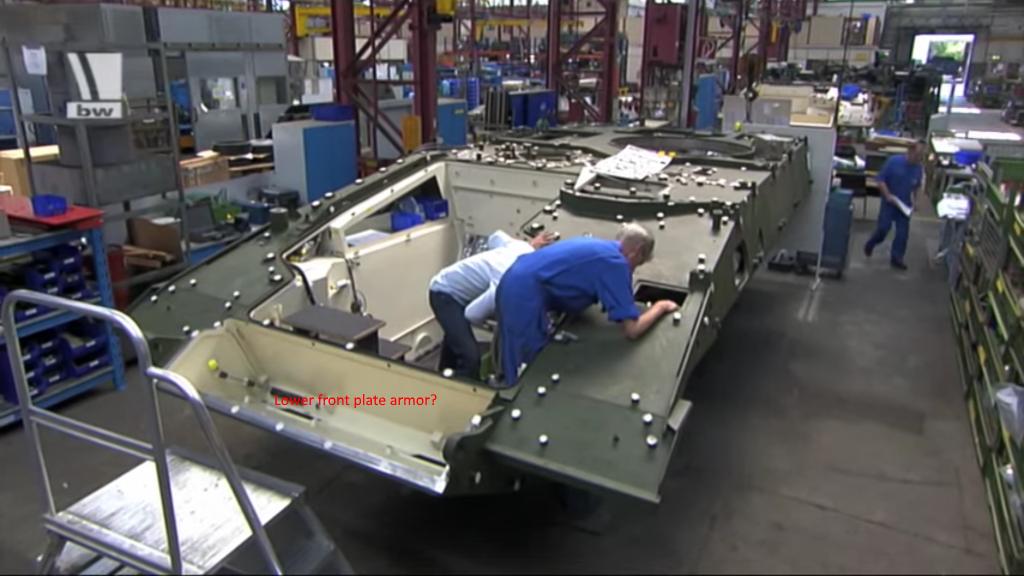
The lower hull compartment houses some components for the drivetrain/transmission/etc., but based on some older CAD graphic, this only covers the uppermost part. It is quite thick and has enough space for advanced armor arrays consisting of multiple NERA panels and ceramic layers.

JZ5OW6r.jpg

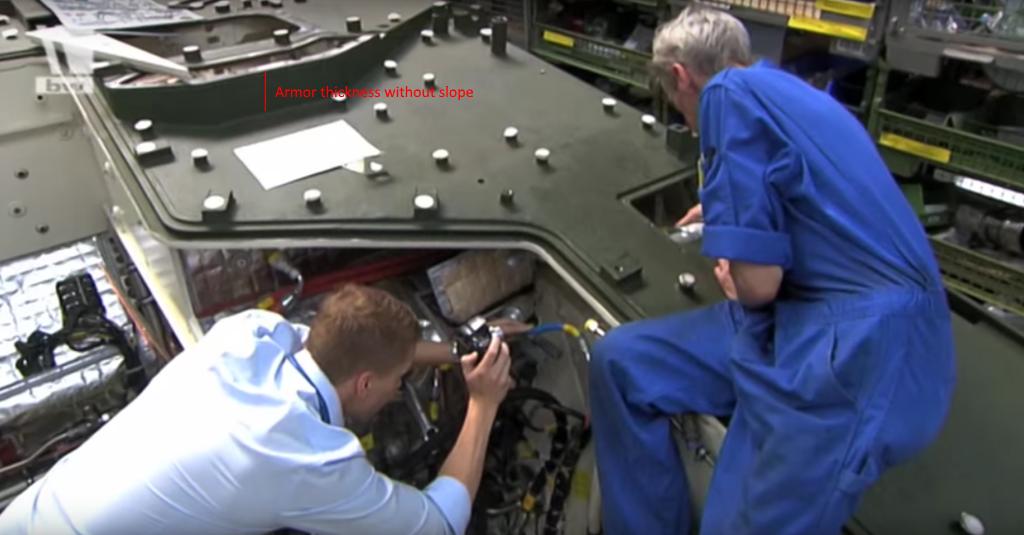
The actual thickness of the Puma frontal hull armor (without slope) can be seen at the photo above. On the completed vehicles, the vision blocks of the driver extrude from the glacis, the steel edge in the photograph is not visible. The Puma's frontal hull is protected against medium calibre ammunition (such as 30 mm APFSDS rounds), explosively formed penetrators (EFPs) aswell as RPGs with shaped charge warheads. Accounting the slope, there should be considerably more than 300 mm of space for armor. Although it should be noted that probably about half of this might be empty space required for the disruptive effect of the NERA to kick in.

8OFXAnq.png

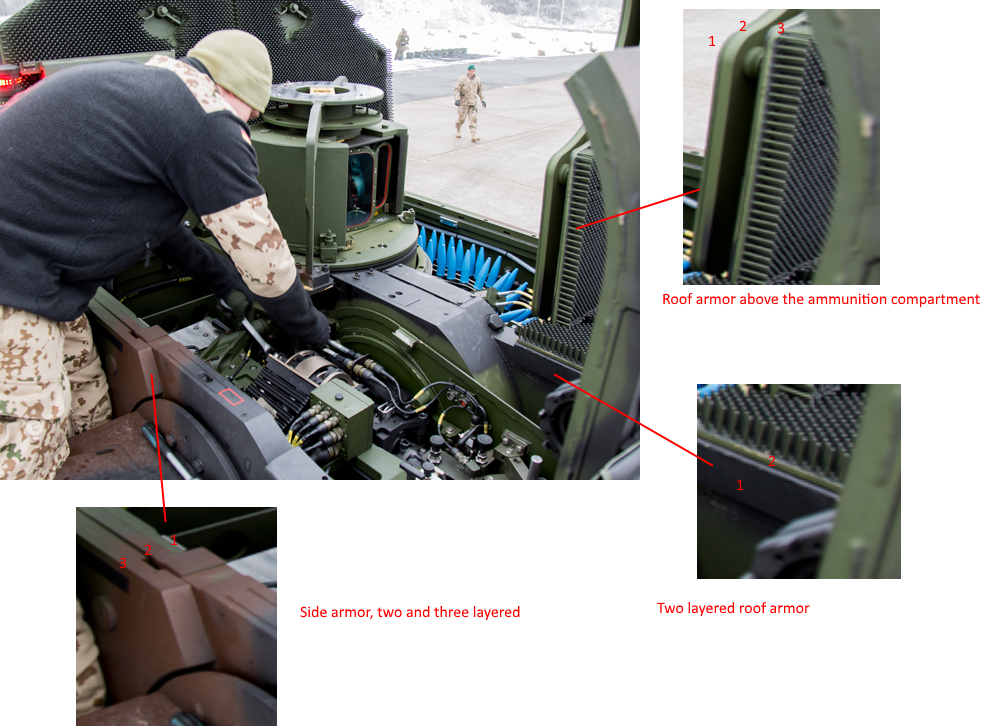
The basic Puma turret provides all-round protection against 14.5 mm AP rounds from heavy-machine guns and anti-materiel rifles. The Puma turret can be fitted with additional armor to provide protection against medium calibre ammunition, larger fragments of artillery rounds and large artillery bomblets with EFP or shaped charge warhead. Except for a smaller curved section behind the gun (which moves when the gun is elevating), the add-on armor for the roof consists of "Igelpanzerung" (hedgehog armor), which utilizes many rubber-spikes to damage the shaped charge warheads of artillery bomblets. Below the bomblets there is additional passive armor on same cases (supposedly ceramic armor), while the hedgehog armor above the ammunition compartment is spaced for some unknown reason. Above the crew positions the roof armor appears to consists of thicker composite plates or two thinner ones. Artillery submunitions with shaped charge warhead can penetrate more than 200 mm of armor steel.
Sketch of the sepculated upper hull armor layout
Most likely the Puma is currently the best protected IFV in active service; depending on exact armor thickness and composition, the T-15 Armata might rival or beat the Puma in terms of protection. The Puma comes with a higher protection level than any infantry fighting vehicle currently in service. For protection against ATGMs the Puma is fitted with the MUSS active protection system, that is being trialed in the United Kingdom for adoption on the Challenger 2 and other combat vehicles. Specifically the protection of the roof section, something often overseen when upgrading older vehicles, is not rivaled by existing vehicles. Still the Puma falls short on the requirements from the original NGP development (which later was cut and modified to the Puma), which called for a modularily reconfigurable vehicle with modular armor package and a weight ranging from 51 to 77 metric tons depending on armor package. The NGP demanded heavier-than-MBT protection for the MBT and IFV variants.

Further upgrades

The Puma still needs to be fitted with the MELLS multi-role missile launching system for the Spike-LR ATGM, but there have been numerous delays with it (beginning with the original missile failing to meet the German requirements for accuracy during the first series of trials, then the launcher had issues and now the budget is used for other things). The TSWA turret-independent secondary-armament still needs to be fitted, but it has been modified in the past year; the original design saw the usage of six 76 mm grenades (lethal and non-lethal) with a relatively short range; the system has been extended by a ring containing about 24 low-velocity and medium-velocity 40 mm grenades with air-burst capability.

2016-05-14_LFS2016_02c_JPW_IMG_9875.jpg

Furthermore there are other upgrade plans. There is a tender for replacing the 5.56 mm MG4 machine gun with a 7.62 mm MG; apparently Heckler & Koch (MG5) and Rheinmetall (with the three-barreled RMG 7.62) are interested in the contract. The Puma also should be fitted with a situational awareness system, probably Rheinmetall's SAS 360 system. Furthermore there are plans for enhancing the computer system, allowing to operate unmanned ground vehicles (UGVs). Shephardmedia wrote in this regard: "The aim is to have operation of UGVs integrated into the vehicles." It is not entirely clear what this means. Will is be possible to convert the Puma to an UGV? Is a modified version of the Puma used to operate multiple UGVs, by using the dismount compartment to house the equipment and seats for several UGV operators? Or will every Puma (while still being a somewhat conventional IFV) be capable of operating one or multiple UGVs? In the latter case one has to wonder who would operate the UGV when the infantry is dismounted: the gunner, commander or driver all have their own tasks to do.


Interestingly the Puma is being offered to Australia for the Phase 3 stage of the LAND 400 program with the upgrade option to the larger and 50% more powerful 35 x 228 mm calibre. It is not known if they would keep the Puma's unmanned turret, but modify it's interior or utilize a completely new turret. Krauss-Maffei Wegmann has developed the IWS-35 remote weapon station using the same optronics as on the Puma IFV, which is fitted with a 35 mm Bushmaster III chain gun and a 0.50 cal heavy machine gun as coaxial armament. The externally-powered Bushmaster III can be upgunned to use 50 mm "SuperShot" ammunition, by replacing the gun barrel and a few other parts. If the optional Puma configuration offered to Australia is using the IWS-35 with the Bushmaster III gun, it would be quite ironical, as the original German requirement for the NGP infantry fighting vehicle called  for a 50 mm calibre gun.