Showing posts with label RUAG. Show all posts

Friday, November 25, 2016

Chile to upgrade Leopard 2 tanks

According to the Mönch Publishing Group, Chile is said to be looking for an upgrade of the Leopard 2A4 main battle tank (MBT) since 2013. Chile is operating the Leopard 2A4 since 2007, after purchasing an initial batch of 128 tanks for less than €1 million a piece - this low price is understood to be the result of political ties and separate contracts for refurbishment. Later the number of tanks has been increased to 140 and then to 172. The MBTs were modified to the Leopard 2A4CHL standard, which has a modified powerpack.

At low air pressure (a result of the high altitude in the Andean mountains) the turbocharger has to make more rotations per minute in an attempt to transport the same amount of air, which will still fail in most cases due to the air being extremely thin. Less air being delivered to the engine will reduce the efficiency of the fuel combustion and increase fuel consumption. As there is less air to transport the heat, several interal engine components and the fuel system will get hotter. The higher temperatures of the fuel system and the higher drive of the turbocharger will reduce the lifetime of said components. This is a common problem with all combustion engines being used at high altitudes.
On the Leopard 2A4CHL the German company MTU has installed a special "high altitude kit", which consists of a number of modified powerpack components to deal with the low air pressure and the higher temperatures. If the temperatures still rises above a certain threshold, the engine will slightly throttle in order to prevent overheating.

The aim of the upgrade is to reach a technological level comparable to the Leopard 2A5. The upgrade should include electric drives for gun and turret, which are less dangerous than the inflammable hydraulic drives and can offer increased performance. The armor protection should be improved by changing the base armor composition or by adding a modular armor package to the tank. It is also meant to receive upgraded optronics and an improved fire control system (FCS). Mönch writes about a program to digitize the vehicle, which most likely means adopting new digital radio units and a battlefield management system (BMS). Last but not least, the upgraded Leopard 2 tanks are mean to feature a remote weapon station (RWS).

The Chilean Army has negoatiated with the three companies KANT, Rheinmetall and RUAG. KANT (Krauss-Maffei Wegmann and Nexter) is a joint-venture of the German company KMW and the partially state-owned French company Nexter Systems. The company is also known as KNDS (KMW + Nexter Defense Systems), the name KANT is understood to have been only a preliminary naming suggestion. KMW is the original manufacturer of most Leopard 2 tanks and was the main contractor for the Leopard 2 program in Germany. Nexter (formerly GIAT) has manufacturered the French Leclerc MBT.

Leopard 2 Revolution
Rheinmetall has won contracts in Indonesia and Poland for the upgrade to the Leopard 2RI and Leopard 2PL configurations respectively. The Leopard 2PL upgrade includes new turret armor, new electric turret and gun drives, an auxiliary power unit (APU) and an improved fire control system, which features new optics and modifications to the gun, allowing the use of high-explosive air-burst ammunition such as the 120 mm DM11 round. The Leopard 2RI includes a better applique armor kit, which also covers the hull, aswell as an air-conditioning system, but lacks further upgrades to the fire control system (except a module to fire air-burst ammunition). Like the Leopard 2PL, it is fitted with electric gun and turret drives however. Rheinmetall is expected to make use of it's modular MBT Revolution upgrade package; a version of the Leopard 2 Revolution mounting all required components for the Leopard 2A4CHL upgrade will probably be offered.
The company was downselected for providing a prototype for the Challenger 2 Lifetime Extension Program (LEP), beating KMW and RUAG among other rival bidders. This might mean that Rheinmetall has an advantage in terms of price or technology compared to the other contenders.

KDNS is in theory capable of using it's complete product range and thus include technology used on the French Leclerc tank; however the production lines for the Leclerc have been retooled and the tank is out of production. Nexter will modernize the French Leclerc tanks to the new Renové standard for assymetric warfare, but it seems rather unlikely that KDNS will react to the Chilean tender in its whole entity. It seems more likely that only Krauss-Maffei Wegmann will propose an upgrade for the Leopard 2, offering system similar to the ones purchased by other nations. The main question is wether KMW will offer a Leopard 2A5 variant or an upgrade kit similar to the Leopard 2A4M? 
Offering an improved Leopard 2A5 (mounting the FLW-200 remote weapon station and a battlefield management system) seems to be a obvious offer to Chile, if the Chilean Army demands an upgrade of the tanks to the Leopard 2A5 level. However the Leopard 2A5 upgrade is a deep modernization, which requires cutting and welding of the original turret and hull structures. This makes the upgrade rather cumbersome and probably also expensive.

Leopard 2A4M CAN
The Canadian Army received a total of twenty Leopard 2A4M tanks. Unlike the Leopard 2A5, the base armor composition of these tanks remains unaltered - instead additional armor modules are installed at the tanks surface. At least Rheinmetall and RUAG claim that their applique armor kits reach a protection level equal or better than the original Leopard 2A5; it seems plausible that KMW can also offer an applique armor kit to boost the Leopard 2A4 protection level to an equal or higher level than provided by the Leopard 2A5's armor.
The Leopard 2A4M itself does not include all features wanted by the Chilean Army, but other KMW-made Leopard 2 variants feature a RWS, a BMS and improved optronics. KMW could simply combine the features from these tanks for an offer to Chile.

The Swiss company RUAG has been rather unsuccesful on the tank market. This might be the result of the company being a smaller player in the armored vehicle market, but might also be affiliated with the offerings of the company. RUAG modernized the Swiss Panzer 87 (Leopard 2A4 tanks) in cooperation with KMW to the new Panzer 87WE standard. While original plans saw the adoption of a mine-protection kit, a modular 360° armor package including anti-bomblet armor at the roof, a battlefield management system, improved optronics, a remote weapon station, an engine muffler, electric gun and turret drives aswell as a rear-drive camera, the final tank included only a fraction of these features due to bugdet constraints. At least one prototype of the Panzer 87WE also included the longer-barreled L/55 gun from Rheinmetall. RUAG also has won a contract for the modernization of Austrian and Belgian Pandur 6x6 wheeled vehicles, but it is not known if there were any other bidders involved. 

RUAG's Leopard 2 MLU
Currently RUAG is offering the Leopard 2 Midlife Upgrade (MLU). This modular upgrade concept appears to be similar to Rheinmetall's MBT Revolution concept. It includes enhanced survivability by using SidePRO-ATR armor and electric drive systems. The tanks internal systems are fully digital and includue a new battlefield management system. The MLU also includes a new commander's sight with integrated thermal imager.

Currently Chile has probably the best equipped land forces in South America, so it is a bit odd to see them pushing for even more upgrades. The neighbouring countries currently have noticably worse tank forces, even when compared to the very basic Leopard 2A4. Argentina only has light tanks and the Tanque Argentino Mediano (Argentinian medium tank; TAM). The TAM is currently in the process of being upgraded, but still lacks a lot of features to be considered superior to the Leopard 2A4 - the 105 mm main gun and the thin armor are in most cases not sufficient. Meanwhile Peru has been searching for a new MBT since a few years, but has yet to make a decision. While several options were considered - including buying the US Abrams tank, the Ukrainian T-84M or second hand Leopard 2 tanks from the Netherlands - the Chinese MBT-2000 (VT-1A) was selected by the Peruvian officials, the order was however canceled shortly after. Currently China is offering the VT-4 (MBT-3000) tank to Peru.

Friday, November 18, 2016

SidePRO-RPG armor

The Swiss company RUAG is offering a wider array of add-on armor types for enhancing the protection of older combat vehicles. It offers three main families of protection products: under the SidePRO brand, armor protection systems for protection the vertical aspects of a vehicle (so the front, sides and rear) are offered, while the RoofPRO brand includes protection systems for the vehicle roof. Lastly the MinePRO brand contains protection solutions for wheeled and tracked vehicles against IEDs, anti-personnel and anti-tank mines.
Aside of SidePRO-KE/IED, which provides ballistic protection against armor-piercing ammunition, explosively formed penetrators (EFPs) and fragments from improvised explosive devices (IEDs), the SidePRO family of products also includes the SidePRO-Lasso anti-RPG net, the SidePRO-ATR armor modules for heavy vehicles and the SidePRO-RPG passive armor. SidePRO-KE/IED requires at least 7 milimetres of steel armor for backing and apparently consists of conventional ceramic armor or (spaced) metal armor depending on application.

The most interesting offer from RUAG's armor protection portfolio seems to be the SidePRO-RPG passive armor system; for all the other armor types there seem to be similar solutions offered by other manufacturers; for example the SidePRO-Lasso armor is nearly identical to AmSafe's Tarian RPG net, while SidePRO-ATR appears to be very similar to the heavy AMAP solution used on the Leopard 2 Evolution and other vehicles.

M113 APC fitted with SidePRO-RPG

The SidePRO-RPG armor modules are less than 250 mm thick; this is broadly comparable to other passive and reactive armor solutions against RPGs. For example the original Chobham armor package developed as upgrade to the Chieftain tank included 204 mm thick side armor modules consisting of spaced steel plates and plastics layers. The SidePRO-RPG armor provides protection against the RPG-7 firing the PG-7V, the PG-7VM or the PG-7VL ammunition. The PG-7VL is the most capable of the mentioned ammunition types, using a 93 mm diameter warhead to penetrate up to 500 mm of armor steel. However it should be noted that all of the RPG-7 rounds mentioned in the SidePRO-RPG marketing material by RUAG use single stage shaped charge warheads, not a single one is using a tandem warhead arrangment. This implies that the SidePRO-RPG armor is not capable of defeating RPGs with tandem shaped charge warheads. Given a thickness of less than 250 mm, the SidePRO-RPG armor reaches a thickness efficiency of up to 2 or more against RPGs with a single shaped charge warhead. This seems to be quite good performance, although not necessarily better than other passive (non-explosive) armor systems against RPGs.

The SidePRO-RPG armor has an areal density of only 45 kilograms per square-metre, which is equivalent to a 5.7 mm thick steel plate! Slat armor (also known as cage armor and bar armor) can be slightly lighter with a weight of only 25 kg/m² when using lightweight aluminium alloys, while flexbile net armor such as SidePRO-Lasso and the Tarian RPG-net can weigh less than 20 kg/m². However the latter two types of armor are known to fail on a regular basis and provide protection against RPGs in only between 50 to 65 percent of all cases. In the other cases the penetration of the RPG is nearly unaffected by the slat/net armor. The SidePRO-RPG armor seems to not suffer from the same issues due to a completely different design.

Defeating a RPG-7 firing a PG-7VL round with 500 mm penetration seems nearly impossible, when the weight of the armor equals to only 5.7 mm steel per metre. Essentially the armor has to provide about 88 times as much protection per weight then armor steel (if one ignores that the base armor might be required to absorb some leftover penetration capabilities of the liner fragments)... this is far beyond the capabilities of most explosive reactive armors (ERA), which usually reaches only about 20 times the protection of an equally heavy steel plate against shaped charges. Slat armor can reach a higher mass efficiency by cutting the fuze wires of a RPG and then crushing the warhead. SidePRO-RPG however is not working in the same manner. So how is this light-weight armor capable of stopping RPGs?


The answer to this question is given in a number of patents from RUAG. Apparently the SidePRO-RPG armor modules consists of an array of metal spikes, which are evenly spaced along the armor module and slightly less than 250 mm long. The distance between the spikes is smaller than the warhead diameter, so that multiple spikes are guaranteed to damage the RPG projectile. There are different options on how the spikes actually work; most likely they prevent the shaped charge jet to properly form, disturbing the metal liner when it collapses after the explosive filler detonates. In tests of similar armor concept against a shaped charge artillery submuntion, which was capable of penetrating 200 mm armor steel, a single thin rubber spike disturbing the jet fromation reduced the penetration to only 3 to 25 milimetres, depending on the spike location. Given that in case of SidePRO-RPG multiple spikes are expected to interfere with the jet fromation, the protection provided by it should be even higher. Armor based on this principle is used on the German Panzerhaubitze 2000 and the Puma IFV to protect the roof against artillery submunitions.
Alternatively the metal spikes might be capable of piercing through the metal liner, before the fuze is triggered. This would lead to a great reduction in penetration capability, a number of hardkill active protection systems rely on piercing the warhead/liner of RPGs (via metal fragments) in order to reduce their penetration performance to a minimum. However given that the metal spike length is limited to 250 mm and the in-built standoff of the PG-7VL at the center section of the warhead is more than that, this seems rather improbable.

Furthermore the armor module contains a crumple shield made of a polymer (i.e. plastic) and is covered by some sort of thin ballistic foil, metal or plastic. An optional layer of perforated armor can be installed inside of the module, which provides protection against heavy machine gun ammunitions or smaller medium calibre rounds, depending on the existing base armor.

RUAG's armor is an interesting concept for upgrading older vehicles, which can only support a limited amout of additional weight, without adopting slat or net armor. The armor has been tested on the M113 armored personnel carrier (APC) and has been showcased on the APC version of the French VBCI 8x8 vehicle. Both these vehicles have rather limited amounts of base armor.

Sunday, August 14, 2016

Challenger 2 upgrade proposals have been submitted

As reported by Jane's IHS, MilTechMag and DefenseNews.com, the offers for the Challenger 2 Life Extension Programme (LEP) have been submitted by the industry to the British Army. The Challenger 2 LEP aims at upgrading the Challenger 2 main battle tank (MBT) to a more modern standard, so that it is competitive in the year 2025 and beyond (currently the CR2 is expected to remain in service until at least 2035). The official name for this project is "Armour (MBT) 2025". Meanwhile Germany and France are developing a next generation tank with a 130 mm tank gun and keep upgrading their existing Leopard 2 and Leclerc MBTs.
Originally a total of seven major American and European defence companies have answered the British request for upgrade proposals for the CR2. However the US-based General Dynamics (the manufacturer of the current M1 Abrams MBT) has decided to join the Team Challenger 2 lead by BAE Systems. BAE Systems acquired Vickers Defence Systems, the manufacturer of the Challenger 2 tank. The British MoD is planning to shortlist two bidders in 2016. On request of one unnamed bidder, the deadline for submitting the proposal has been moved by one month and the program was thus delayed. With the delay, the tender response date was moved the 11th August, after this the two most promising bids will be selected in the next weeks. Two contracts of £19 million (€22 million) are expected to be signed with the favoured bidders by end of October. In total the contract for upgrading of up to 227 CR2 tanks is expected to have a worth of up to £624 million (currently €722 million).

In a different contract the UK Ministry of Defence (MoD) has decided to let QinetiQ evaluate the German MUSS softkill active protection system (APS) for integration into the Challenger 2 tank and other British fighting vehicles. A decision to adopt a softkill APS on the Challenger 2 is scheduled for April 2018.


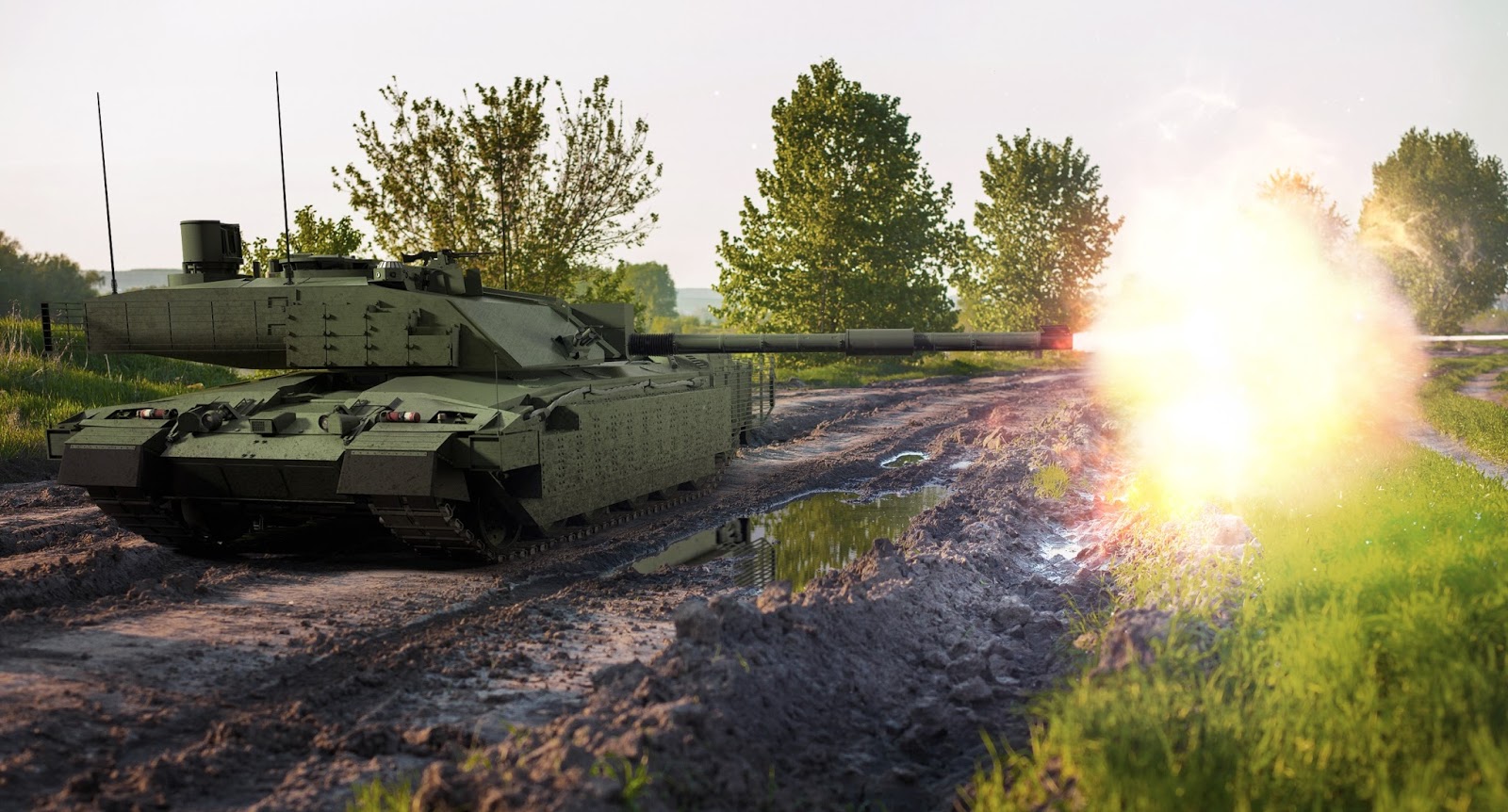
The German company Rheinmetall has made a few aspects of their initial upgrade proposal known in a press release. The company suggest not only replacing outdated components, but also enhance the tank's capabilities further. Upgrades to mobility and protection are further options. Rheinmetall has partnered with the British companies Supacat, Thales UK and BMT.

Seoss sight of the MBT Advanced Technology Demonstrator
The press release included a rendering of an upgraded Challenger 2 tank. The commander's main sight has been replaced by the Seoss stabilized electro-optical sighting system from Rheinmetall. This stabilized optronics include a dual-axis stabilized sensor head with a third generation SAPHIR thermal imager, a laser-rangefinder and a high resolution CCD camera. It is also fitted with an integrated fire control system. The Seoss sight enables a high accuracy even when the tank is moving against static and moving targets. The same sight system has been used on the MBT Revolution/Advanced Technology Demonstrator and on the Boxer CRV. It can be fitted with the Main Sensor Slaved Armament (MSSA) remote weapon station.
It is not clear if the gunner's primary sight has also been replaced with a version of the Seoss sight or the original Gunner's Primary Sight (GPS) from Pilkington Optronics (nowadays part of Thales UK) has been kept. The rendering still shows a distinctive box ontop of the gun mantlet, which used to house the Thermal Observation and Gunnery Sight 2 (TOGS-2) on the original Challenger 2. This might imply that the TOGS-2 thermal sight was kept or upgraded, instead of being replaced by a single sight unit with integrated thermal imager. The rendering however does not show a flap in the armored box; it is not known wether this is result of the 3D model being poor or the TOGS-2 was actually replaced. 

A SAS module below a ROSY smoke grenade discharger
One single unit of Rheinmetall's Situational Awareness System (SAS) can be seen ontop of the turret. Most likely there are two or more SAS units, enough to provide a full 360° sensor coverage. Each unit contains three high definition sights (either day sight CCD cameras or uncooled thermal imagers), each set at 45° angle apart of eachother. Two SAS modules are required to provide a full 360° coverage of the surroundings either at day or night, four for a 360° sensor coverage with cameras and thermal imagers at the same time. The system is designed for easy integration in existing system thanks to an open architecture. It also features an automated warning system, which can be triggered by moving objects when enabled. Optional features of the SAS include automated mission recording, tracking and tracing, a sniper warning system (not installed in the rendering), laser warners (apparently installed) and the integration of SAS into existing fire control and battlefield management systems.  
Rheinmetall also offers the replacement of the outdated rifled Royal Ordnance L30 gun with it's current L/55 smoothbore gun with enhanced armor penetration. This gun would also enable the tank to fire programmable ammunition. 

Elbit Systems' COAPS commander's sight
Lockheed Martin UK has partnered with the Israeli company Elbit Systems for the Challenger 2 LEP. According to DefenseNews, this partnership was established just 24 hours before the deadline for the industry proposals. This is probably the result of Lockheed Martin's partner for upgrading the Warrior MICV, Thales UK, partnering with Rheinmetall. Given that Lockheed Martin's own technological portfolio, as previously noted, is the smallest of all bidding companies, they were forced to find a new partner.
Most likely the proposal from LM and Elbit will include the replacement of the sights with new models made by Elbit Systems. Most likely the commander's sight will be replaced by the Commander Open Architecture Panoramic Sight (COAPS) sight used on the Sentinel II and the TAM upgrade. This dual-axis stabilized sight includes a day sight CCD camera, a laser rangefinder and a latest generation thermal imager. The Pilkington Optronics Gunner's Primary Sight might be replaced with a similar device from Elbit Systems, possibly incorporating a thermal imager and thus allowing the removal of the gun-mounted TOGS-2 sight. Possible upgrade options include the Knight FCS (Elbit's FCS developed for the Merkava tanks) aswell as the Thermal Imaging Fire Control System (TIFCS), which Elbit developed as an upgrade option for existing vehicles.
Laser warning system from Elbit
Given that the last two international land vehicle projects from Elbit Systems included the adoption of a laser warning system, the Challenger 2 LEP proposal from Lockheed Martin UK and Elbit might aswell include the adoption of this system.

Earlier already CMI Defence announced their cooperation with the British company Ricardo UK. While CMI has experience with the manufacturing and upgrading of turret systems, Ricardo is one of the leading British companies in automotive and systems engineering. It is understood that this results in a separation of tasks: CMI Defence is responsible for upgrading the turret, while the hull is being upgraded by Ricardo UK. The latter company has been working with the Defence Science and Technology Laboratory (DSTL) of the British Ministry of Defence on optimizing the drive- and powertrain of the Challenger 2 as part of obsolecence management studies. Ricardo has developed a tool set for accessing the effectiveness and costs of upgrades.
Not much details about CMI Defence's and Ricardo's proposal are known. It might include the adoption of the RUAG-designed Compact Tank Gun (CTG), for which CMI Defence has acquired a licence; however exact details on this licence are unkown and RUAG may be the only company offering said gun for the CR2 upgrade. CMI press releases for earlier products speak of a 120 mm smoothbore Cockerill high-pressure gun; if this is the name for the licence-made CTG or refering to another product has to be clarified.
Most likely the two companies will suggest replacing the sights and electronics, while also adding a new APU or upgrading the powerpack or drivetrain of the tank. CMI Defence has used optronics from different companies for their medium and large calibre turrets, but some of their latest products utilize sights from French manufacturer Safran. However Safran is cooperating with BAE Systems.


General Dynamics and BAE Systems have formed Team Challenger 2, while RUAG announced to cooperate with a group of UK-based industrial partners. The German company Krauss-Maffei Wegmann (KMW), the Leopard 2 manufacturer, has released no details of their upgrade proposal to the public yet, but it appears likely that KMW will rely on optronics supplied by Airbus Defence and Space (formerly Cassidian), which were also used on the current iterations of the Leopard 2 MBT and the Puma infantry fighting vehicle (IFV).

Pound Sterling loosing worth, image by Stratfor
Given the BREXIT, there still should be a big question mark wether the Challenger 2 Life Extension Programme will be futile. The negative impact on the UK economy is currently undeniable, despite the actual BREXIT still being a problem for the future. The British Army is already running other expensive modernization programs such as the procurement of the Scout SV (including the turreted AJAX variant), which is heavily relying on technology and components supplied by EU-based companies, and is also looking to acquire an 8x8 wheeled mechanized infantry vehicle (MIV). Pretty much all candidates rumored for the MIV are European products, which will be more likely affected by the BREXIT than other military procurements.

Saturday, January 30, 2016

CR2 upgrade contenders

According to Jane's IHS, several contenders are in the run for the Challenger 2 LEP upgrade contract.

The contenders that send bids to the UK Defence Equipment and Support (DE&S) are:
  • BAE Systems Combat Vehicles
  • General Dynamics Land Systems UK
  • Lockheed Martin UK
  • Krauss-Maffei Wegmann
  • Rheinmetall
  • CMI Defence
  • RUAG Defence
The Challenger 2 life extension programme (LEP) was announced some time after the reveal of the T-14 Armata tank in Russia during the Moscow Victory Day Parade 2015. At first the UK MoD also considered buying a completely new main battle tank (MBT) as replacement of the Challenger 2. In particular the lethality and the effectivity of the L30A1 tank gun has been questioned.
Unlike other tanks such as the M1 Abrams and the Leopard 2 MBTs, the Challenger 2 has not seen any major upgrades since it's introduction into British Army service in the 1990s. The British Army already investigated the replacement of the rifled L30 gun with a German Rh 120 L/55 smoothbore gun during the Challenger 2 lethality improvment programme (CLIP) beginning in 2001, but this project was terminated due to too high costs. The German gun together with the superior tungsten ammunition proved to be more effective during the British trials.
The follow-up to CLIP was the Challenger 2 capability sustainment programme (C2 CSP), which incorporated most parts of the CLIP and some new upgrade ideas. However the C2 CSP also ended up being too expensive and was thus terminated in 2008.
The Challenger 2 LEP was announced in July 2013 and started one year later. The reveal of the T-14 Armata however triggered however the UK's interest in owning a tank strong enough to cope with the T-14.

The Challenger 2E is the most advanced version of the CR2 to be developed by Vickers/BAE yet.
The list of contenders is rather interesting. BAE as owner of Vickers has the in-house advantage, but has not gathered any experience in modern tank design/building since the Challenger 2. Even worse BAE had to rely on the purchased Hägglunds for any sort of the success on the AFV export market in the recent history. In theory BAE might fall back to the old Vickers Challenger 2E tank designed for export, which failed to perform equally well as the Leopard 2, Leclerc and M1 Abrams in the Greek trials in the early-2000s. The Challenger 2E offers a number of considerable upgrades over the current CR2: a EuroPowerPack (MTU MT883 engine together with Renk HSWL 295TM transmission) and a new, superior fire control system with the SAGEM MVS 580 periscope and SAGEM SAVAN 15 gunner's sight. However BAE announced in 2005 that the development of the CR2E was stopped following lack of success on the export market.

General Dynamics is having the Abrams as up-to-date modernized MBT. While the upgrades might not be as deep as the ones offered by other companies on the market, this seems to be largely related to the lack of funding from the US and the low interest in upgrading foreign M1 Abrams tanks (due to the fact that most Abrams user's like Egypt, Iraq and Australia do not have the money for any tank upgrades).
For the Scout-SV programme General Dynamics European Land Systems however had to rely quite a bit on other companies from this list: the turret for the Ajax is based on Rheinmetall's Lance Modular Turret System and at least partly manufactured in Germany, whereas Lockheed Martin UK has developed the fire control and reconnaissance systems for the Ajax.

The upgraded Warrior using Rheinmetall's turret design as base is the best reference that LM can offer.
Lockheed Martin plays a major in the Warrior capability sustainment programme (WCSP) and in the Ajax variant of the Scout-SV, but lacks any own vehicle designs. Instead LM mostly upgrades electronics and other sub-components of AFVs mostly. For the Scout-SV and the WCSP Lockheed Martin relied on turret technology supplied by Rheinmetall and technology/components supplied by other sub-contractors.

Krauss-Maffei Wegmann (KMW) is currently the world market leader when it comes to tanks and thus should be considered a very safe bet. While on pure numbers the M1 Abrams and the T-90 have sold more units, this is often the case by allowing the local assembly of cheap, downgraded and subsidized versions (such as the M1A1 tanks for Egypt or Iraq and the T-90S tanks for India). KMW has shown the willingness to create local versions of the Leopard 2 and to allow local assembly. They also have shown intention to upgrade designs made by other companies (such as their bid to upgrade the Brazilian M113s). During the 1980s and early 1990s KMW developed a special tank based on the Leopard 2 tank for the Spanish Army. KMW could just as well "leopardize" the Challenger 2 by fitting the Challenger 2 with as many proven sub-system of  the Leopard 2 as possible.

Rheinmetall has seen increased success on the tank market, after starting to compete against KMW for Leopard 2 upgrades in 2010. They just recently managed to win a contract for the modernization of the Polish Leopard 2A4 tanks to a new Leopard 2PL standard. Rheinmetall has a wider variety of subsidaries and can probably, unlike pretty much any other contender, provide most technologies and components by themselves, without the need to hire a subcontractor.
With the MBT Revolution upgrade, Rheinmetall does already offer a modular upgrade which in theory is designed to fit (with some adaption) to any tank. So maybe we can see some type of Challenger 2 Revolution?
Leopard 2 Revolution prototype - will the CR2 soon look similar to this?

CMI Defence is probably the least expected candidate for the Challenger 2 LEP tender. It never has produced or designed a complete AFV or even a major AFV upgrade. Instead CMI Defence is specialized on light-weight medium/large caliber guns (such as the series of Cockerill 90 mm guns or the Cockerill CV 105 gun) and making ammunition for these. However in the past years CMI has extended it's portfolio into the market of turrets and weapon stations.

CMI's biggest turret on a CV90
RUAG Defence of Switzerland has experience with the modernization of medium and heavy combat vehicles for the Swiss Army and several other export costumers. The Panzer 87WE upgrade for the Swiss Army was developed in cooperation with KMW, previously RUAG also upgraded the Swiss fleet of M109 howitzer. Other tank modernizations from RUAG include upgrades for the older Panzer 68 and cooperation with Jordan on the M60 Phoenix MBT prototype. In 2015 RUAG has managed to win a contract for upgrading Austrian and Belgian Pandur APCs.

Currently RUAG is offering a Leopard 2A4 upgrade - does it work for CR2 aswell?
In general it is unkown how the UK MoD wants the CR2 to be upgraded. It is understood that the scope of the upgrade is rather limited, as the budget is very tight. Replacing the gun is expensive, because the interior of the Challenger 2 MBT is not configured for storing long 120 mm unitary rounds. In case of the CR2 fitted with the German L/55 gun as prototype during the CLIP, there was only proper stowage space for a total of 6 rounds (!) of main gun ammunition.

This 6 round compartment stores all the ammunition of the CLIP prototype...

In theory only Rheinmetall and RUAG/CMI can offer a main gun replacement with their own technology. Rheinmetall has developed the Rh 120 L/44 and L/55 guns of the Leopard 2 MBT, aswell as a 105 mm smoothbore gun and the 120 mm L/47 LLR (lightweight, low-recoil) gun.
RUAG has developed the 120 mm CTG (compact tank gun), which was designed with reduced recoil as a low-cost/low-modifcation upgrade option for various existing tanks. Jordan has tested this gun on a Challenger 1 tank, the M60 Phoenix upgrade prototype and on the Falcon-2 turret system, BAE used this gun for the CV-90/120 light tank and the Swiss Army trialed it on their Panzer 68 upgrade.
Depending on required maximum recoil and muzzle break, the CTG has a length of 47 to 51 calibres.
Will CMI or RUAG offer the CTG to the UK?
However it is unclear wether RUAG or CMI could offer this gun to the British Army (even if they could afford major modifcations to the CR2 interior) - CMI has bought at least some rights of marketing the CTG to at least some markets. Maybe CMI bought the full rights, or RUAG and CMI agreed on both having full rights for this design. 

Another interesting concept, that however might as well be too expensive for the British Army, just as fitting a smoothbore, is the idea of mounting a new turret on a Challenger 2 hull. The turrets of the M1 Abrams and of the Leopard 2 can fit onto the turret ring of a Challemger 2 hull, but require some deeper modifications, which again could be too expensive for the British military. The M1 Abrams turret does not include most of the gun and turret drives, which are located in the tank's hull and are also hydraulic in the M1 Abrams. This is an important difference to the CR2 turret, which includes electric gun and turret drives. US trials have also revealed that upgunning the M1 Abrams with the longer L/55 gun of the Leopard 2A6 requires deeper modifications, which is why it was judged as being to expensive for the US Army. The big advantage of a M1 Abrams turret would be the rather large ammunition load of 34 or 36 rounds (depending on which racks are installed).
The Leopard 2 turret has electrical drives housed in the turret, so that it would be easier to integrate onto a CR2 hull - however the Leopard 2 stores only 15 round main gun ammunition in the turret buslte, so that the CR2 hull would require modifications for storing further ammo.
CMI is specialized on guns and turrets, so they could offer a version of their Cockerill XC-8 105-120HP turret fitted with a 120 mm smoothbore gun, if the turret rings are compatible. Problematic is in this case the different level of protection (CMI's turret is lacking thick composite armor) and the fact that the British Army might not like being forced to utilize an autoloader.

According to Jane's IHS only two contenders will be shortlisted. I'd bet that this will be BAE and either General Dynamics or Lockheed Martin - simply because they have the best position in British politics and they have manufacturing facilities in the UK. The UK government was willing to increase the price tag for their Scout-SV programme by several millions, just to move the manufacturing site from Spain to Wales.
In terms of technology, I'd choose Rheinmetall, General Dynamics or KMW however. Unlike BAE these companies have state-of-the-art products available and do not make most of their living from old 1980s designs such as the Warrior or Bradley. Compared to CMI and Lockheed Martin, all of these companies do have manufacturing capabilities for deeper modifications and upgrades. RUAG is probably comparable, but lacks a wider portfolio and as many successfull contracts as Rheinmetall/KMW/GD.

Probably the Challenger 2 LEP will end up being only a minor improvment due to budget cuts. Some new ammunition maybe, an improved fire control system, a new APU and maybe some other digital stuff.