Wednesday, February 10, 2016

M829A3 APFSDS penetration power - common internet estimation failures?

The M829A3 is currently the latest type of APFSDS ammo in service with the United States armed forces. It replaced the M829A2 in 2003.
In the next year(s) the M829A4 will take over the place of the M829A3. It is already confirmed to have the same exterior dimension and general characterisitics as the M829A3, but utilize an improved penetrator designed to penetrate even newer types of ERA ("3rd Generation Explosive Reactive Armor").
The M829A3 APFSDS of the US Army
In order to estimate the penetration power of APFSDS different mathematical fomulas can be used, such as the formula developed by Lanz and Odermatt for the Swiss military procurment agency. This formula has gained most acception in also mentioned in different documents of the US Army Research Laboratoy. It is an empiric forumla, which means it's a mathmatical interpolation of actual tests results in dependence of the changed parameters (density, length, diameter, etc.).

The M829E4 is confirmed to have the same dimensions as the M829A3
On different forums such as Tank-Net, the WoT forums and for different software, such as the Steelbeasts simulator/game from eSim Games, people have tried to calculate/estimate the penetration power of the M829A3 APFSDS based on measurements on photographs and available data from the manufacturer's website.
However most of these people are assuming a penetrator length of 780 mm to sometimes even above 800 mm! This is solely based on the increased length of the in-flight projecitle and the assumption that the M829A3 uses a "stepped" tip assembly like the M829A2 APFSDS. This way, the estimated penetration of the M829A3 APFSDS from the 44-calibre long M256 gun against rolled homogenous steel (RHS) reaches or even exceeds the penetration of other types of ammunition fired from the longer Rheinmetall L/55 gun. Penetration values above 750 mm into RHS after 2 kilometres are commonly estimated for the M829A3.
Does the M829A3 possibly look like this?

However patents from Alliant Techsystems (ATK) show us a different possibility of the M829A3 design: instead of utilizing an elongated DU penetrator with conventional tip to defeat tanks fitted with heavy ERA by "brute force", it is suggested to use a special tip assembly to overcome ERA. The tip is a solid steel construction with a length "greater than 100 mm", while the main penetrator has a length of "about 630 mm, preferably greater than about 650 mm, and more preferably greater than about 670 mm". Specifically the last value is interesting, because this is very close to the reported length of the penetrators used in the previous M829A1 and M829A2 APFSDS rounds. Furthermore the thickness of the rod was increased from 22 to 25 mm, which result in a 67% higher bending stiffness (and thus better performance against ERA).
Such a penetrator design has a big benefit against targets protected by heavy ERA, which is what the main target of the M829A3 development was. The solid steel tip will punch a hole into the ERA, but is designed with a special weakpoint at the connection to the main penetrator; it will break of instead of transfering the stress created by the interaction with the ERA-plates onto the main penetrator. While the M829A1 was unable to defeat the contemporary Soviet tanks with Kontakt-5 heavy ERA, the M829A2 was designed as "brute force" solution against Kontakt-5 armed Soviet tanks. The M829A3 was the "elegant way" to defeat better armored tanks with Kontakt-5 or the follow-up ERA.

There are further reasons to assume that the M829A3 APFSDS follows the above mentioned design:
Unlike it's three direct predecessors, no M829A3 cut-through model has ever been displayed, while cut-through models of the earlier APFSDS types were presented while they were the latest stuff the US Army had. 
Furthermore there is the weight growth of the M829A3 compared to the M829A2. While the sabot material was changed - an improved compostion reduced the density - the overall sabot weight of the M829A3 is understood to be higher to due the much longer sabot petals. Values from the US laboratories responsible for developing/manufacturing (composite) sabots for the M829 series show that the sabot weight of the M829A3 should be 3 kilograms and that of the M829A2 should be about 2.4 kg. A 780 milimetre long DU rod with 25 mm diameter will already weigh 7.08 kg and thus be a contradiction to the 10.0 kg weight for the complete projectile assembly from ATK's brochures. A rod with a length of about 680 mm and a 25 mm diameter made from DU  however will weigh about 6.18 kg and thus leave about 0.6 kg for tracer, fin assembly and the 100 mm steel tip. Given that a 100 mm steel rod with 25 mm diameter weighs about 400 grams, assuming that the M829A3 uses a 680 mm DU rod with 100 mm steel tip seems to be very reasonable based on the weight.

The US Army had no problems showcasing a cut-through M829A2
What impact does this have on the penetration estimates mentioned earlier? According to the patents from ATK, such a design increases the penetration into RHS protected by an unkown type of heavy ERA by 20 to 30% compared to the same penetrator without solid steel tip. Against normal RHS not protected by any form of ERA however the penetration increased only by 5 to 10%, which is to be expected due to the steel tip also prodividing penetration.
The M829A3 might as well be optimized for fighting tanks with heavy ERA such as the main tanks of all potential enemies of the US/NATO - China, Russia, North Korea all utilize heavy ERA on their latest tanks. So instead of having some mind-boggling penetration (for an APFSDS fired with the short L/44 barrel) against all types of armor, the penetration against RHS/composite armor might be as low as ~660 to 700 mm; enough to defeat the main armor of tanks like the T-80U, T-90 and Type 99.
Penetration of APFSDS with steel tip vs conventional tip

Saturday, February 6, 2016

Germany and the Netherlands increase military cooperation

On the 4th of February, Germany and the Netherlands announced a closer cooperation of their militaries. This process was already reported earlier in late 2015.

German and Dutch Defence Ministers signing a letter of intent

About 3000 Dutch soldiers from the 43rd Mechanized Brigade of the Royal Netherlands Army will be integrated into the 1st German tank division, together with the last 16 Leopard 2 tanks from Dutch stocks. 2 further Leopard 2 tanks will be rented/bought by the Netherlands to get to the 18 tanks required for a tank company. All of these tanks are understood to be upgraded in near future to the latest Leopard 2A7 configuration.

The Leopard 2A7 tank entered service in late 2014
On the other side a 400 men strong mixed brigade will be put under Dutch command. This will include a German tank battalion to be stationed at Loheide/Bergen in Lower Saxony, Germany.

The closer cooperation of the German and Dutch land forces already started in 2014, when the 11 Luchtmobiele Brigade (11th air-mobile brigade) was integrated into the structure of the German Division Schnelle Kräfte.

Regarding naval forces, both the German and Dutch government have agreed upon a letter of intent, which includes plans of the German Navy being allowed to utilize the Dutch Karel Doorman support ship, while the German naval battalion will be integrated into the structure of the Dutch marine corps, but not be relocated to the Netherlands.

The Karel Doorman support ship
 Such European cooperation can be beneficial for all partner: Germany will probably not buy new support ships, despite originally planning to order two new ones; the Dutch Navy on the other hand had troubles affording the Karel Doorman, so German money will help out a lot.
Without the integration of the Dutch tanks into the German Army, the Netherlands would lack two tanks for having a whole company and the support structure related to using MBTs after retiring all Leopard 2 tanks a few years ago. On the other hand Germany has only enough tanks and soldiers to create the new 414th tank battalion thanks to the Dutch tanks.

Saturday, January 30, 2016

CR2 upgrade contenders

According to Jane's IHS, several contenders are in the run for the Challenger 2 LEP upgrade contract.

The contenders that send bids to the UK Defence Equipment and Support (DE&S) are:
  • BAE Systems Combat Vehicles
  • General Dynamics Land Systems UK
  • Lockheed Martin UK
  • Krauss-Maffei Wegmann
  • Rheinmetall
  • CMI Defence
  • RUAG Defence
The Challenger 2 life extension programme (LEP) was announced some time after the reveal of the T-14 Armata tank in Russia during the Moscow Victory Day Parade 2015. At first the UK MoD also considered buying a completely new main battle tank (MBT) as replacement of the Challenger 2. In particular the lethality and the effectivity of the L30A1 tank gun has been questioned.
Unlike other tanks such as the M1 Abrams and the Leopard 2 MBTs, the Challenger 2 has not seen any major upgrades since it's introduction into British Army service in the 1990s. The British Army already investigated the replacement of the rifled L30 gun with a German Rh 120 L/55 smoothbore gun during the Challenger 2 lethality improvment programme (CLIP) beginning in 2001, but this project was terminated due to too high costs. The German gun together with the superior tungsten ammunition proved to be more effective during the British trials.
The follow-up to CLIP was the Challenger 2 capability sustainment programme (C2 CSP), which incorporated most parts of the CLIP and some new upgrade ideas. However the C2 CSP also ended up being too expensive and was thus terminated in 2008.
The Challenger 2 LEP was announced in July 2013 and started one year later. The reveal of the T-14 Armata however triggered however the UK's interest in owning a tank strong enough to cope with the T-14.

The Challenger 2E is the most advanced version of the CR2 to be developed by Vickers/BAE yet.
The list of contenders is rather interesting. BAE as owner of Vickers has the in-house advantage, but has not gathered any experience in modern tank design/building since the Challenger 2. Even worse BAE had to rely on the purchased Hägglunds for any sort of the success on the AFV export market in the recent history. In theory BAE might fall back to the old Vickers Challenger 2E tank designed for export, which failed to perform equally well as the Leopard 2, Leclerc and M1 Abrams in the Greek trials in the early-2000s. The Challenger 2E offers a number of considerable upgrades over the current CR2: a EuroPowerPack (MTU MT883 engine together with Renk HSWL 295TM transmission) and a new, superior fire control system with the SAGEM MVS 580 periscope and SAGEM SAVAN 15 gunner's sight. However BAE announced in 2005 that the development of the CR2E was stopped following lack of success on the export market.

General Dynamics is having the Abrams as up-to-date modernized MBT. While the upgrades might not be as deep as the ones offered by other companies on the market, this seems to be largely related to the lack of funding from the US and the low interest in upgrading foreign M1 Abrams tanks (due to the fact that most Abrams user's like Egypt, Iraq and Australia do not have the money for any tank upgrades).
For the Scout-SV programme General Dynamics European Land Systems however had to rely quite a bit on other companies from this list: the turret for the Ajax is based on Rheinmetall's Lance Modular Turret System and at least partly manufactured in Germany, whereas Lockheed Martin UK has developed the fire control and reconnaissance systems for the Ajax.

The upgraded Warrior using Rheinmetall's turret design as base is the best reference that LM can offer.
Lockheed Martin plays a major in the Warrior capability sustainment programme (WCSP) and in the Ajax variant of the Scout-SV, but lacks any own vehicle designs. Instead LM mostly upgrades electronics and other sub-components of AFVs mostly. For the Scout-SV and the WCSP Lockheed Martin relied on turret technology supplied by Rheinmetall and technology/components supplied by other sub-contractors.

Krauss-Maffei Wegmann (KMW) is currently the world market leader when it comes to tanks and thus should be considered a very safe bet. While on pure numbers the M1 Abrams and the T-90 have sold more units, this is often the case by allowing the local assembly of cheap, downgraded and subsidized versions (such as the M1A1 tanks for Egypt or Iraq and the T-90S tanks for India). KMW has shown the willingness to create local versions of the Leopard 2 and to allow local assembly. They also have shown intention to upgrade designs made by other companies (such as their bid to upgrade the Brazilian M113s). During the 1980s and early 1990s KMW developed a special tank based on the Leopard 2 tank for the Spanish Army. KMW could just as well "leopardize" the Challenger 2 by fitting the Challenger 2 with as many proven sub-system of  the Leopard 2 as possible.

Rheinmetall has seen increased success on the tank market, after starting to compete against KMW for Leopard 2 upgrades in 2010. They just recently managed to win a contract for the modernization of the Polish Leopard 2A4 tanks to a new Leopard 2PL standard. Rheinmetall has a wider variety of subsidaries and can probably, unlike pretty much any other contender, provide most technologies and components by themselves, without the need to hire a subcontractor.
With the MBT Revolution upgrade, Rheinmetall does already offer a modular upgrade which in theory is designed to fit (with some adaption) to any tank. So maybe we can see some type of Challenger 2 Revolution?
Leopard 2 Revolution prototype - will the CR2 soon look similar to this?

CMI Defence is probably the least expected candidate for the Challenger 2 LEP tender. It never has produced or designed a complete AFV or even a major AFV upgrade. Instead CMI Defence is specialized on light-weight medium/large caliber guns (such as the series of Cockerill 90 mm guns or the Cockerill CV 105 gun) and making ammunition for these. However in the past years CMI has extended it's portfolio into the market of turrets and weapon stations.

CMI's biggest turret on a CV90
RUAG Defence of Switzerland has experience with the modernization of medium and heavy combat vehicles for the Swiss Army and several other export costumers. The Panzer 87WE upgrade for the Swiss Army was developed in cooperation with KMW, previously RUAG also upgraded the Swiss fleet of M109 howitzer. Other tank modernizations from RUAG include upgrades for the older Panzer 68 and cooperation with Jordan on the M60 Phoenix MBT prototype. In 2015 RUAG has managed to win a contract for upgrading Austrian and Belgian Pandur APCs.

Currently RUAG is offering a Leopard 2A4 upgrade - does it work for CR2 aswell?
In general it is unkown how the UK MoD wants the CR2 to be upgraded. It is understood that the scope of the upgrade is rather limited, as the budget is very tight. Replacing the gun is expensive, because the interior of the Challenger 2 MBT is not configured for storing long 120 mm unitary rounds. In case of the CR2 fitted with the German L/55 gun as prototype during the CLIP, there was only proper stowage space for a total of 6 rounds (!) of main gun ammunition.

This 6 round compartment stores all the ammunition of the CLIP prototype...

In theory only Rheinmetall and RUAG/CMI can offer a main gun replacement with their own technology. Rheinmetall has developed the Rh 120 L/44 and L/55 guns of the Leopard 2 MBT, aswell as a 105 mm smoothbore gun and the 120 mm L/47 LLR (lightweight, low-recoil) gun.
RUAG has developed the 120 mm CTG (compact tank gun), which was designed with reduced recoil as a low-cost/low-modifcation upgrade option for various existing tanks. Jordan has tested this gun on a Challenger 1 tank, the M60 Phoenix upgrade prototype and on the Falcon-2 turret system, BAE used this gun for the CV-90/120 light tank and the Swiss Army trialed it on their Panzer 68 upgrade.
Depending on required maximum recoil and muzzle break, the CTG has a length of 47 to 51 calibres.
Will CMI or RUAG offer the CTG to the UK?
However it is unclear wether RUAG or CMI could offer this gun to the British Army (even if they could afford major modifcations to the CR2 interior) - CMI has bought at least some rights of marketing the CTG to at least some markets. Maybe CMI bought the full rights, or RUAG and CMI agreed on both having full rights for this design. 

Another interesting concept, that however might as well be too expensive for the British Army, just as fitting a smoothbore, is the idea of mounting a new turret on a Challenger 2 hull. The turrets of the M1 Abrams and of the Leopard 2 can fit onto the turret ring of a Challemger 2 hull, but require some deeper modifications, which again could be too expensive for the British military. The M1 Abrams turret does not include most of the gun and turret drives, which are located in the tank's hull and are also hydraulic in the M1 Abrams. This is an important difference to the CR2 turret, which includes electric gun and turret drives. US trials have also revealed that upgunning the M1 Abrams with the longer L/55 gun of the Leopard 2A6 requires deeper modifications, which is why it was judged as being to expensive for the US Army. The big advantage of a M1 Abrams turret would be the rather large ammunition load of 34 or 36 rounds (depending on which racks are installed).
The Leopard 2 turret has electrical drives housed in the turret, so that it would be easier to integrate onto a CR2 hull - however the Leopard 2 stores only 15 round main gun ammunition in the turret buslte, so that the CR2 hull would require modifications for storing further ammo.
CMI is specialized on guns and turrets, so they could offer a version of their Cockerill XC-8 105-120HP turret fitted with a 120 mm smoothbore gun, if the turret rings are compatible. Problematic is in this case the different level of protection (CMI's turret is lacking thick composite armor) and the fact that the British Army might not like being forced to utilize an autoloader.

According to Jane's IHS only two contenders will be shortlisted. I'd bet that this will be BAE and either General Dynamics or Lockheed Martin - simply because they have the best position in British politics and they have manufacturing facilities in the UK. The UK government was willing to increase the price tag for their Scout-SV programme by several millions, just to move the manufacturing site from Spain to Wales.
In terms of technology, I'd choose Rheinmetall, General Dynamics or KMW however. Unlike BAE these companies have state-of-the-art products available and do not make most of their living from old 1980s designs such as the Warrior or Bradley. Compared to CMI and Lockheed Martin, all of these companies do have manufacturing capabilities for deeper modifications and upgrades. RUAG is probably comparable, but lacks a wider portfolio and as many successfull contracts as Rheinmetall/KMW/GD.

Probably the Challenger 2 LEP will end up being only a minor improvment due to budget cuts. Some new ammunition maybe, an improved fire control system, a new APU and maybe some other digital stuff.

Thursday, January 21, 2016

Why rating tank armor and penetration into RHAe is wrong

People on the internet and even some authors of military textbooks and magazines often pretend that armor and penetration can be accurately measured in milimetres of equivalent steel thickness. They use a so-called rolled homogenous armor equivalency (RHAe) to rate the performance of special armor in comparison to rolled steel (RHA o RHS). 
The logic is simple: When a projectile penetrates X armount of steel armor, but only X-Y after penetrating a certain type of special armor, then Y is the protection provided by this armor. To a certain degree RHAe has been used in science, but to a much more limited extend than people on the internet and many authors of books focused on tanks pretend.

There are many different examples which however show that this is not the case. Relatively simple spaced armor used to provide considerable protection against earlier types of AP(FSDS) ammunition, but has been rendered useless by more modern APFSDS designs. Kontakt-5 used to be highly effective against APFSDS, but modern APFSDS design and improved metalugry make it obsolete. ERA and NERA are highly effective against shaped charge warheads, but warheads with precursor charges and tandem charges perform very well against most types of (N)ERA.
But also the exact shape and design of the used ammunition will affect the efficiency of modern special armor. The Soviets experimented with DU as material for HEAT ammunition and even adopted one type of DU-HEAT, despite this ammunition not performing better against RHS; against special armor however the DU-HEAT was considerable better.

This also affects the supposedly superior penetration of DU compared to tungsten penetrators. According to US studies, penetrators made from tungsten-iron-nickel (W-Fe-Ni) alloys had between 8 and 10%1 less penetration depth into rolled homogenous steel targets than DU penetrators.

An example about how big the difference between penetration into special armor and RHS is given in a scientific study of different penetrator designs.2 The penetration of conventional monoblock penetrators and jacketed penetrators into a block of steel and a block of steel protected by spaced armor is compared.
Both penetrators have an aspect ratio of 25 to 1 and are fired with the same propellant. The jacketed penetrator is a tad faster, due to the steel jacket fitted to the tungsten penetrator weighing less than the tungsten of the unitary penetrator.
Against normal RHS, the jacketed penetrator had a 12% lower penetration compared to the unitary one - against the target protected by spaced armor however, it had a 17% higher penetration depth! So while any "RHAe values" would put the penetration of an unitary penetrator above that of a jacketed one, the reality shows that against more complex armor systems the jacketed penetrator might be a lot better.


1 - The values for the lower penetration of tungsten vs DU into semi-infinite RHS targets comes from "Tungsten Alloy Properties Relevant to Kinetic Energy Penetrator Performance" from Downing et al; but improved tungsten alloys have mimicked DU's self-sharpening ability
2 - J. Stubberfield, N. J. Lynch & I. Wallis, "Comparison of unitary and jacketed rod penetration into semi-infinte and oblique plate targets at system equivalent velocities", International Symposium on Ballistics

Monday, January 11, 2016

The drawbacks of front-mounted engines in modern main battle tanks

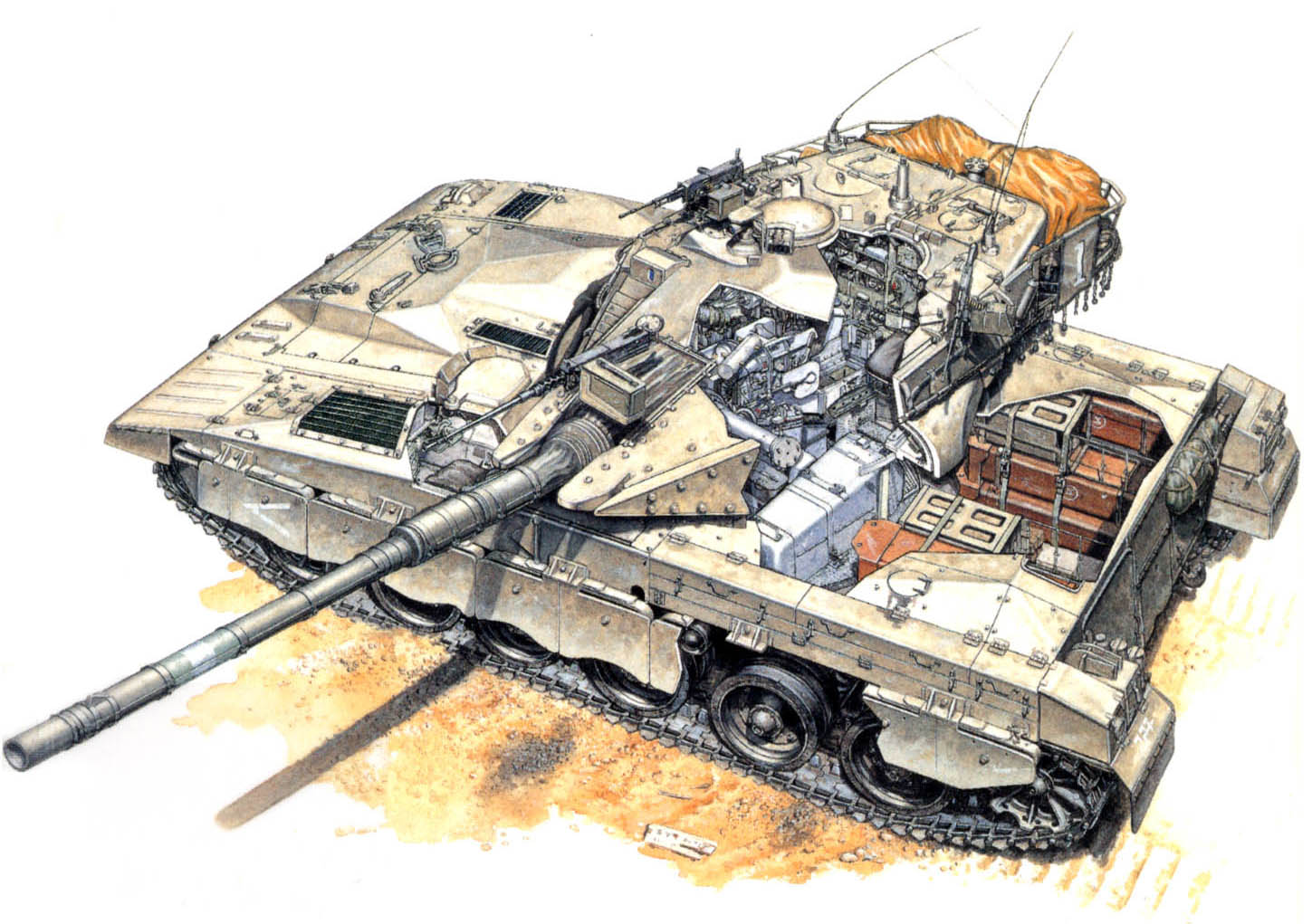
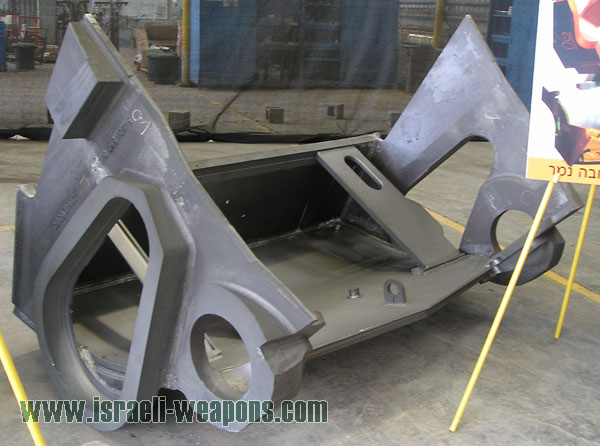
The Merkava series of main battle tanks (MBTs) is currently the only real MBT with a front-mounted engine. On light tanks, armored personnel carriers (APCs), self-propelled guns (SPGs) and infantry fighting vehicles (IFVs) placing the engine infront of the crew compartment is a common design practice, but on main battle tanks this is a rarity.

The Merkava tanks with their front-mounted powerpacks are a modern oddity and rarity

The reason for this is that having a front-mounted engine comes with a rather huge number of drawbacks, compared to only a few advantages, which by most countries are not considered as mandatory improvments for a tank.

A front-mounted engine does have a number of drawbacks in regards to the tank's armor protection:
  • A frontal engine reduces the space available for special armor  
    • Modern composite armor is very bulky and requires a lot of space (more than 600 milimetres for the hull on modern tanks) in order to deal with all available threats; a powerpack is taking up a lot more length (about 1500 mm for the MT 883 engine), but increasing the length of the tank's hull is not desireable, as it has a huge number of drawbacks. In case of the Merkava tank, the frontal hull armor is thinner than that of a comparable MBT from another country. 
  • It also increases hull height
    • The height required for a seated driver (in a reclining position) is lower than the height required for a powerpack. In case of the German Leopard 2 MBT, the height at the start of the UFP (upper front plate) is about 1 metre above the ground. The height at the end of the UFP is about 1.522 metres above the ground, where the rear section of the hull where the powerpack is mounted, is located 1.774 metres above the ground: mounting the engine at the hull front would increase the height of the hull by 222 mm (or 272 mm if we include the difference in ground clearance between Leopard 2 hull front and rear). That's about half the size of the UFP!
  • This also can lead to an increased turret height
    • Due to the higher hull and the turret ring being moved backwards (in comparison to other tanks), the turret has to be higher, unless a lower range for gun depression and elevation is deemed as acceptable. If the turret was not taller, the gun would hit the UFP everytime the crew tries to depress the gun. In case of the Merkava reducing the gun depression was chosen, so that the Mark IV has only 7° gun depression instead of the approximately 10° reached by other tanks with manned turrets.   
  • A front-mounted engines also means that more weight and volume of the special armor has to be utilized for reaching the same amount lateral protection
    • In order to reach what is considered by tank manufacturers a decent level of protection for the crew, heavy ballistic skirts (with a thickness of 65 to 200 mm) are used on the frontal sections of the hull. Unlike the non-ballistic skirts, the heavy ballistic skirts consist of composite armor or ERA, and are designed to provide protection along the frontal 60° arc for the whole crew compartment. Due to placing the crew compartment of the tank behind the engine, a larger area of the sides needs to be protected by heavy ballistic skirts, which means (for a constant weight) that less armor can be utilized for the front.

Additional length for the heavy ballistic skirts (red) and base armor (yellow) are needed on the Merkava to protect the crew (teal)

Compared to a Leopard 2, the Merkava has about 100 mm less ground clearance and an about 200 mm greater height to the turret roof. The height to the top of the UFP is about 300 mm larger on the Merkava, as measured on different photographs of the Merkava II and Merkava III.

This drawing of a M1 Abrams hull shows how the hull front is not as tall as the rear and thus the frontal profile can be kept smaller

While a powerpack and also fuel tanks will offer some amount of protection against impacting projectiles (although less than actual armor will - both per thickness and per weight), it should be taken into account that this is a different type of protection:
Once the powerpack is damaged from a projectile or the fuel systems are ignited, the tank will become imobile and won't be able to participate in any further combat actions. Instead of the crew dying, the damaged tank will be a mobility kill or a mission kill. This also means however that other parts of the forces have to secure the damaged tank and guard it until reinforcements or combat engineers have arrived - because otherwise the damaged tank will turn very easily into a total loss, when enemy forces attack it. In other words: a front-mounted engine can only provide crew protection, the tank as a system however will be even more susceptible to damage.
Actual armor on the other hand does not only crew protection, but also system protection. If an impacting projectile is stopped by the special armor, it won't be able to damage the internal components of the tank. The tank as a system stays intact and can still participate in combat.

The lower front plate of the Merkava is protected by very thin armor only
Furthermore a number of negative performance features are interwoven with the decision to utilize a front-mounted powerpack in a modern tank. The driver's vision in close proximity is reduced, because he is located further away from the frontal edge of the hull and because the hull is taller. The static track tension will be higher. The drive sprokets located at the front are more exposed to rocks and other obstacles, which means at higher speeds the drive sprockets can be hit and will be damaged easier. Also the air-intakes and/or the exhaust vents have to be located at the sides of the hull or at the front, which will get clogged on dusty/sandy terrain more easily. 

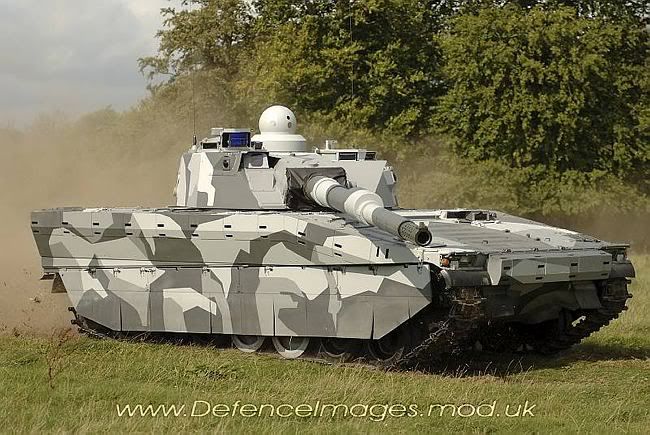
In case of infantry fighting vehicles and armored personnel carries, placing the powerpack in the front of the vehicle does offer a great benefit: a rear ramp/door - the infantry squad can enter and disembark from the vehicle without being exposed to enemy fire, while the thicker frontal armor of the vehicle can face the enemy. As there are currently not many purpose-built light tanks, most light tank designs are based on IFVs in order to keep costs down. Here placing the engine at the front means just saving costs compared to redesigning the hull and vehicle.

Like most modern light tanks, the CV90-120 just mounts a turret on the IFV chassis
For self-propelled guns placing the engine in the front of the vehicle is benefical, because the vehicle have a huge demand for ammunition (so a rear door for ammo replenishment is needed) and due to the extreme length of the gun barrels, which requires the turret to be placed further away from the front to reduce gun overhang and add stability while firing.

For the Merkava series the front-mounted engine made sense, when we look at it's history. Israel lacked modern armor technology and thus relied on spaced armor only. The armor layout of the Merkava I and II is optimized for hull-down combat from static positions, which was the most common type of operation for tanks during most of the Israel-Arab conflicts of the past, such as the Yom-Kippur War and the Six Days War. The weaker lower hull of the Merkava would be hidden behind the terrain or prepared (concrete reinforced) positions, so that the hitting them would not be possible. The lack of (bulky) composite armor also meant that no system protection is lost compared to a tank with homogenous or spaced armor and rear-mounted engine.

The frontal hull armor of a Merkava I or II tank. All armor is placed in front of the engine!
The later models of the Merkava series however suffer unnecessary weaknesses from their inheritance. At a 60-65 metric tons weight, but a larger physical size and a much larger armored surface (more armor required for the frontal surface, for the sides, the rear, the roof, aswell as for the mine-protection), the Merkava tanks should not be expected to be as well armored as their European or some of their Asian competitors.

Object 299 prototype tank - the front-mounted engine had a huge impact on mobility and maximum armor thickness.
All major tank building nations have experimented with tanks, which had their engines mounted in the front or in the center section of the tank. None of these experiments resulted in the adoption or creation of a new MBT with front-mounted powerpack.

Thursday, December 31, 2015

Happy new year

I'd like to use this opportunity to wish the few readers of this blog a happy new year. Unfortunately I haven't reached any of my major goals with this blog. It's quite lacking behind my plans in terms of post amount, frequency and quality - but well, it's something. So if you like to read "something", why not this blog.

Happy new year.

The truth about spaced armor on modern tanks and AFVs

A lot of websites and even a number of written books claims that spaced armor is mainly designed to deal with shaped charge weapons such as high-explosive anti-tank (HEAT) ammo, anti-tank missiles and rocket-propelled grenades (RPGs).

However in many cases spaced armor is designed to deal with armor-piercing ammunitions such as AP and APDS rounds mainly. This already started during WW2, when spaced armor was first introduced on German Panzerkampfwagen III and IV tanks. The Panzerkampfwagen III Ausf. L received spaced frontal armor by adding a 20 mm steel plate at the hull superstructure and the gun mantlet. This first steel layer was designed to damage or shatter the caps of APCBC ammunition, so that the face-hardned main armor was more effective.

A Panzerkampfwagen III with spaced armor (note the brackets and the spaced 20 mm plate)
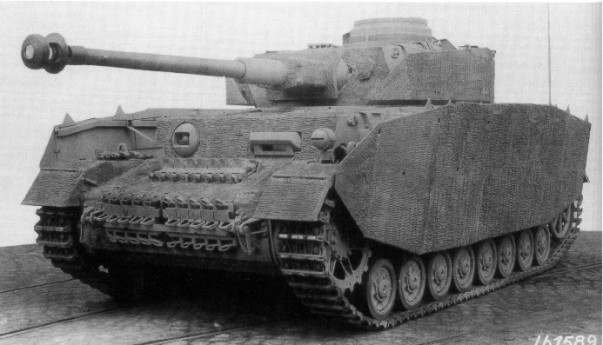
In a slightly different form, but still mainly designed to deal with AP ammunition (to be more exact, to deal with 14.5 mm anti-tank rifles), spaced armor was adopted on the late-model Panzerkampfwagen III and IV as Schürzen. A thin 5 mm steel plate or on later models wire mesh was designed to tumble the 14.5 mm AP round, so that it would have a greater cross-section upon impact at the main armor (and hence a lower penetration into the armor).
Panzerkampfwagen IV Ausf. H with spaced armor against anti-tank rifle ammunition

While not adopted on follow-up production tanks in the late 1940s and 1950s, spaced armor was still tested and reintroduced to modern tank design in the late 1960s and early 1970s.
In an attempt of accessing the usefullness of shaped charges against future heavy tanks, the British army decided to trial spaced armor as upgrade option for the Conqueror heavy tank.

Conqueror fitted with spaced armor
The armor consisted of 14 mm thick steel plates of I.T.100 steel mounted on 4 to 8 inches (102 mm to 204 mm) long spacers made of mild steel. The spacers used on the hull had a length of 5.75 inches (146 mm). Furthermore a 20 mm thick steel plate was welded onto the main glacis armor. Six missiles were fired onto the tank (5 American Dart missiles and 1 Malkara), of which only one Dart missile failed to penetrate. All other missiles caused enough damage to kill at least the crew members in the splinter cone.

Meanwhile Germany and the United States were together working on a new main battle tank, known as the MBT-70. The MBT-70 was fitted with spaced armor at the hull front and turret, which used a thicker and harder outer plate than the previously mentioned designs. According to R. M. Ogorkiewicz, the outer plate had a thickness of 40 mm and had a hardness of over 500 BHN, or about twice as much as used on the then-used cast steel turrets. The main armor had greater thickness, but only medium hardness. The outer plate served as disruptor - it's main goal was to shatter or break the impacting penetrator instead of slowing it down by any major amount. This was extremely effective until the late 1970s and early 1980s, because most penetrators used brittle tungsten-carbide cores or steel cores. Supposedly against such ammunition, spaced steel armor utilizing steel plates of different hardness can increase the protection by up to 50% compared to homogenous steel of the same weight. At least it has been claimed by W. J. Spielberger, that the MBT-70 was protected against 105 mm APDS ammunition fired from 800 m distance, while the same ammunition was able to penetrate the 254 mm thick turret of the M60A1 tank even at 1,500 m range - the MBT-70 was designed to weigh 46 metric tons, but in reality ended up 48 metric tons (second generation prototypes), whereas the M60A1 weighs 52 metric tons!
This armor design went - after being used on the Keiler and early Leopard 2 tanks - into series production with the German Leopard 1A3 tank in 1973.

The cut-out section of a Leopard 1 turret side wall shows the spaced armor.
Other armored fighting vehicles have been fitted with spaced armor aswell. The original M2 Bradley used spaced armor in some places - e.g. the side skirts consisted of two 6.4 mm thick steel plates, which like the Panzerkampfwagen IV's Schürzen should make 14.5 mm AP rounds tumble. The Marder 1A3 has been fitted with spaced armor for protection against 30 mm AP(DS) ammunition - at the upper front plate it has a thickness of about 5 - 10 mm and might be made out of harder steel.
The list of modern armored vehicles utilizing spaced armor for protection against AP ammunition is very large and includes vehicles such as the Boxer, several armor upgrades for BTR and BMP, some versions of the Stryker, many different versions of the M113 and the AAV-7.

Ukrainian BTR with spaced armor for protection against HMG rounds.

Spaced armor allows achieving a greater level of armor protection per weight, but it does increase the physical size of the vehicle at the same time.