Showing posts with label Jordan. Show all posts

Sunday, January 14, 2018

Marders to Jordan (part 2)

The German company Rheinmetall announced on the 13th December 2017 that the Kingdom of Jordan is set to receive a second batch of 25 second-hand Marder 1A3 IFVs, that were originally operated by the German Army. The delivery of the vehicles will start in the first quarter of 2018. A first batch of a total of sixteen Marder 1A3 IFVs was already handed over to the Royal Jordanian Army in December of 2016.

Marder 1A3s of the first batch delivered to Jordan
The Marder 1A3 is an infantry fighting vehicle (IFV) currently in service with the armed forces of Chile, Germany, Indonesia and Jordan. The Argentinian military operates the TAM family, which is based on the Marder design. The Marder IFV is armed with a 20 mm MK 20 Rh 202 gas-operated autocannon with a maximum rate of fire ranging between 800 and 1,000 rounds per minute. As secondary armament the vehicle is fitted with a 7.62 mm MG3 machine gun and a launcher for the Milan anti-tank guided missile (ATGM). The Marder's propulsion is provided by a liquid-cooled MB 883 V6 engine from MTU, which delivers 600 horsepower at 2,200 rpm. It is coupled to a semi-automatic RENK HSWK 194 transmission. The Marder 1A3 has a combat weight of about 33.5 metric tons and reaches a top-speed of 65 kilometres per hour (km/h). Its spaced armor provides all-round protection against fire from 12.7 and 14.5 mm heavy machine gun, while the frontal arc is protected against medium calibre ammo including 30 x 165 mm armor-piercing ammunition. The Marder 1A3 is not fitted with an underbelly armor plate for protection against mines and improvised explosive devices (IEDs).

The Royal Jordanian Army is receiving the German-made IFVs as part of a military aid, which was started by the Federal Republic of Germany in the last two years in an attempt to improve the stability of the region by enabling the militaries of some Middle Eastern countries to fight better against insurgents and terrorists. Aside of a first batch of Marder 1A3 IFVs, Jordan also has received 600 RGW-90 hand-held recoilless guns, surveillance equipment, 56 vans and 70 trucks. Like the first batch of Marders, the second one was also ordered by the German government, rather than being ordered by Jordanian officials. Rheinmetall states that the contract - awarded in October 2017 - has a total value of more than €17 millions and includes completely refurbishing the vehicles to a (near) mint condition, painting them with a desert camouflage pattern (understood to be similiar to the single-tone "desert yellow" used on many US combat vehicles), spare parts, ammunition and tools, technical documentation aswell as support and training for the crews and local maintenance personnel.
Originally it was planned to deliver all 50 Marders meant for Jordan until end of 2017. There currently is no official explanation for the delay, it might however be related to politicians having troubles allocating the budget for the deal or the negotiations with Rheinmetall taking longer than expected.

An upgraded Marder 1A3 could be fitted with additional armor, an unmanned turrets and a more powerful engines.
There are a number of upgrade possibilities to enhance the protection, firepower and mobility as well as options to reconfigure the Marder to another role. The Marder can be used as APC, light/medium tank, tank destroyer, surface-to-air missile carrier, fire support vehicle, command post vehicle, ambulance vehicle, fire-fighting vehicle and as mortar carrier. Different upgrade paths such as the Marder CCV and the Rheinmetall Lynx infantry fighting vehicle have already been mentioned in the blog post regarding the first transfer of Marders to the Royal Jordanian Army.

Thursday, December 22, 2016

Marders to Jordan

Jordan has received an initial batch of 16 ex-German Marder infantry fighting vehicles (IFVs) on the 11th December of 2016 as part of German military aid. The delivery also included 20 mm RH202 autocannons, spare parts and a Marder driver training vehicle. It must be noted that the permission for an export of 24 Marders, 28 Rh 202 autocannons and one Marder driver training vehicle to Jordan was given for 2016. The costs of this equipment is €12.8 million. This means that most likely a second batch of Marders will be shipped this year. A total of 50 Marder IFVs are being delivered to Jordan until end of 2017. Furthermore Jordan is set to receive surveillance equipment, 56 vans and 70 trucks.
The military aid to Jordan is part of a bigger initiative, which costs about €100 million in 2016 and €130 million in 2017. Other recipients of the German military aid are the Iraq, Tunesia, Mali, Nigeria and Niger. Jordan received about €25 million from the German government in order to be able to purchase the Marders.

Marder 1A3s being handed over to the Jordanian Army
The Marder IFV is an older design, being introduced into German Army service in 1971. It replaced the HS.30 Schützenpanzer lang, the first infantry fighting vehicle of the world. While offering only average firepower for it's time, the Marder was designed to feature a higher degree of armor protection, being heavier than all other IFV counterparts of the same era.

The Marder 1A3 is fitted with spaced applique armor, even at the roof

The engine cover of the Marder has a thickness of 11 mm, which together with the slope of 78° leads to an effective thickness of 53 milimetres. Supposedly the rest of the upper hull front is slightly thicker at 15 mm. The lower hull front has a thickness of 32 mm sloped at 24°, leading to a thickness of 35 mm from the front. The side armor is only 15 mm thick, but sloped at the upper part and covered behind the sideskirts at the lower sections. The armor of the low-profile turret is 25 mm thick at the front, which due to the 40° slope results in a line of sight thickness of 33 mm.

Marder 1A3 turret after being hit by 30 mm ammunition
Jordan received the Marder 1A3 variant, which can be identified by the thicker armor, but still features the old sideskirts with a wave-pattern. This version features no additional mine protection plate, which seems to be a miscalculation, based on how improvised explosive devices (IEDs) and mines are commonly used by insurgents and terrorists.
The main change in the Marder 1A3 compared to earlier versions is a further layer of spaced armor being fitted to the front, sides and also the roof. This raised the weight of the vehicle by about 5.5 metric tons. The exact protection level of this armor is unknown, but it has been tested against 30 mm ammunition (either AP or APDS) fired from 400 metres distance without any penetration of the main armor. The sides are resistant against 14.5 mm AP ammunition fired from short ranges.

The Mader 1A3 upgrade entered service in 1989
The exact thickness of the add-on armor is still unknown, but it's frontal add-on plate is estimated to be about 7 to 10 mm thick. The add-on armor is spaced several centimetres apart form the base armor, the steel stand-offs include a special rubber padding. This allows the armor to be a lot more effective than just a single layer of steel with equal thickness. Unlike many other combat vehicles such as the Bradley and Warrior, the Marder's armor upgrade also enhanced the roof protection.

The biggest downside of the Marder is the firepower. While being rather well armed in the 1970s and still very acceptable in the 1980s, the lack of firepower upgrades has worsened the situation. The Marder has no fire on the move capability and hunter/killer capability, two features that were added to the M2A3 Bradley in the late 1990s. The 20 mm Rh 202 autocannon of the Marder was still capable of defeating the Soviet-designed BMP-1, BMP-2 and BMP-3 at 1,000 metres or more using the APDS ammunition.

Currently all Marders are armed with the Rh 202 gun
The original upgrade proposal of the German industry that lead to the Marder 1A3 also featured a 25 mm autocannon and a 720 hp engine, but neither of these features were not adopted by the German Army. A main reason for this the development of a Marder successor, starting with the Marder 2 infantry fighting vehicle developed in the late 1980s. The development of the Marder 2 was started in 1984 (first requirements), the first prototype was delivered in 1991. The collapse of the Soviet Union however meant a re-thinking of the German defence doctrine, which lead to the cancellation of the Marder 2. After the Marder 2 project was ended, the requirements for a new IFV were incorporated in the Neue Gepanzerte Plattform (NGP, "new armored platform") in 1996. While the original NGP was meant to include a modular chassis for all tracked combat vehicles (including main battle tanks, recovery vehicles, self-propelled guns, etc.), all of them were canceled except for the IFV. The IFV version of the NGP then became - after numerous design and requirement changes, reducing the maximum weight by 45% - the current Puma IFV. In German service the Marder 1 is currently being replaced by the Puma IFV, it entered service in 2014.
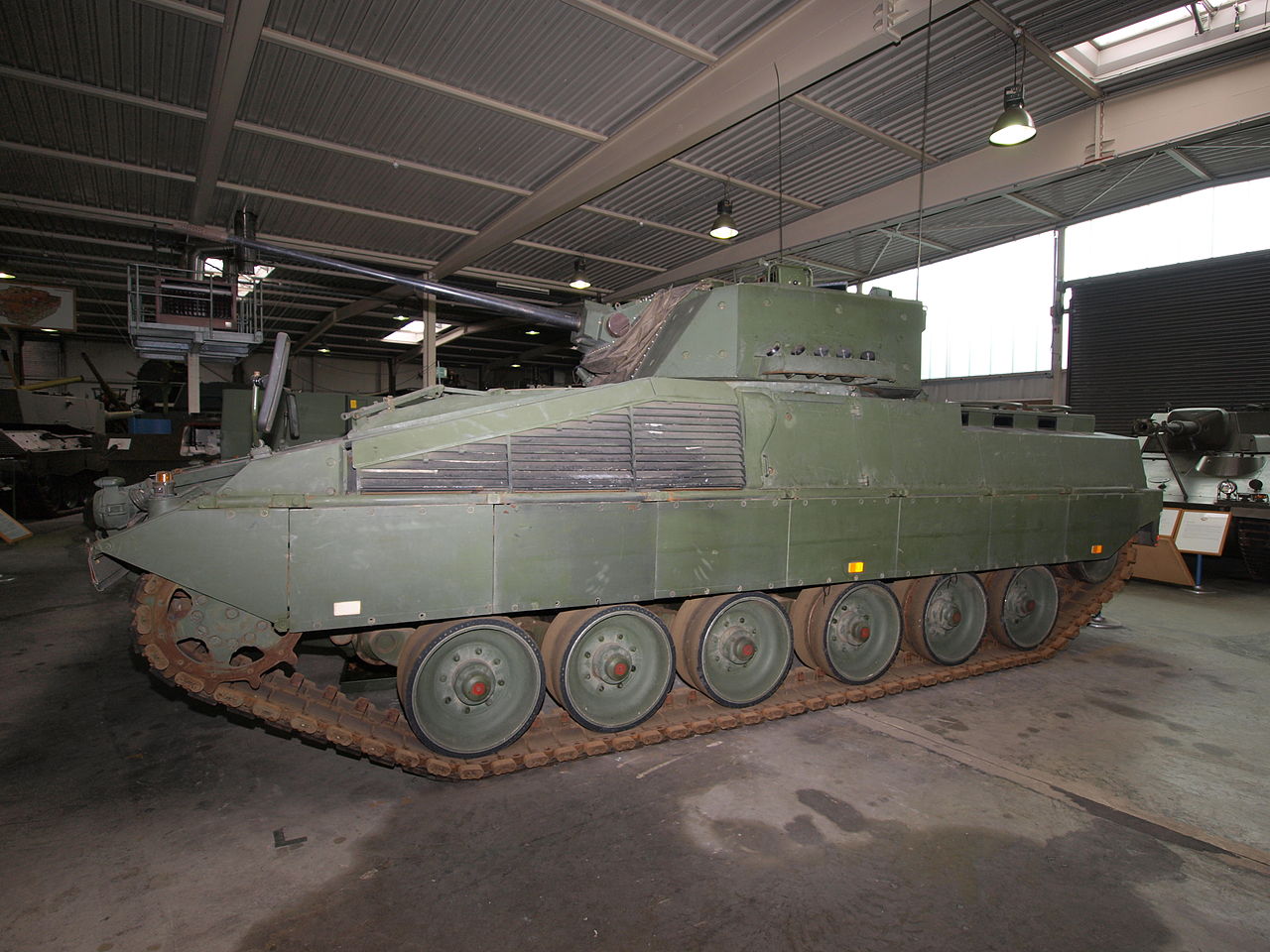
The Marder 2 was the first IFV with hunter/killer capabilty and ceramic armor
Meanwhile Germany has decided to upgrade a small amount of Marders as a result of cuts to the Puma order (reduced from 410 to 350 vehicles) and production delays (most of which are result of modifying the Puma's design to meet new requirements). The upgrade is scheduled to include new thermal imagers for 200 Marders and the MELLS (multi-role guided missile system), a version of the Israeli SPIKE-LR anti-tank guided missile.
The Marder has been exported to Chile and Indonesia. 237 Marders were sold to Chile, while Indonesia bought only 50. A sale of more than 400 Marder 1A3 IFVs to Greece failed due to the international finance crisis. Tunesia is scheduled for receiving the Marder infantry fighting vehicles in an unknown quantity.

Aside of the planned German Army upgrades to optronics and missile system, a number of further upgrade options are available for the Marder. A very simple upgrade option is replacing the turret with an off-the-shelf turret design for enhanced firepower. KUKA, now a part of Rheinmetall, offered the M12 with Mauser 30 mm autocannon for the Marder in the late 1990s. Furthermore a number of different turrets have been tested on the Marder during the 1970s to 1990s.


The protection can be enhanced by installing add-on armor, the Marder still should have enough weight left for this. Two types of explosive reactive armor, the French BRENUS and the German CLARA designs, have been tested on the Marder. Alternatively slat armor or lightweight composite armor such as RUAG's SidePRO-RPG could be fitted to the Marder, if needed (Germany considered slat armor a bad solution and has rejcted the use of it). The Active Defence System (ADS) developed by IBD Deisenroth in cooperation with Rheinmetall has been tested on the Marder 1A5.

The Marder CCV is fitted with an unmanned Lance-RC turret
More complex upgrades inlcude the Marder CCV, which was developed for Canada's close combat vehicle (CCV) requirement. This variant is fitted with thick layers of AMAP composite armor, a remotely-controlled Lance-RC turret with Wotan 30 mm chain gun, an air conditioning unit and an upgraded engine. The Marder CCV has not been purchased by any country yet.

The Lynx is apparently based on the Marder's hull
The new Lynx family of combat is believed to be based on the Marder 1A3. More specifcially, the Marder hull is used as the base of the Lynx, but essentially all internal components are replaced by Rheinmetall. The powerpack is changed, the tracks are replaced, a new turret is fitted, some armor elements are replaced. the Lynx also includes modern computer systems and optics.
The IFV variant of the Lynx is fitted with a two-men Lance modular turret armed with either a Wotan 30 mm or 35 mm chain gun. These guns have a magnetic coil for firing Rheinmetall's suite of programmable ammunition. Furthermore the turret can be fitted with a remote weapon station (RWS) slaved to the commander's main optic and a dual-launcher for SPIKE-LR ATGMs. The Lynx has been offered to Australia as part of the LAND 400 program.

Sunday, May 22, 2016

KADDB shows off new developments

The King Abdullah II Design And Development Bureau (KADDB) presented a number of interesting new developments at the SOFEX 2016.

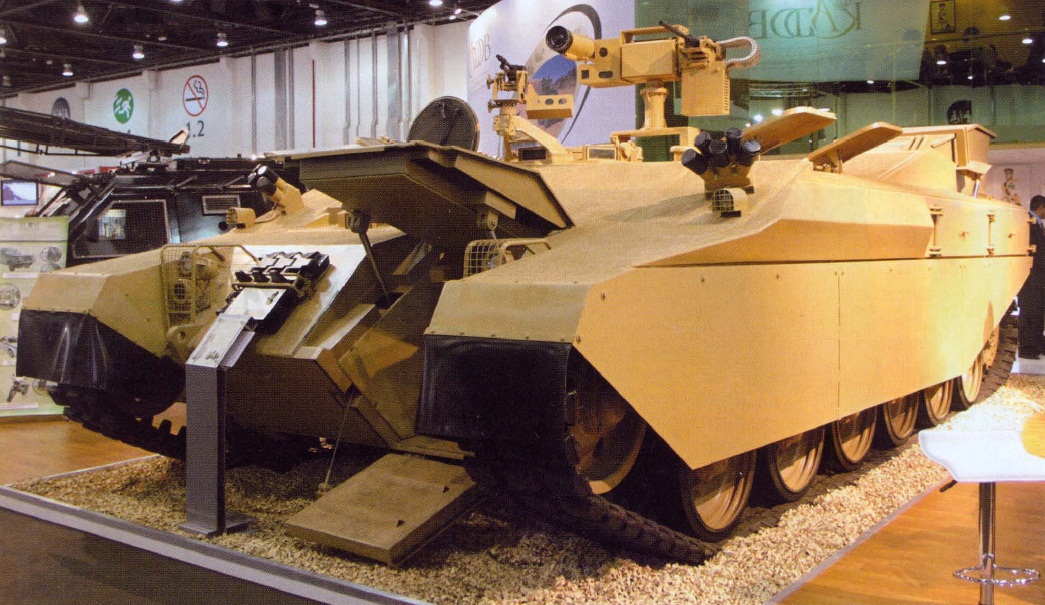
The al-Dawsar heavy armored personnel carrier (APC) is based on the hull of the obsolete Tariq main battle tank (MBT), itself a local version of the British Centurion tank, retrofitted with an US AVDS-1970 diesel engine and a relatively modern fire control system (FCS) from the Belgian company SABCA. The Tariq also features an improved suspension aswell as turret drive and stabilization systems from the US company Textron. Overall 293 Centurion tanks were converted into Tariq MBTs, however with the adoption of the Chieftain, the Khalid tank (an improved version of the Chieftain originally intended for Persia, it features the ICSS FCS and Condor CV12 engine later adopted on the Challenger 1 tank) and also ex-British Challenger 1 tanks, the Tariq tanks have become obsolote.
In an attempt to reuse the already existing hulls of the Tariq, the KADDB has been developing a heavy APC based on the Tariq chassis since several years. In 2001 the KADDB revealed the Temsah heavy APC, which was a Tariq hull modified by the KADDB in cooperation with companies from the UK and South-Africa. The Temsah has a front-mounted powerpack, which allows the usage of a rear ramp like commonly found on tracked APCs like the M113 and infantry fighting vehicles (IFVs) like the Bradley, BMP and Marder.

A prototype of the Temsah HAPC.
The Temsah however was never ordered nor adopted in any form. The prototypes have been fitted with numerous different weapon systems including machine guns (MGs), autocannons and anti-tank guided missile (ATGM) launchers.

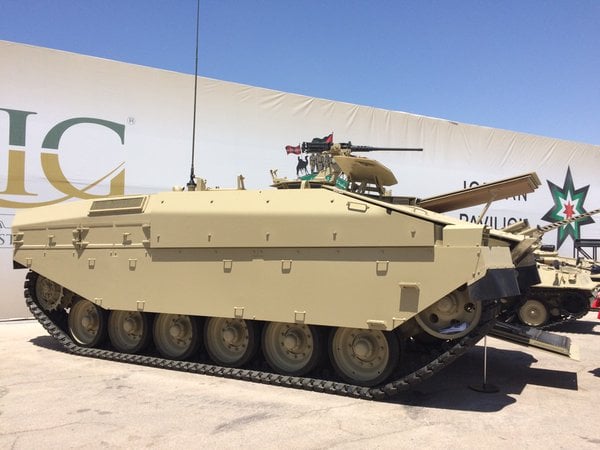
The MAP II/Dawsar APC. The front door and hatches are open, the rear door is folded up (at the right).
Following the Temsah and it's end, the next project for re-using the Tariq MBT was the Modular Armored Platform, MAP. The MAP II was finally adopted in 2014 as (al-)Dawsar. Unlike the Temsah, the MAP APC retains the rear-mounted powerpack with the AVDS-1790 engine, but has a small rear door together with a path at the left side of the powerpack. When not folded up, the rear door has a height of only 450 milimetres (mm). A larger 750 mm wide and one metre tall front door is located at the frontal hull, slightly moved to the left. Four hatches of 500 x 550 mm allow access to the roof. Overall 11 soldiers and 2 crew members can be carried inside the MAP II APC. The armament consists of two MGs with an option for a missile launcher. It provides protection against medium calibre ammunition. The MAP II has been nicknamed "al-Dawsar".

The upgraded al-Dawsar at SOFEX 2016
The upgraded al-Dawsar design presented at the SOFEX 2016 has yet to enter service, but it has a number of improvments over the previous model. While the drivetrain and powerpack are still identical to the older Tariq MBT, the armor has been improved compared to the MAP II by adding a further layer of spaced armor, probably to increase protection against KE penetrators. Unlike the MAP II, which has a 450 mm (1.5 feet) widened hull, the al-Dawsar has retained the standard Centurion hull width - this decrease production costs and time, but results in a smaller vehicle. Unlike the MAP II, the al-Dawsar from SOEFX can only carry 7 dismounts and a crew of two, although an alternative seating arrangment might increase the number of dismounts. It doesn't have a rear door. 
Protection is provided in accordance with STANAG 4569 level 5 against kinetic energy ammunition (resists 25 mm APDS at the frontal arc), but only level 1 against mines and IEDs, which seems rather poor.

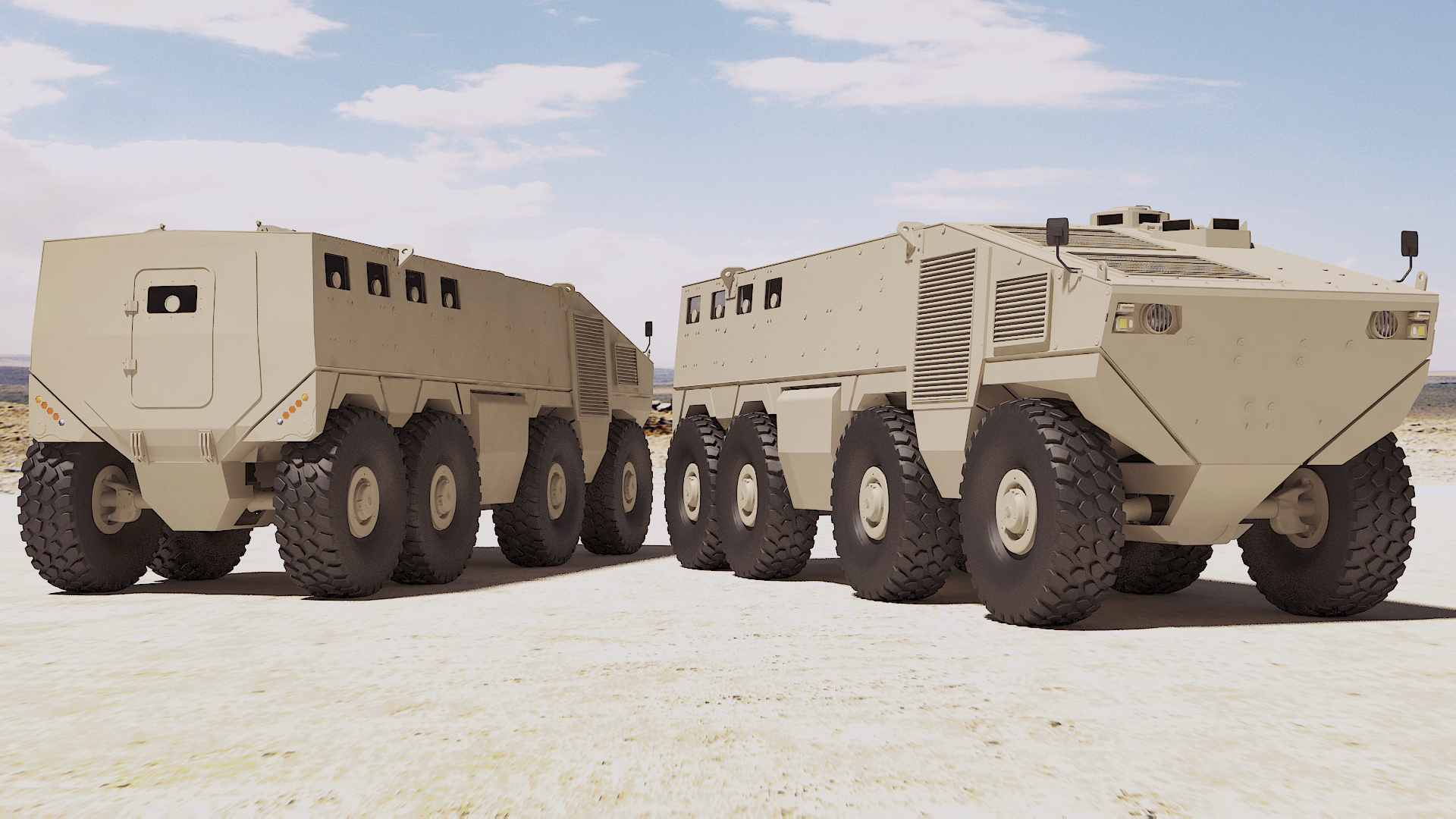
CGI of the new 8x8 APC developed by the KADDB
Another new development presented by the KADDB is a new 8x8 wheeled vehicle. It's design in form of a scale  model was first presented at the DSEI 2015 exhibition in London, but no prototype. With a total weight of 25 metric tons (depending on armor and mission configuration), the new vehicle can reach a top speed of about 100 kilometres per hour (kph). The total range lies at about 700 km. In general the KADDB 8x8 wheeled vehicle design seems a bit lacklaster compared to offerings from European companies, but should perform rather well in the regional context. It does have 4 wheel steering only and it's independent tetra back bone suspension is very similar to the ones currently used on civil Tatra trucks, it seems likely that there is a connection. 
The dismounts of the APC version can fire their individual weapons through firing ports - one is located in the rear door, while four firing ports are located at each side of the crew compartment. This is an interesting feature, but very old fashioned. The  firing ports are embedded into bullet-proof glass. Firing ports have been abandoned by other vehicle manufacturers, as they are weakspots that lower the armor protection of the surrounding area.
No details about engine, performance and armor protection have yet been released. However at a weight of only 25 metric tons, a protection level larger than STANAG 4569 level 4 against kinetic energy (protection against 14.5 mm AP all-round) seems to be very unlikely. More likely seems to be only protection in accordance with level 3 (protection against 7.62 mm AP all-round) together with protection against 14.5 mm AP along the frontal arc seems more likely given the firing ports. The v-shaped hull and high overall ride of the crew should give the vehicle a rather high level of mine proteciton.

The KADDB announced at DSEI, that they are interested in developing multiple variants including an APC version, an IFV and a tank destroyer/fire support vehicle with 105 mm gun.