Wednesday, September 30, 2015

Panzerhaubitze 2000 and other former-German equipment sold to Lithuania


The Lithuianian ministry of defence (MoD) announced on 28th of September 2015 that the army has purchased a total of 53 combat vehicles from Germany. The contract was signed one day later on the 29th of September.

The complete purchase includes:
  • 21 Panzerhaubitze 2000 self-propelled guns 
  • 26 M577 V2 command post vehicles 
  • 6 BPz 2 armored recovery vehicles
The total costs of the deal was €58.3 million, which will be alocated until 2019. €16.2 million were paid for the 53 vehicles, while €42.1 million were paid for modernization, upgrading the new vehicles with communication and mangaement systems as used by the Lithuanian army, and for adjusting military infrastructure for the Panzerhaubitze 2000 as well for training personnel.

The Panzerhaubitze 2000 (PzH 2000) is a self-propelled howitzer equipped with a 155 mm L/52 rifled gun. The chassis is made of armor steel and provides a relatively high level of protection (supposedly equal to the Leopard 1 hull). Additional armor can be mounted on top of the Panzerhaubitze 2000 roof in order to provide adequate protection against counter-battery fire and bomblets. The useage of many Leopard 1 and Leopard 2 military off-the-shelf (MOTS) components reduces the unit price of a PzH 2000.
Compared to the previous 105 mm towed artillery used by the Lithuanian army, the PzH 2000 has more than three times the effective firing range - according to the MoD, the PzH 2000 can accurately engage targets up to 40 kilometers, while the 105 mm howitzers have a range of 11 kilometers.

The M577 V2 command post vehicle is originally an American vehicle based on the M113. The German army bought 220 M577A1 vehicles during the Cold War. The designation M577 V2 seems to be local or it might be a mistranslation of the German NDV2 upgrade, that was applied to several M113-based vehicles. The NDV includes a new and more powerful engine (providing 300 hp output, made by MTU) and a new transmission.

The Bergepanzer 2 (BPz 2) is an armored recovery vehicle based on the Leopard 1 chassis.

The delivery of the first vehicles is expected to begin in 2016, the last vehicles should be received as of 2019.

Meanwhile the decision for an 8x8 wheeled infantry fighting vehicle has not been made yet by the Lithuanian armed forces. While - as previously reported - the army prefers the German Boxer, other parts of the Lithuanian military and/or government seem to dislike the high unit costs of a Boxer. The total costs supposedly are about €500 milions and the unit costs are supposedly 35% higher than some other alternatives investigated by the Lithuanian army according to an interview of the Lithuanian newspaper DELFI (use google translator).
On the other hand the Boxer with Puma turret (nicknamed PuBo by German officials) is probably the most capable vehicle offered to Lithuania.

Tuesday, September 22, 2015

Rheinmetall Boxer CRV

Rheinmetall has offered a special version of the Boxer to Australia as participation in the LAND 400 program. The Boxer Combat Reconnaissance Vehicle (CRV) is a version of the Boxer IFV with Lance Modular Turret System (Lance MTS), a version already showcased earlier in 2012 on the Eurosatory defence expo. Rheinmetall is partnering with Northtrop Grumman in order to increase chances of winning the contract.

The Boxer IFV with Lance MTS as shown in 2012

The Boxer CRV is armed with a MK-30/2 ABM autocannon and an anti-tank missile system, which yet has to be disclosed.  The MK-30/2 ABM gun is chambered in the 30 x 173 mm caliber and is gas-operated. It is dual-belt fed and has been equipped with an additional magnetic coil to allow the use of programmable air-burst ammunition. For this the muzzle velocity of the fire round is measured and via the magnetic coil the timer inside the projectile is set, which should result in a higher precision of the air-burst.
Available ammunition includes armor-piercing APFSDS, KE-TF (air-bust fragmentation against infantry), FAPDIS (frangible armor-piercing) and PELE (Penetrator with Enhanced Lateral Effect) ammunition.
 As secondary armament a 7.62 mm machine gun can be fitted coaxial to the main gun.

The Lance MTS is fitted with two Rheinmetall SEOSS sight units, which both include a day-channel aswell as a third-generation thermal imager. One of the sights is mounted at the front of the turret, whereas the other one is placed on top of the turret. Furthermore the Lance turret might be fitted with  two units of Rheinmetall's Situational Awareness System, which provide a 360° view of the close proximity.
In one trailer from Rheinmetall, the Boxer CRV has been fitted with SAAB's Barracuda Mobile Camouflage System.

The Boxer MRAV (multi-role armored vehicle) is the final result of a program, which originally was iniated by Germany, France and the UK to build a heavily protected common wheeled multi-role platfrom for all three countries. The Boxer is a modular vehicle, allowing to adopt different mission modules on the same chassis. It is well-protected by AMAP composite armor and fitted with a high level of built-in mine and IED protection.


UK to look for Challenger 2 replacement

As reported by the UK-based defence news agency Jane's IHS, the UK is looking for either an upgrade or a replacement for the Vickers Challenger 2 main battle tank.

Following the introduction of the T-14 Armata tank, the British army has questioned the ability of the Challenger 2 - in particular the performance of the L30A1 tank gun with two-piece ammunition - to be suited for future combat operations.

According to Jane's, the British army has already talked to several armored vehicle manufacturers about upgrading the Challenger 2 or replacing the tank.

Monday, September 7, 2015

AMV 35 CRV revealed

Patria and BAE have teamed up to participate in the LAND 400 program from the Australian army.
The LAND 400 seeks for a wheeled vehicle with heavy armor (STANAG 4569 level 6 - protection against 30 mm APFSDS at the frontal arc) in the versions Combat Reconnaissance Vehicle (CRV), Infantry Fighting Vehicle (IFV), Manoeuvre Support Vehicle (MSV) and Integrated Training System (ITS).

The vehicle chosen as part of the LAND 400 program is expected to replace the old M113AS4 IFV (a version of the M113 with 25 mm gun turret) vehicles and replace a number of ASLAVs (a version of the Swiss Piranha).

Illustration of the AMV 35 CRV from Patria - it's a photoshopped image.

The AMV 35 CRV seems to be a normal Patria AMV hull fitted with the turret of the BAE CV9035. The turret is housing an exteranlly-powered 35 mm Bushmaster III autocannon, which offers increased lethality over the more common 25 and 30 mm calibers. A barrel swap allows the usage of larger 50 mm supershot ammunition.
However ammunition stowage is poor compared to smaller calibers. The CV9035 has 2 belts of 35 rounds each loaden in the main gun, which is what should be expected from the AMV 35 CRV aswell. A total of 140 further rounds are stored inside the CV9035, a similar number of additional ammunition might be stored in the AMV 35 CRV.

The turret is a welded steel construction which is fitted with additional modules of composite armor and the SAAB Universal Tank and Anti-Aircraft Sight (UTAAS) fire control system.

The Patria Advanced Modular Vehicle (AMV) is a proven 8 x 8 wheeled vehicle, which has been rather successful on the export market in the past years.

Sunday, August 30, 2015

Yong APC from ROKA

The Republic of Korea Army (ROKA) has been running a program for a new 8 x 8 wheeled APC in the past years. It was announced some time ago that Hyundai Rotem's design was considered the winner.

The 8 x 8 wheeled vehicle from Hyundai Rotem in ROKA camouflage
Defence-Blog.com has posted a number of photographs of the new "Yong" APC from Hyundai Rotem, which will enter service with the ROKA. At least 600 vehicles are expected to enter service until 2020.
Four hatches at the crew compartment allow the dismounts to participate in combat.
The main armament of the photographed Yong consists of a single 12.7 mm M2 heavy machine gun, which is manually operated. The gunner is protected by a gun shield made of steel. This is quite a surprise, considering how many countries have moved to remote weapon stations.
It is safe to assume that a number of different weapons can be mounted on the Yong. Most likely there will also be an option for a 40 mm automatic grenade launcher.
The swim engines (pum-jets?) of the Yong are located at the vehicle rear.
Supposedly the Yong can reach a top speed of up to 100-105 kmph. The vehicle is estimated to have  a total operational range of 600 kilometres. Two swim engines, which appear to be pump-jets, make the vehicle amphibious.
The engine of the vehicle provides an output of approximately 420 horsepower.
The front of the Yong. Note the armor panels.
The Yong is fitted with applique armor panels, which seem to be composite armor. Probably the vehicle utilizes ceramic composite armor similar to MEXAS or AMAP, which are used on the Stryker ICV, Fuchs 1A8, VAB and Boxer. The low weight required to remain amphibious however means that a relatively low level of protection can be achieved only.
It seems that the frontal arc is most likely protected against heavy machine guns (i.e. 14.5 mm API) at short ranges, but the sides and rear are probably not designed for this level of protection.
The seats do not appear to be mounted in a mine protected configuration.
First vehicles are expected to enter regular troop service in 2016.


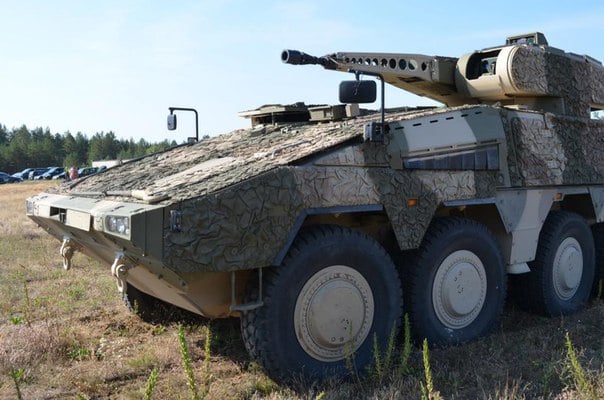
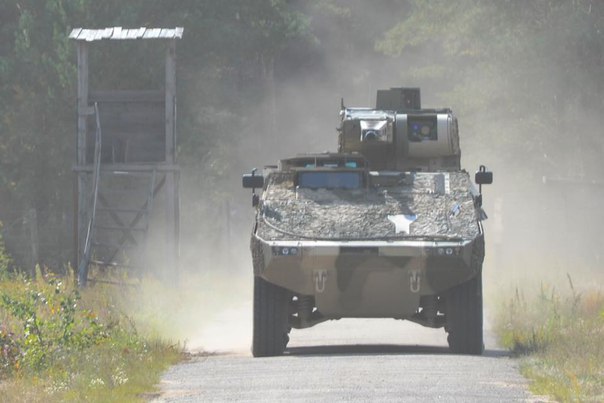
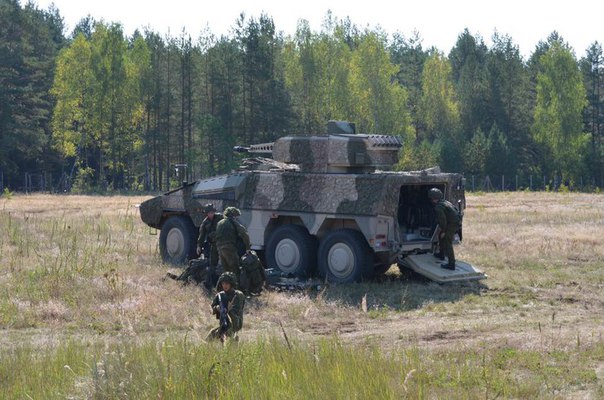
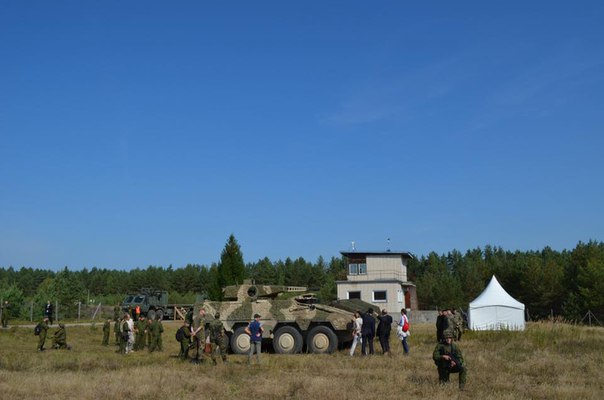
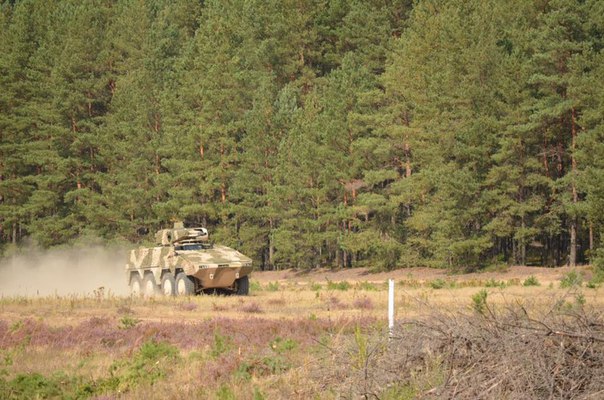
Boxer IFV trialed in Lithuania

Defence-Blog.com has posted a number of photographs showing the Boxer being trialed in Lithuania.
The configuration of this vehicle is quite interesting, because it mounts the unmanned turret from the Puma IFV, instead of using the LANCE turret from Rheinmetall (which exists in manned and unmanned versions).

The Puma turret seems to be pretty much unmodified. It houses the 30 mm MK-30/2 ABM gun with magnetic coil for programming time-fuzed ammunition, while using the same PERI RTWL-B and EOTS sights with third-generation thermal images as the original Puma.
However the MUSS softkill active protection system is not included. The vehicle also lacks a Javelin ATGM launcher that has been requested by the Lithunian army (although this will be retrofitted most likely).

It is also fitted with the Barracuda MCS camouflage system.

The Boxer IFV is currently one of a staggering 10 contenders for the wheeled IFVs of the Lithuanian armed forces. While the government of Lithuania has not yet chosen on winner, the armed forces already openly said that they favor the German-made Boxer (as previously reported here and at a later time by Jane's IHS).


Tuesday, August 25, 2015

US Army to buy Oshkosh JLTV

So the US Army decided that the Oshkosh submission for the Joint Light Tactical Vehicle - a vehicle to replace the aging HMMWV - is to enter production for service with the Army and USMC. The other contenders from AM General and Lockheed Martin.

JLTV enters low rate production

"WASHINGTON (August 25, 2015) -- Today, the U.S. Army awarded the Oshkosh Corporation located in Oshkosh, WI, a firm fixed price production contract for the Joint Light Tactical Vehicle (JLTV) program. The total contract value, including all options is $6,749,799,374.25. JLTV is an Army-led, joint acquisition program with the U.S. Marine Corps (USMC) intended to close an existing gap in each Services' light tactical vehicle fleet.

"I am tremendously proud of the JLTV program team," said Heidi Shyu, the Assistant Secretary of the Army (Acquisition, Logistics and Technology). "Working with industry, they are delivering major improvements in protected mobility for Soldiers and have succeeded in executing a program that remains on-budget and on-schedule."

The Army selected the Oshkosh Corporation from three competing firms participating in the program's engineering and manufacturing development phase, which began in 2012 and concluded earlier this year. Each vendor delivered 22 prototype vehicles as part of JLTV development, which were utilized as part of an intensive, 14-month competitive test.

"With America's Soldiers and Marines in mind, the program team successfully met both Services' requirements for affordable, achievable capability advancements that will make a true difference," said Sean Stackley, the Assistant Secretary of the Navy (Research, Development, and Acquisition). "Today's award brings us a step closer to delivering a flexible vehicle that balances the payload, performance, and protection critical in the operating environments of today and tomorrow."

Low Rate Initial Production is slated to begin in the first quarter of fiscal year (FY) 2016. The Army and Marine Corps will procure approximately 17,000 vehicles under this initial contract, with a decision on full rate production by the Department expected in FY18. Procurement of 5,500 USMC vehicles are front-loaded into the JLTV production plan. Initial USMC operating capability is expected in Fiscal Year 2018 with fielding to Marine Corps complete in FY2022.
The Army anticipates having its first unit equipped in FY2018. Army procurement will last until approximately 2040 and replace a significant portion of the Army's legacy light tactical vehicle fleet with 49,099 new vehicles.

JLTV manufacturing will be performed in Oshkosh, WI with deliveries beginning 10 months after award. A full rate production decision is expected in FY2018. JLTV remains a priority modernization effort for the Army and USMC."


Source: Army.mil