Thursday, July 30, 2015

Ukraine receives upgraded T-80 tanks

According to Jane's IHS the Ukrainian army has taken over the first 8 T-80 tanks modernized by Kharkiv Morozov Machine Building Design Bureau (KMDB) on 15th July 2015 (15 days ago, I am certainly having troubles writing .

The tanks are fitted with Kontakt reactive armor and will serve for "anti-terror operations", which means that they are intended for fighting in the East-Ukraine against the separatists. Other sources than Jane's (i.e. Ukrainian sources) claimed that these tanks were for an air-mobile unit, which does not take part in any combat operations in the east of the country.

The "new" tanks for the Ukranian army
The Ukrainian ministry of defence however has stated, that these tanks will serve with n unit of the airborne forces.
Other than adding Kontakt ERA, other not further mentioned changes were done to turret and hull structure.

Source: Jane's IHS


This tanks show in which a desolate situation the Ukrainian army is - the T-80 used are outdated and the modernization is a joke. They are far worse than the modernized T-64BM Bulat or the current T-84-based Oplot tanks.
The use of Kontakt-1 ERA (which does provide only very limited amounts of protection compared to more modern ERA systems) and the retaining of the old infra-red sights certainly shows that the lack of money and/or production capacity in the Ukraine is a real problem. These tanks were "modernized" (refurbished seems to be more appropriate) to a technology level of approximately 1984!

That said, it appears that tank vs tank combat is highly limited in the Ukrainian conflict. Still viable protection against rocket-propelled grenades and anti-tank missiles is not offered by the modernized T-80 tanks.
The fire control unit of the old T-80(B) is probably accurate enough against structures and infantry, when firing from slow move (25 kmph) or from static positions..

Pakistan prefers Oplot?

According to rumors spread on the internet, Pakistan recently trialed the latest version of the Ukranian Oplot-M main battle tank and the Norinco MBT-3000. Supposedly, the results were in favor of the Ukranian tank.

The Oplot MBT in Pakistan
The Oplot-M main battle tank is made by the Kharkiv Morozov Machine Building Design Bureau in the Ukraine. It is protected by composite armor and heavy Duplet reactive armor along the frontal arc, while ERA protects the flanks. It is also fitted with the Varta proteciton system (an improved version of the Shtora system of the Soviet Union), which already has been adopted on the Al-Khalid.
The main armament consists of a modern 125 mm KBA-3 smoothbore gun, which is fitted with a T-80-style autoloader. The Oplot-M also features a modern fire control unit with thermal sights for both gunner and commander.
The Oplot is powered by a six-cylinder 6ТD-2 multifuel diesel engine, which provides an output of up to 1200 hp.

More detailed information can be accessed on the manufacturer's website.

The Chinese MBT-3000 was claimed to be very similar to the current version of the Al-Khalid and seen "as not much of an improvment". Given the relationship between the Al-Khalid (which started as a modified Chinese Type 90 design) and the MBT-3000 (which is a modified Type 90/Type 96 tank design) this seems to be plausible.

The Chinese MBT-3000, supposedly tested in Pakistan alongside the Oplot.


Author's opinion: I don't know if these rumors are true, but it seems to be reasonable to choose the Oplot-M over the MBT-3000. At least the Oplot-M seems to be a more advanced and better design.
However it is rather questionable if the Ukraine is able to manufacture enough tanks for Pakstain (they already have troubles with the Thailand deal) and also wether the Ukraine is willing to agree on a local production (which seems to be demanded by Pakistan).

Low activity...

So, it seems that my attempt to create a blog and keep it running is about to end within the first two months. I have tried to find to time for writing posts, but I have only found enough time to post a few recaps of news articles (with my opinion added in a few sentences) in the past.

I actually am still trying to write more posts of higher quality,  but everytime I end up looking for proper sources - and imo sources are very important - I require lots of time (was it written in this book or that book - or was it on a website?). This results in very little progression, specifically when looking at how much I want to write (currently this blog has 20 published posts, but a further 17 are in the making...).

For some posts time is not necessarily a critical factor, but when I want to write about more or less recent news (or my opinion about the second early access phase of Armored Warfare...), not publishing the posts within a few days makes them rather useless.

Let's see what will happen here. Maybe I will write more recapitulations of news; maybe I will make longer and more detailed posts, but reduce the frequency to one or two posts a month. Maybe I will have time to focus more on AW... let's see.


Thursday, July 16, 2015

China is developing a new APC

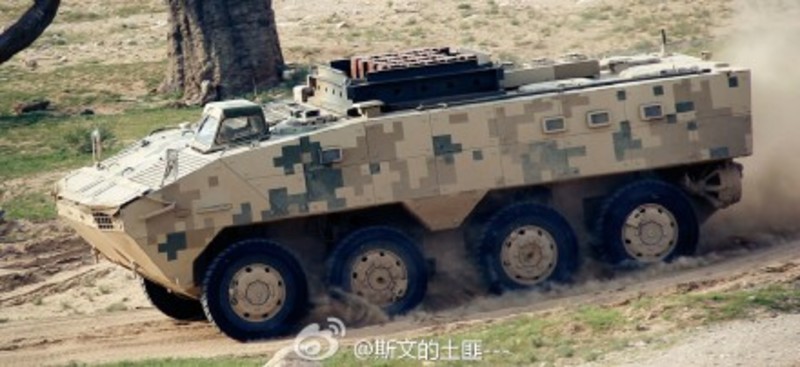
Norinco of China is developing a new armored personnel carrier with the designation "VP10". From the front it looks like a copy of the Patria AMV or the Singaporean Terrex, the spacing of the wheels and the layout of the rear compartment are however easy to distinguish.

Prototype of the VP10, without proper driver's hatch and weight demonstrator instead of a turret.

The VP10 armored personnel carrier is a 8x8 wheeled vehicle with conventional front-engine layout. Two propeller engines at the rear allow the amphibious vehicle to swim. The rear compartment is fitted with vision blocks (probably in combination with gun ports on the final vehicle) and hatches at the roof.
The rear ramp can be hydraulically operated and also includes a door as alternative exit, which is also fitted with a small window.

A version armed with a remote weapon station has been shown in Norinco video footage, but it is expected that a number of versions of the VP10 will be fitted with turrets armed with larger weaponry.

The vehicle hull is fitted with bolt-on armor, which suggest a type of modular spaced or composite armor.

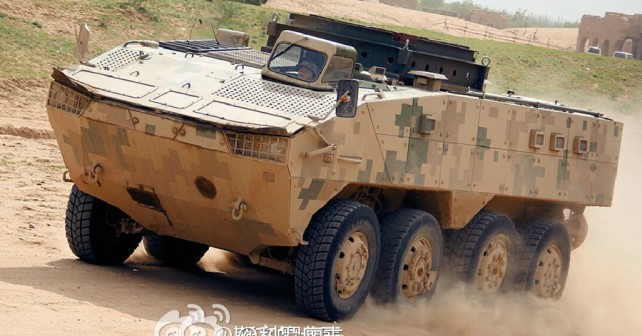
According to Sputniknews, which also claim that this is the Chinese analouge to the new 8x8 Bumerang vehicle of the Russian army, the vehicle can transport 8 to 10 infantrymen, depending on version.

Same protoype vehicle, different angle of view
Source: Defence-Blog.com, Sputniknews


Author's opinion: China keeps developing new vehicles at an alarming rate. If this vehicle is intended for export costumers or as new vehicle for the Chinese army is however unknown.
In the current VN1 8x8 wheeled vehicle, China already had a relatively modern amphibious platform.

Side-view of the already existing VN1 in IFV configuration.
The VN1 however seems to be a bit smaller than the VP10; in the IFV version it does only feature one vision block with gun port per side, the height of the vehicle is also much smaller (which also seems to be the result of lower ground clearance). So maybe the VN1 was underperforming despite being procured in larger quantities by the Chinese army?

Monday, July 13, 2015

Fuchs 2 in Algeria

According to Defence-Blog.com, Algeria already has produced 247 Rheinmetall Fuchs 2 armored personnel carriers out of a total 980 to be assembled locally.

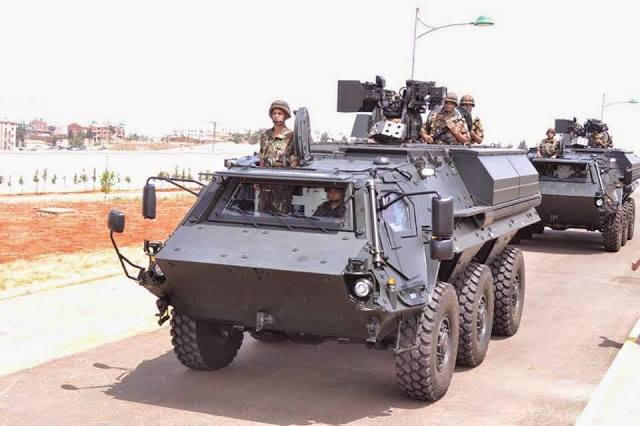
Two Fuchs II APCs

As indicated by the photograph, the Algerian Fuchs 2 is fitted with MEXAS or AMAP applique armor, which consists in this case of a layer of ceramic tiles sandwiched between a ballistic foil and a backing. The same armor has been adopted on the German Fuchs 1A7 before participating in KFOR.
The Fuchs 2 in service with the Algerian army is fitted with a remote weapon station (RWS).

The Fuchs 2 is an improved version of the original Fuchs 1 APC, which entered service with the German army in 1979. The Fuchs 2 features a number of improvments including a higher payload, a more powerful engine and improved brakes. 
Armor protection is provided against heavy machine guns (incl. 14.5 mm AP) when fitted with the applique armor, however the heavier armored vehicle might have lost it's amphibious capabilites (at least this was the case with the original Fuchs 2 prototypes, where the heavy armor version lacked the propellers).

While the NBC-Recon version has seen much success, the APC configuration of the Fuchs has not seen much success on the export market, with German companies developing a number of wheeled vehicles (like the Condor, the UR-416 and the TH390) specifically for the export market.


Defence-Blog.com also reports, that a new order (worth 700 million Euro) has been placed for/on the Algerian Fuchs 2 manufacturing plant. The number of new vehicles has not been disclosed.

Boxer news

Here is a short recap of a number of news surrounding the German-Dutch Boxer wheeled vehicle:


The 300th Boxer has been delivered by ARTEC. This specific vehicle was an ambulance version of the Royal Netherlands Army. Together Germany and the Netherlands have ordered a total of 472 vehicles in a first batch.
A follow-up order of 131 further Boxer for the German army has been suggested in May 2015, but no contract has been made yet.


The Lithuanian army is interested in buying a number of new Boxer vehicles in the IFV configuration. According to the Lithuanian news website Delfi.lt, a spokesperson from the Lithuanian army confirmed the interest of buying new Boxer vehicles on last Thursday. The army spokesman said that the army would suggest signing a contract for the acquisiton of the Boxer.
However later on the same day, the Lithuanian minister of defence Juozas Olekas said in an interview that no decision for a new wheeled combat vehicle has been made and that a total of 10 different vehicles are participating in the army tender, including the French VBCI and the Finnish AMV.

It is understood that the Lithuanian army wants to buy the Boxer in an infantry fighting vehicle version, fitted with a 30 mm MK-30/2 ABM autocannon in a manned Lance turret. According to Delfi.lt the vehicle is also expected to be armed with a Javelin missile launcher. 
The new wheeled vehicle is intended as replacement of the old American-made M113 APCs.


The Boxer is also a contender of the Australian LAND 400 competition. An article of Defence Technology review is covering the submission of the Boxer by Rheinmetall Defence Australia. The "Boxer CRV" is fitted with a two-men Lance turret armed with the 30 mm MK-30/2 ABM gun and a 7.62 mm coaxial machine gun. A twin-launcher for ATGMs will be added in the near future.

Australia is looking to purchase a wheeled family of vehicles as part of the LAND 400 program to replace the M113AS4 IFV and the ASLAV. The future vehicle will be used in the roles of the CRV (combat reconnaissance vehicle), IFV (infantry fighting vehicle), MSV (manoeuvre support vehicle)and as ITS (integrated training system).

Saturday, July 4, 2015

Slovakia increases AMV orders

Slovakia has decided to buy a further 30 AMV armored personnel carriers. These are to be made in Poland, following a Slovakian-Polish cooperation argreement.

Slovakia plans to buy 30 armored personnel carriers (APC) from Poland over the next three years in a deal worth about $32 million, Polish Prime Minister Ewa Kopacz said on Friday.
Under the agreement, Slovak firms will jointly develop the vehicles with Poland, and provide turrets for the APCs, Kopacz said at a joint news conference with Slovak counterpart Robert Fico.
The vehicles will be an updated version of the Rosomak APC, manufactured in southern Poland under a license agreement with Finnish firm Patria. Kopacz said she hoped the model could be exported globally.

A European Union embargo on arms imports from Russia has pushed Slovakia, among other EU states, to accelerate its transition from Russian-made military hardware to NATO-standard weaponry.

Source: Reuters 


Author's opinion: The modernization of the East-European armies has been delayed by politics and budgetary problems for far too long. Only the Ukraine crisis has risen the awareness for the harsh truth about modern international politics.
Seeing Slovakia buy more Patria AMVs is a good thing, but it's only possible, because the troubles started in the Ukraine. What would have happened, if a EU or a NATO country would have been the target of Russia's aggressive expansion policy?